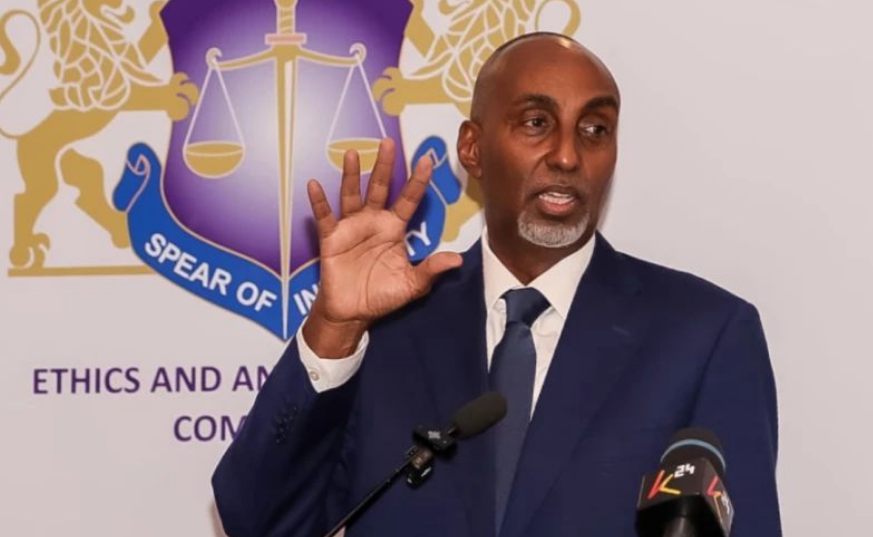
 EACC CEO Abdi Mohamud during a capacity building forum for members of the Bungoma County Assembly /HANDOUT
The Ethics and Anti-Corruption Commission Thursday warned universities, colleges, examination bodies and professional regulators against lax verification systems that could allow forged academic certificates to be used by individuals seeking elective office in the 2027 General Elections.
The commission warned institutions against colluding with individuals seeking to fraudulently acquire academic certificates to qualify for nomination to elective positions without undertaking the required courses or attaining the necessary qualifications.
Speaking during the official opening of a capacity-building forum for members of the Bungoma County Assembly Service Board and Committee on Powers and Privileges in Kisumu, EACC Secretary and Chief Executive Officer Abdi Mohamud said the commission is intensifying its crackdown on academic fraud and would continue pursuing individuals who obtain public positions using fake qualifications.
The remarks were delivered on his behalf by Western Regional Manager Eric Ngumbi during the Thursday workshop focusing on implementation of the Conflict of Interest Act, 2025.
Mohamud said the period leading to general elections often sees increased attempts by aspirants lacking the required qualifications to forge academic documents in order to secure nominations and clearance to contest for public office.
“To safeguard the integrity of the electoral process in the upcoming elections and to ensure that only legitimately earned academic qualifications are used for public office, the Commission urges universities, colleges, examination bodies, and regulators to strengthen their internal control systems,” he said.
“During this time, individuals seeking elective positions without the requisite academic qualifications may seek shortcuts to qualify for nominations and clearance to contest elections.”
He said learning institutions must ensure no person is issued with a certificate for courses they did not undertake or qualifications they did not attain.
The EACC also reaffirmed that it would continue recovering salaries and benefits fraudulently acquired through forged academic certificates.
At the same time, the EACC challenged county assemblies to strengthen oversight and accountability in county governments, warning that conflict of interest remains one of the leading drivers of corruption in devolved units.
Mohamud said investigations by the commission had identified procurement and staff recruitment as the sectors most vulnerable to abuse, often resulting in irregular tender awards, ghost projects, substandard works and appointments influenced by personal interests.
He warned that some county assemblies had compromised their constitutional oversight role by operating as extensions of governors’ offices instead of acting independently.
According to the EACC boss, some county executive officials irregularly direct tenders to proxy companies linked to Members of County Assemblies in exchange for protection from accountability.
He also cited cases where MCAs allegedly demand advance payments for anticipated tender awards while using threats of impeachment to pressure county executives.
The workshop focused on implementation of the Conflict of Interest Act, 2025, which introduced stricter wealth declaration requirements for public officials and designated County Assembly Service Boards and Committees on Powers and Privileges as key entities in enforcing the law at county level.
Mohamud urged county assemblies to uphold integrity and independence in exercising oversight over governors and county executives to protect the gains of devolution and restore public confidence in governance.
Mohamud warned that conflict of interest remains one of the key drivers of corruption in county governments, particularly in procurement and staff recruitment.
“This results in procurement irregularities, appointments influenced by private interests, and decision-making skewed towards personal gain rather than public good,” he said.
Bungoma speaker Emmanuel Situma said the workshop was timely as public expectations on accountability and ethical leadership continue to rise.
He said the Committee on Powers and Privileges and the County Assembly Service Board play a critical role in promoting integrity and accountability within county governments.
“The expectations placed upon public institutions continue to rise, with citizens demanding higher standards of transparency, accountability, and ethical leadership,” the clerk said.
“As a county assembly, we occupy a central position in the governance framework, not only as a legislative body but also as an institution entrusted with oversight and the protection of public interest.”