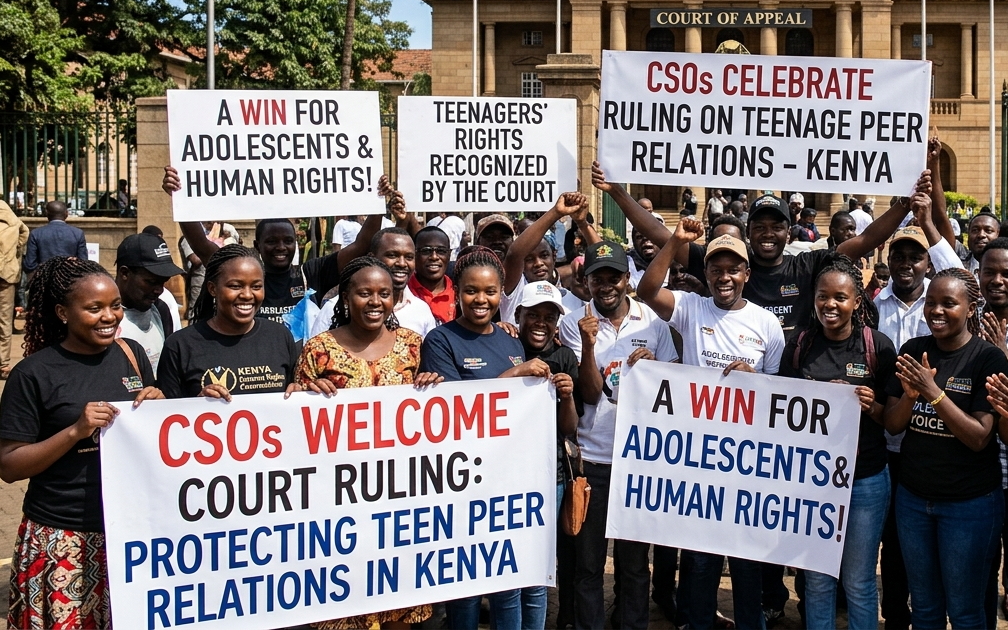
Civil society organisations have welcomed a High Court ruling that they say will shield adolescents from criminal prosecution for engaging in consensual, non-exploitative peer relationships.
In a joint statement issued following the May 20, 2026, decision in Petition E490/2025 HSO & 3 Others (NAYA) v. ODPP & 4 Others, the organisations described the judgment as a significant step in the protection of children’s rights and the development of constitutional jurisprudence.
The groups said the court affirmed that adolescence should be treated as a developmental stage requiring protection and support rather than punishment through the criminal justice system.
The statement said the Sexual Offences Act, which was enacted to protect children from exploitation and coercion, had, over the years, been applied in ways that criminalised adolescents involved in consensual and non-coercive peer relationships.
According to the organisations, the enforcement approach adopted in some cases had failed to consider the realities adolescents face, including barriers to accessing reproductive health information and services.
They said some adolescents had been arrested, detained in adult facilities and left with criminal records because of consensual relationships with their peers.
“This approach has treated young adolescents as criminals rather than rights-holders, ignoring their evolving capacities and developmental maturity,” the statement said.
The organisations cited the experiences of the petitioners in the case, saying they reflected how vulnerable adolescents from disadvantaged backgrounds were disproportionately affected by criminal prosecution.
They said two of the petitioners, identified as HSO and CNK, were arrested for being in a consensual relationship, while another petitioner, AMO, faced criminal charges linked to a consensual relationship that later resulted in a family.
The organisations argued that such cases highlighted systemic failures in the handling of adolescents within the justice system, particularly among low-income families lacking legal representation or stable caregiver support.
“Rather than receiving guidance, care, or access to sexual and reproductive health services, that aligns with advancing the best interest principle, they are confronted with police surveillance and punitive court proceedings,” the statement said.
The groups further argued that the existing legal framework had undermined constitutional rights, including the rights to dignity, equality, privacy, education and health.
They also claimed criminalisation discouraged adolescents from seeking health services for fear of prosecution, which they said contributed to unintended pregnancies, sexually transmitted infections and unsafe abortions.
The organisations added that Kenya’s obligations under international and regional treaties, including the Convention on the Rights of the Child and the African Charter on the Rights and Welfare of the Child, require recognition of a child’s evolving capacities.
According to the statement, the High Court directed that the Sexual Offences Act should be interpreted in line with the Constitution and that investigative and prosecutorial agencies must distinguish between exploitative conduct and consensual adolescent peer relationships.
The organisations said the court also ordered state agencies responsible for health, education and child protection to ensure adolescents can access sexual and reproductive health information and services without fear of criminalisation.
The court additionally halted criminal proceedings against the adolescent petitioners involved in the case.
The civil society organisations said the ruling effectively ended what they termed as the systemic arrest and prosecution of adolescents engaged in consensual and non-exploitative relationships.
They also said the judgment reaffirmed the state’s obligation to act in the best interests of children and underscored the importance of comprehensive sexuality education.
The groups described the ruling as a precedent that aligns Kenya with regional and international human rights standards.
Despite welcoming the judgment, the organisations said legal and policy reforms were still necessary.
They called on Parliament to amend sections 8, 9, 11 and 43(4)(f) of the Sexual Offences Act to clearly distinguish between exploitative sexual offences and consensual peer relationships involving adolescents.
The statement also urged the National Police Service and the Office of the Director of Public Prosecutions to stop the arrest and detention of adolescents involved in consensual conduct and to review investigative protocols relating to sexual offences involving minors.
The organisations further called on agencies responsible for health, education and child protection to develop coordinated measures that would allow adolescents to access confidential and youth-friendly sexual and reproductive health services, as well as age-appropriate sexuality education.
In addition, they appealed for the expungement of criminal records for individuals previously convicted under what they termed unconstitutional applications of the law.
The groups also called for psychosocial support for affected adolescents.
“We stand in solidarity with the petitioners and with all adolescents in Kenya,” the statement said.
“Today marks a shift from punishment to protection and from stigma to dignity.”