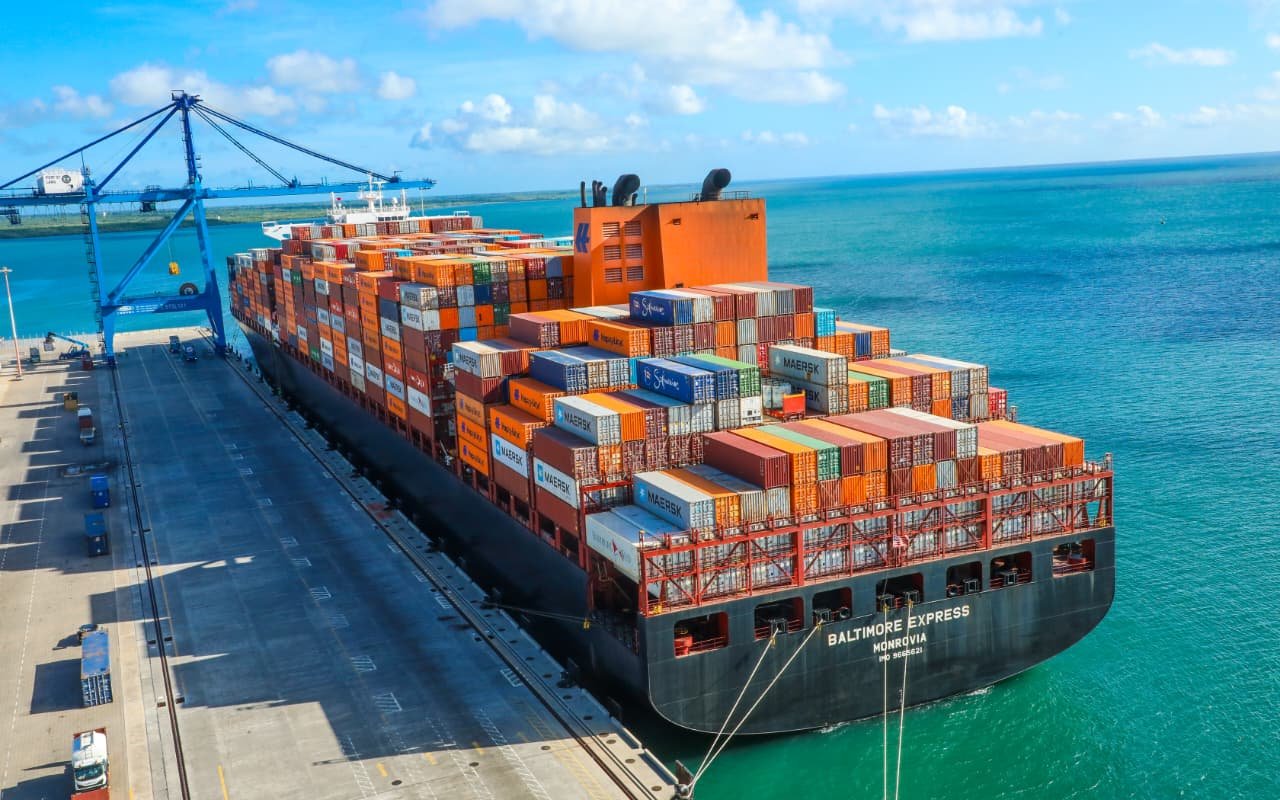
 MV Baltimore Express docked at the Port of Lamu.
The Port of Lamu has handled over 120 vessels since the start of 2026, with more ships expected to call in the coming days.
The development has allowed the port to continue positioning itself as a major regional maritime hub.
The latest and most significant vessel to dock at the port is the MV Baltimore Express, which on Sunday evening became the largest ship ever to call at any port in East and Central Africa.
The vessel, measuring 369 meters in length overall, arrived at the Port of Lamu from Salalah Port in Oman.
To put its size into perspective, the ship stretches almost the length of three football pitches with an additional 69 meters to spare.
Despite its massive size, the vessel docked smoothly at Lamu Port thanks to the facility’s 400-meter quay length per berth, highlighting its capacity to handle ultra-large ships that many regional ports cannot accommodate.
Operated by German shipping line Hapag-Lloyd, the MV Baltimore Express handled restows of dangerous cargo during its stay in Lamu, involving the repositioning of dangerous goods aboard the vessel in compliance with International Maritime Organization regulations.
The vessel’s arrival follows another milestone achieved in August 2025 when the sister vessel MV Nagoya Express, measuring 335 meters, docked at the Port of Lamu.
KPA General Manager for the Port of Lamu, Abdulaziz Mzee, said the successful handling of the vessel demonstrates the port’s growing global stature.
“This call lifts Lamu’s profile on the global maritime map and compares to some of the world’s most developed ports like Singapore, Rotterdam and Hamburg,” he said.
One of Lamu Port’s greatest advantages is its naturally deep harbour with a depth of 17.5 meters, allowing Panamax and post-Panamax vessels to access the port with minimal or no dredging.
This gives Lamu a competitive edge over many African ports that require continuous dredging to accommodate mega vessels.
The natural depth positions Lamu not only as a transshipment gateway but also as a strategic maritime hub capable of handling high cargo volumes and next-generation vessels.
To support the growing traffic, the Kenya Ports Authority is investing in modern equipment, with new cranes, terminal tractors and other cargo handling machinery expected to arrive later this year.
Mzee confirmed that 90 motor vehicles out of the 5,000 units discharged at the port in March have already been evacuated.
The Port of Lamu is experiencing an unexpected surge in activity following the diversion of vessels originally destined for the Arabian Gulf, as ongoing tensions involving the United States, Israel, and Iran continue to disrupt traditional maritime routes.
He said Lamu Port now offers flexibility for cargo owners, allowing goods to either be held, redirected, or transshipped onward depending on logistical arrangements.