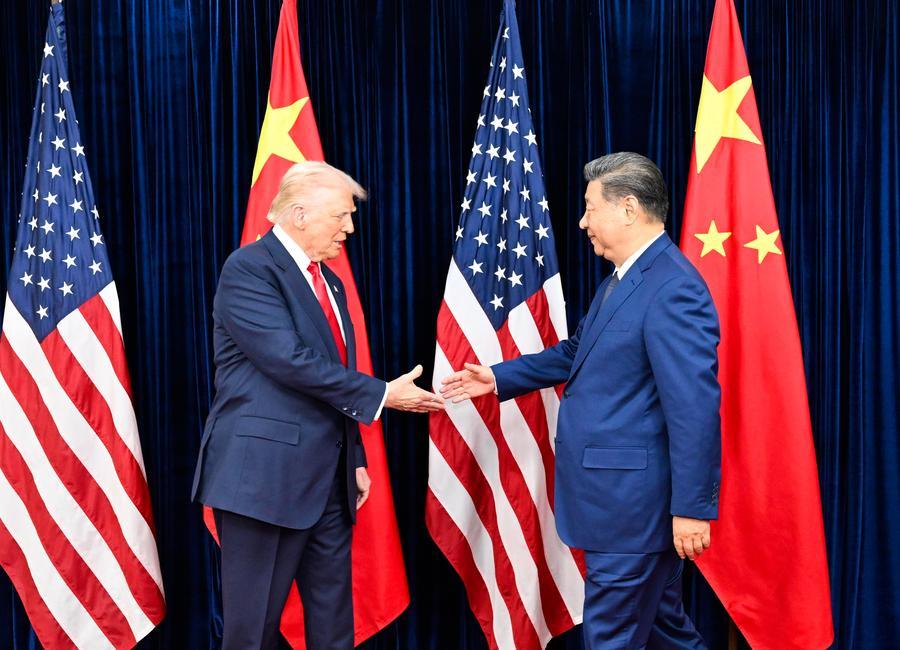
 Chinese President Xi Jinping meets with US President Donald Trump in Busan, South Korea, in October. 30, 2025. (Xinhua/Shen Hong)
As the United States and China seek to reset relations through a high-level meeting between President Donald Trump and Chinese President Xi Jinping, much of the global attention will understandably focus on the immediate bilateral issues between the two powers.
Xi and Trump are meeting tomorrow and Friday.
The Taiwan question – a red line in Chinese diplomacy for those who don’t recognise that the island is part of China – trade disputes, technology restrictions, and military competition in the Indian Ocean and Pacific Ocean straits, as well as the prevailing strategic mistrust, are all expected to feature prominently. But for Africa, the significance of the meeting extends far beyond Washington and Beijing.
This follows the widely held view that the trajectory of US-China relations is one of the single most consequential factors shaping the global political and economic order today. Any thaw, escalation or reset between the two powers most definitely sends ripple effects across continents, markets and institutions.
Africa, which has growing attracted competing global interests, cannot afford to watch from the sidelines. For years, African countries found themselves navigating a competitive geopolitical environment.
The focus on Africa has increased tremendously, as the competing sides attempt to leave a mark on the continent. As a partner in the Global South, China has become Africa’s largest bilateral trading ally and a major financier of infrastructure projects, from railways and ports to highways and energy plants.
The United States, for its part, remains a critical security partner, a major source of humanitarian and development assistance and an influential player in global financial institutions. The continent therefore finds itself in the crosshairs of the rivalry pitting the powerful economies, France being the latest to up its game, if the just-concluded Nairobi-led overtures by French President Emanuel Macron is anything to go by.
When relations between Washington and Beijing deteriorate, Africa often experiences the indirect consequences. Global supply chains become unstable, commodity prices fluctuate sharply and international financial markets react nervously. African economies, many of which remain vulnerable to external shocks, usually feel the pressure first.
Take trade tensions as an example. During previous periods of US-China tariff wars, global demand patterns shifted unpredictably, affecting exports of African raw materials such as copper, cobalt and oil. A slowdown in China’s economy often translates into reduced demand for African commodities. Equally, economic uncertainty in the United States affects investment flows and development financing worldwide.
The Trump-Xi meeting therefore matters because it could signal whether the world is heading toward deeper confrontation or a more stable coexistence. For Africa, stability between the two giants is preferable. The continent needs a predictable international environment to pursue industrialisation, attract investment and manage growing debt burdens.
Escalating tensions between the US and China risk dividing the world into competing political and economic blocs, forcing smaller nations into uncomfortable choices. Africa, like the proverbial grass stumbled upon by a fighting bull, has to resist any situation that pits the superpowers. The continent’s interests are best served by strategic positioning – or alignment – and targeted engagement with all major powers, and has to deal well, knowing it is likely to be used as a pawn in the geopolitical chess game.
Instead, African states/countries should leverage competition between the powers to secure better trade terms, more infrastructure financing, more opening up – enhanced people-to-people exchanges, technology transfers and expanded market access.
At the same time, the meeting presents an opportunity for Africa to rethink its own place in global diplomacy. It is argued that Africa is often discussed but rarely included in major strategic conversations. Yet the continent is central to the future global economy, with its youngest population, vast critical mineral reserves and rapidly expanding consumer markets.
Minerals found in African countries, including cobalt, lithium and rare earth elements, are essential for the green energy transition and advanced technologies that both Washington and Beijing are aggressively pursuing. This reality gives Africa leverage; hence, rather than merely reacting to global developments, African leaders should increasingly position the continent as an indispensable strategic partner whose interests must be considered in any evolving world order.
The Trump-Xi engagement also carries implications for multilateral institutions. If the two powers choose cooperation over confrontation, there could be renewed momentum in areas such as climate financing, debt restructuring and global health cooperation.
With all these issues being of direct importance to Africa, there should be no room for mistrust, as it makes the case worse of international institutions, leaving developing nations exposed.
Ultimately, Africa must pay attention because the future of US-China relations, as would be defined by the events at the Tiananmen Square’s Great Hall of the People, will shape the future of globalisation itself. For China, multilateralism has been the clarion call.