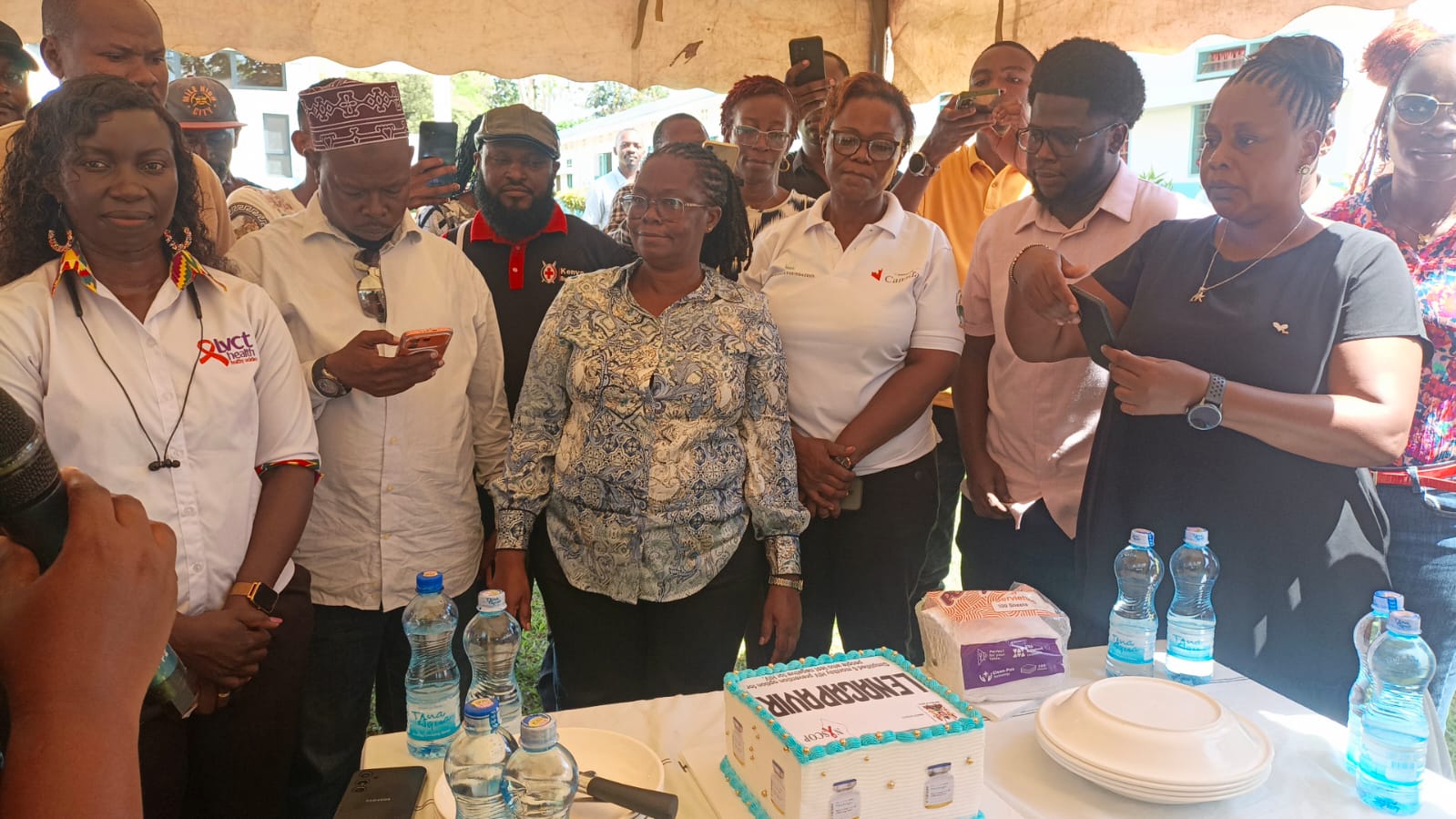
 LVCT, Kilifi County government, and Kenya Red Cross officials during the launch of the new simplified six-monthly HIV Prevention option using injection Program at Muyeye Health centre in Malindi town.
Kilifi county has officially launched the new HIV prevention programme featuring Lenacapavir, a simplified six-month injection aimed at protecting people from contracting the virus.
The programme, rolled out in February, is part of Kenya’s broader strategy to significantly reduce new HIV infections from nearly 20,000 cases recorded in 2024 to less than 1,000 by 2030.
Kenya officially launched Lenacapavir on February 26, 2026, becoming the first country in East Africa to introduce this long-acting, twice-a-year HIV prevention injection.
Administered every six months as Pre-Exposure Prophylaxis (PrEP), it aims to reduce new infections, particularly among high-risk groups, and is offered free of charge in select public facilities.
Kilifi is emerging as one of the first counties to begin implementation.
Speaking during the launch, county health officer in charge of disease prevention Catherine Munyoki said the programme is currently being offered in 10 health facilities across Kilifi.
She said that the initiative is critical in creating awareness and strengthening efforts to curb new HIV infections both in Kilifi and across the country.
“The long-acting HIV prevention injection, Lenacapavir, started in March this year in Kilifi county and is currently available in 10 health facilities,” she said.
The launch brought together senior officials from the Kilifi county department of health, representatives from non-governmental organisations including LVCT Health and the Kenya Red Cross, among other stakeholders.
Patricia Jeckonia, Senior Manager at LVCT Health Kenya said Kenya still faces a major challenge in reducing new HIV infections despite previous targets.
She revealed that Kenya recorded 19,991 new HIV infections in 2024.
“As a country, we have set a target of reducing new HIV infections to less than 1,000 by the year 2030. We now have only a few years left to achieve that goal, and this is not a marathon, it is a sprint,” she said.
Health officials said the introduction of Lenacapavir is expected to improve HIV prevention efforts by offering a more practical and accessible option for individuals vulnerable to infection.
According to the Ministry of Health, at least 1.4 million Kenyans still live with HIV, therefore, prevention remains critical.
Clinical studies show Lenacapavir can be up to 96 per cent effective in preventing HIV infection.
The World Health Organization has been a key partner in the rollout, providing technical guidance, supporting the adaptation of national clinical guidelines, training healthcare workers, and strengthening safety monitoring systems to track uptake and impact.
The initial rollout is backed by 21,000 starter doses targeting 15 high-burden counties, including Nairobi, Kisumu, Mombasa, Homa Bay and Kilifi, with plans to expand across all 47 counties in phased stages.
The injection is free of charge at public health facilities and sits alongside existing prevention tools such as daily oral PrEP, condoms, and voluntary medical male circumcision.
End……
Instant analysis
The launch of Lenacapavir in Kilifi marks a significant shift in Kenya’s HIV prevention strategy by introducing a long-acting injectable option that could improve adherence and accessibility. Unlike daily preventive medication, the six-month injection reduces the burden of frequent dosing, particularly for high-risk populations who struggle with consistency. Kilifi’s early adoption also positions the county as a testing ground for wider national rollout.