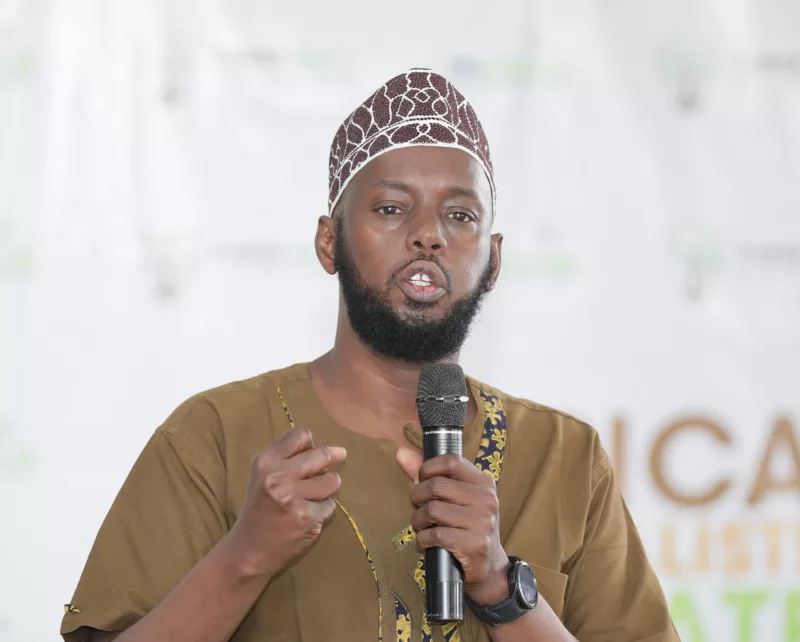
 Mombasa Press Club chair Omar Abdallah at the 2nd
Environmental Media Dialogue in Kuruwitu, Kilifi county / BRIAN OTIENO
Mombasa Press Club chair Omar Abdallah at the 2nd
Environmental Media Dialogue in Kuruwitu, Kilifi county / BRIAN OTIENOJournalists should not focus too much on politics, but actively engage in other sectors of the sphere including environmental journalism, a senior journalist has said.
Mombasa Press Club chairman Omar Abdallah said although politics sells fast and is exciting to follow, too much focus on it risks one’s life as politicians do not like criticism.
“There are other areas of journalism that can also drive meaningful change in society. The environment affects all of us, even when not reporting in it.
“Thus, it is important that we give the environment as much focus as we give politics because mother nature never forgets and can be cruel. So we better take care of the environment,” Abdallah said.
Speaking during the 2nd Environmental Media Dialogue held in Kilifi, Abdallah emphasized the critical role media practitioners play in promoting environmental conservation, blue economy awareness, and sustainable development.
“Journalists have a responsibility not only to inform but also to educate and inspire communities on issues that directly affect their livelihoods. Kenyans should not only be fed political news every day, but also stories that create real impact and bring positive change to society,” Abdallah said.
The dialogue brought together key stakeholders from the media, environmental sector, and blue economy players, with discussions centered on enhancing environmental reporting and increasing public awareness on conservation issues.
Abdallah noted that despite the Coast region’s strategic position along the Indian Ocean, environmental stories, particularly those touching on ocean conservation and the blue economy, remain largely underreported.
“It is unfortunate that the Coast region, with its vast ocean resources and enormous blue economy potential, has not been fully explored by journalists,” he said.
He said there are countless opportunities and benefits for local communities within the blue economy sector, yet these stories remain untold.
He urged journalists to take a proactive role in uncovering stories around marine resources, climate change, coastal conservation, and economic opportunities tied to the ocean.
“The ocean is not just a natural resource. It is an economic lifeline for many coastal residents. Through responsible and informed reporting, journalists can help communities understand and maximize these opportunities while safeguarding the environment,” Abdallah said.
The media dialogue highlighted the need for stronger collaboration between media practitioners and environmental stakeholders to ensure accurate, impactful, and sustained coverage of environmental issues.
Participants were encouraged to embrace specialized reporting on environmental matters as a way of influencing policy, shaping public discourse, and supporting sustainable community development.
The 2nd Environmental Media Dialogue marks a growing push to position environmental journalism as a key pillar in addressing emerging ecological and socio-economic challenges in Kenya’s coastal region.