
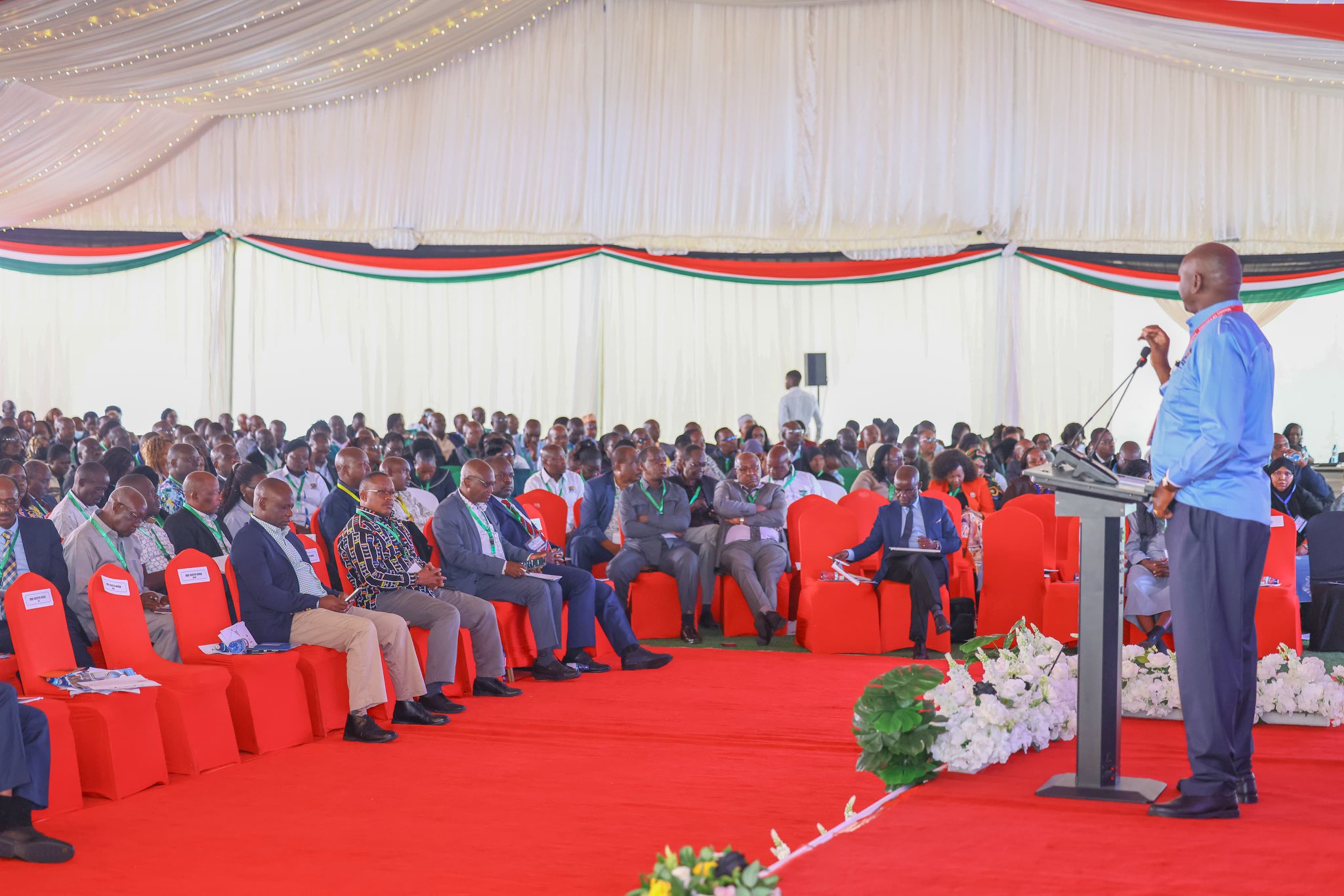
 Basic Education PS Julius Bitok addressing the 2nd National Education Conference 2026 in Naivasha on Friday,May 8, 2026. /JULIUS BITOK/X
The Ministry of Education has outlined an ambitious digital transformation plan aimed at enhancing learner experience and improving education standards, including the deployment of laptops and smartboards in public primary schools.
Speaking on Friday during the 2nd National Education Conference 2026 at the Lake Naivasha Resort, Basic Education Principal Secretary Julius Bitok said the ministry plans to deploy 25,000 laptop computers and smartboards across public primary schools countrywide.
A smartboard is an interactive whiteboard that functions as a large touch-sensitive display, allowing users to control computer applications, write notes and manipulate digital content directly on the screen using fingers or digital pens.
The devices are commonly used in classrooms and meeting rooms and often feature built-in operating systems for internet browsing, screen sharing and document viewing.
Bitok said the initiative is part of the wider benefits that will come with the transition to the Kenya Education Management Information System (KEMIS), an upgraded digital platform expected to replace the National Education Management Information System (NEMIS).
The new system is intended to eliminate “ghost students” and fraudulent funding claims by integrating data across all levels of education in real time, from Early Childhood Development (ECD) to universities and Technical and Vocational Education and Training (TVET) institutions, creating what the ministry describes as a more accurate and secure “single source of truth”.
“KEMIS is going to be a game changer because KEMIS has three principal components. One, we are able to monitor our data more effectively and more accurately,” the PS said during a panel discussion.
He said the centralised management of learner data across all levels of education will enhance transparency by enabling the government to track each learner throughout their academic journey.
“The second issue is the information system which will give us feedback. Sitting in Jogoo House, I should be able to monitor through a security centre what is going on in our schools across the country. I should be able to get all that information summarised — how many students have reported — and I should be able to see that information in real time.”
Bitok said access to such data would enable the ministry to make policy decisions promptly based on real-time information from schools across the country.
He added that the third benefit of KEMIS is its support for digital learning without placing prohibitive financial pressure on schools or the ministry.
“Through KEMIS, we are going to deploy some of the textbooks through the system. We will be providing, from time to time, lessons, say Mathematics Grade 9, and somebody from a certain school can be able to teach through the KEMIS network.”
Bitok said the government has already begun rolling out the infrastructure needed to support the ambitious programme.
“The Ministry of ICT is now doing connectivity in all our schools, we are doing solarisation and we are now deploying 25,000 laptops and smartboards in all our primary schools around the country,” he said.
As of 2025, Kenya had 39,339 primary schools, 24,566 of them public institutions.
“Those laptops should have software called KEMIS so whenever they land in schools, you know they are going to be used to improve data, monitor what is happening in schools and, when you key in, the system is connected to the headquarters in Nairobi,” Bitok said.
The smartboards are expected to transform teacher-learner classroom interaction from the traditional “chalk-and-talk” model to a more interactive, learner-centred teaching, potentially improving digital literacy.
However, it remains unclear whether the government will fully implement the programme given the challenges that plagued a similar initiative in the past.
The Sh32 billion Digital Literacy Programme introduced in 2013, which sought to distribute tablets to more than 21,000 schools, faced major setbacks including infrastructure gaps, unreliable electricity supply and low utilisation levels.
The three-day conference, which ends on Saturday, brought together education stakeholders for discussions on education reforms, leadership and accountability.
President William Ruto, who opened the conference on Thursday, May 7, emphasised ongoing reforms under the Competency-Based Education (CBE) curriculum.



Comments 0
Sign in to join the conversation
Sign In Create AccountNo comments yet. Be the first to share your thoughts!