
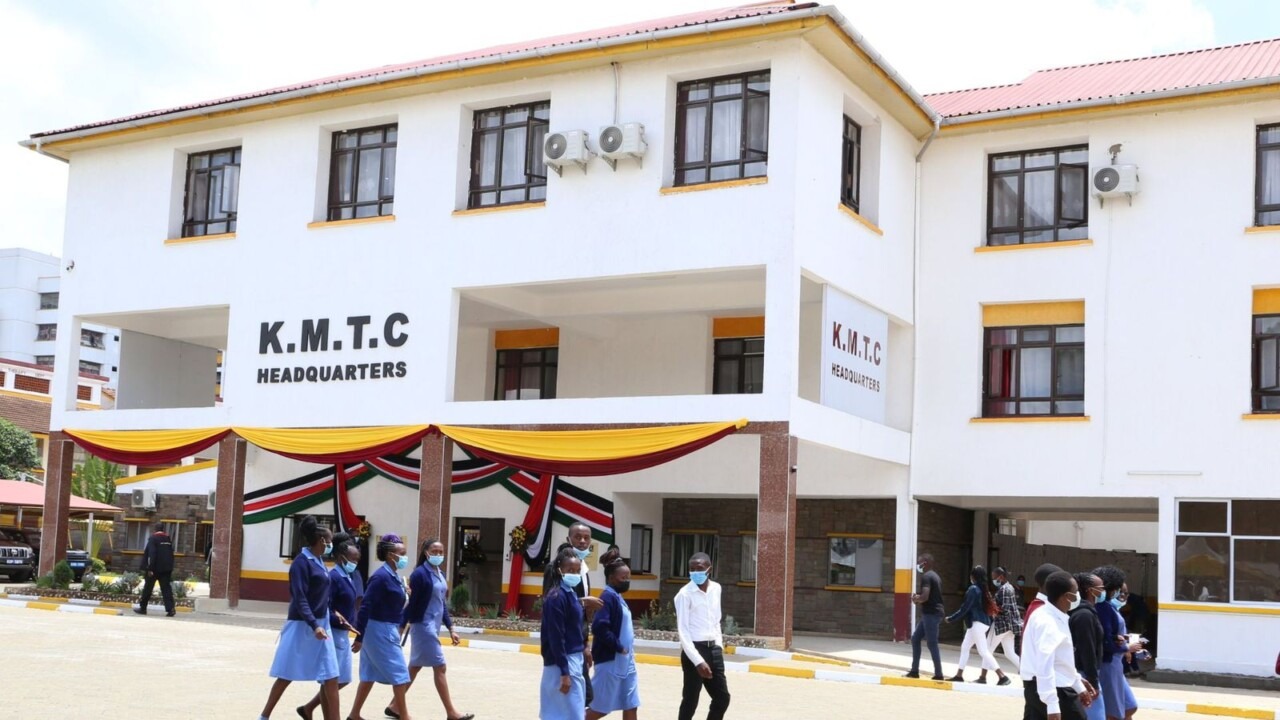
The 2026 Economic Survey shows enrolment at the Kenya Medical Training College (KMTC) rose to 36,330 students in the 2024-25 academic year, up from 32,723 the previous year.
Of these, 22,626 were female and 13,704 were male.
This means women accounted for about 62 per cent of all trainees. KMTC is Kenya's largest training college for middle-level health professionals and likely mirrors the trend at other smaller private institutions.
The imbalance is even more visible when broken down by programme. Diploma courses, which form the bulk of KMTC enrolment, recorded 28,309 students, of whom 17,492 were female and 10,817 were male. Certificate programmes had 6,916 students, including 4,531 females and 2,385 males.
In both categories, women clearly outnumber men, maintaining a consistent female majority across the main entry points into the health workforce.
Specific courses further illustrate this trend. Community Health Nursing, the largest single programme, enrolled 5,715 students, most of them women, while other nursing-related courses also reported higher female participation.
These programmes traditionally attract more women and continue to drive the overall gender balance in health training.
Graduation data reflects the same pattern. In the 2024-25 academic year, KMTC produced 22,746 graduates, including 14,334 females and 8,412 males.
Women, therefore, made up about 63 per cent of all graduates, confirming the female majority seen in enrolment is sustained through to completion.
The increase in graduates was largely driven by diploma programmes, which also had a higher number of female students.
“During the review period, the health workforce continued to grow across most cadres. The most notable increase was among registered nurses, which rose by 12.7 per cent to 65,284 in 2025. Other notable increases included graduate nurses and diploma clinical officers,” says the Economic Survey, released last week.
Emergency medical training shows signs of partially bucking the broader feminisation trend, with a noticeably narrower gender gap compared to other health courses.
According to the 2026 Economic Survey, Emergency Medical Technician (EMT) certificate programmes enrolled 1,362 students in 2024-25, of whom 748 were male and 614 female.
This means men made up about 55 per cent of trainees, a clear contrast to most other certificate and diploma programmes where women account for well over 60 per cent.
This feminisation of training feeds directly into the workforce. The number of registered nurses rose by 12.7 per cent to 65,300 in 2025, a cadre that is traditionally dominated by women.
As a result, the frontline of Kenya’s health system—particularly in hospitals and community care—remains largely female.
However, the gender pattern becomes less uniform at higher levels of education.
University data shows that total health sciences graduates rose to 7,056 in 2025-26, including 6,325 undergraduate and 731 postgraduate graduates. While women still dominate certain disciplines, the overall distribution is more balanced compared to middle-level training.
In nursing and community health degree programmes, women remain the majority. Nursing alone accounted for 29 per cent of all university health graduates, and the report notes that female graduates outnumbered males in these courses.
This indicates the female dominance seen at the diploma level continues into degree training in specific fields.
But the trend does not hold across all disciplines. According to a 2022 study, while more women chose medicine as their profession around the world, the trend does not hold in postgraduate ranks.
“The career paths of men and women differ after a certain point, and more and more female talent is lost along the career stages,” says the study, Female participation or “feminisation” of medicine” published in a Springer journal.
“Motherhood and related absence is the main career obstacle, but gender bias and missing role models are also factors hindering women to thrive.”
In programmes such as medicine and surgery, dentistry and other specialised health sciences, the report suggests a more even gender split, although it does not provide exact male-female totals for each course.
This points to a gradual narrowing of the gender gap as students move into more specialised and competitive professional tracks.
At the postgraduate level, the gender difference appears even less pronounced. With 731 postgraduate graduates recorded, the Kenyan survey does not indicate a clear female majority comparable to that seen in certificate and diploma training.
This suggests that while women dominate entry and mid-level training, representation becomes more balanced at advanced levels.
Overall, the Economic Survey data reveals a clear hierarchy. Women dominate certificate and diploma training, making up about 62 to 63 per cent of both enrolment and graduates.
At the university level, they remain dominant in key areas such as nursing but share space with men in other disciplines. By postgraduate level, the gender gap appears to narrow significantly.
The findings highlight the central role women continue to play in Kenya’s health system, particularly at the frontline where most services are delivered.
At the same time, the more balanced representation at higher levels suggests opportunities to expand women’s participation in specialised fields and leadership positions.


Comments 0
Sign in to join the conversation
Sign In Create AccountNo comments yet. Be the first to share your thoughts!