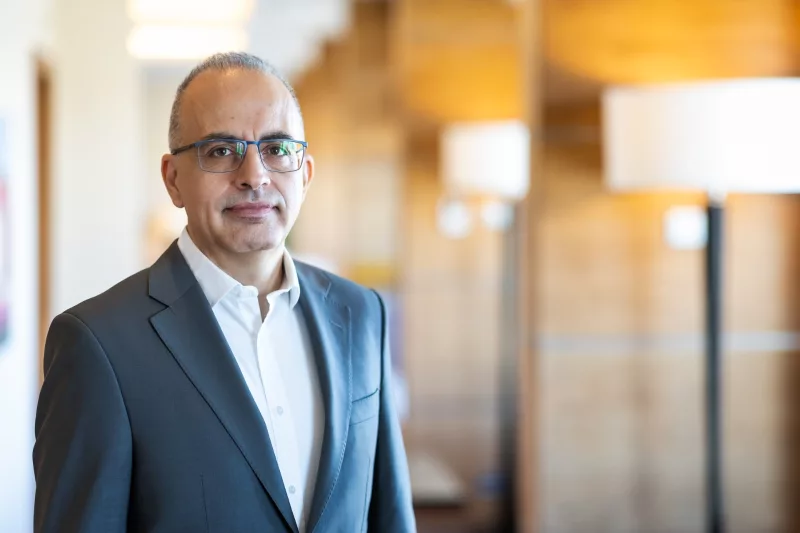
Car and General group chief executive Vijay Gidoomal /JACKTONE LAWI
Car and General is rolling out a new financing solution targeting boda boda riders, marking a strategic pivot as traditional asset financing models lose dominance.
The Nairobi Securities Listed firm, historically reliant on third-party financiers to drive motorcycle sales, is now building its own financial ecosystem anchored on SACCOs and digital platforms to retain customers and unlock new revenue streams.
Car and General Group Chief Executive Vijay Gidoomal said the shift reflects a rapidly evolving credit market where riders have multiple funding options beyond traditional asset financiers.
“Two years ago, financing accounted for about 75 per cent of bike purchases. Today, that has dropped to closer to 30 per cent as riders access credit through SACCOs, banks and other channels,” he said.
To adapt, Car and General is scaling its “Sacco Labs” model alongside a digital Chama platform that connects riders to financing, savings and operational tools.
The platform already has over 3,000 members and is targeting at least 100 motor bike Sacco’s by year-end, tapping into a sector estimated to have more than 10,000 groups nationwide.
The move positions the company not just as a distributor of motorcycles, but as a financial and digital services provider within the boda boda ecosystem—an industry that remains one of Kenya’s largest informal employment segments.
The new strategy comes amid a broader shake-up in the asset financing space, where firms such as Watu have reduced exposure to motorcycle lending, forcing dealers to rethink their growth models.
Group general manager George Rubiri said the shift has exposed the risks of overreliance on a single financing channel, prompting the company to diversify aggressively.
“We were too dependent on two-wheelers and the financing behind them. When that changed, it forced us to pivot,” he said.
The group is also laying the groundwork for a future digital banking-style platform, with Gidoomal indicating that financial services could become a major standalone business over the next decade.
“In 10 years, we could be a significant digital business built off the back of our financial services,” he said.
The company is now betting on a multi-pronged growth strategy that combines financial services, manufacturing, digital platforms and regional expansion.
Manufacturing has emerged as a key pillar, with the firm investing in local production of motorcycle components such as helmets and riding gear.
The company is targeting regional scale, exporting to multiple African markets and leveraging trade blocs including the African Continental Free Trade Area (AfCFTA).
Gidoomal said the long-term goal is to localise up to 40 per cent of motorcycle components, up from about a dozen parts currently produced locally, a move expected to deepen industrial linkages and create jobs.
“We are looking at this over a five to 20-year horizon. The opportunity is continental,” he said.
Car and General is also expanding into agriculture equipment, where it has doubled market share from 5 per cent to 10 per cent and is targeting 15 percent in the near term, as well as exploring opportunities in e-mobility and clean energy.
Plans are also underway to scale its manufacturing footprint, including a new facility expected to come on stream by 2027 once infrastructure developments along the Malindi highway are finalised.
Beyond core operations, the company is investing in digitisation and skills development, including training thousands of mechanics and integrating them into digital systems to improve productivity and earnings.
As part of its long-term roadmap, Car and General is targeting at least 20 percent market share across its key segments, while expanding into new African markets and strengthening its presence in existing ones.
The diversification strategy, executives say, is designed to insulate the company from market shocks in any single segment, particularly in politically sensitive periods such as election cycles.
“With operations across multiple countries and sectors, any disruption in one market becomes manageable rather than existential,” Gidoomal said.