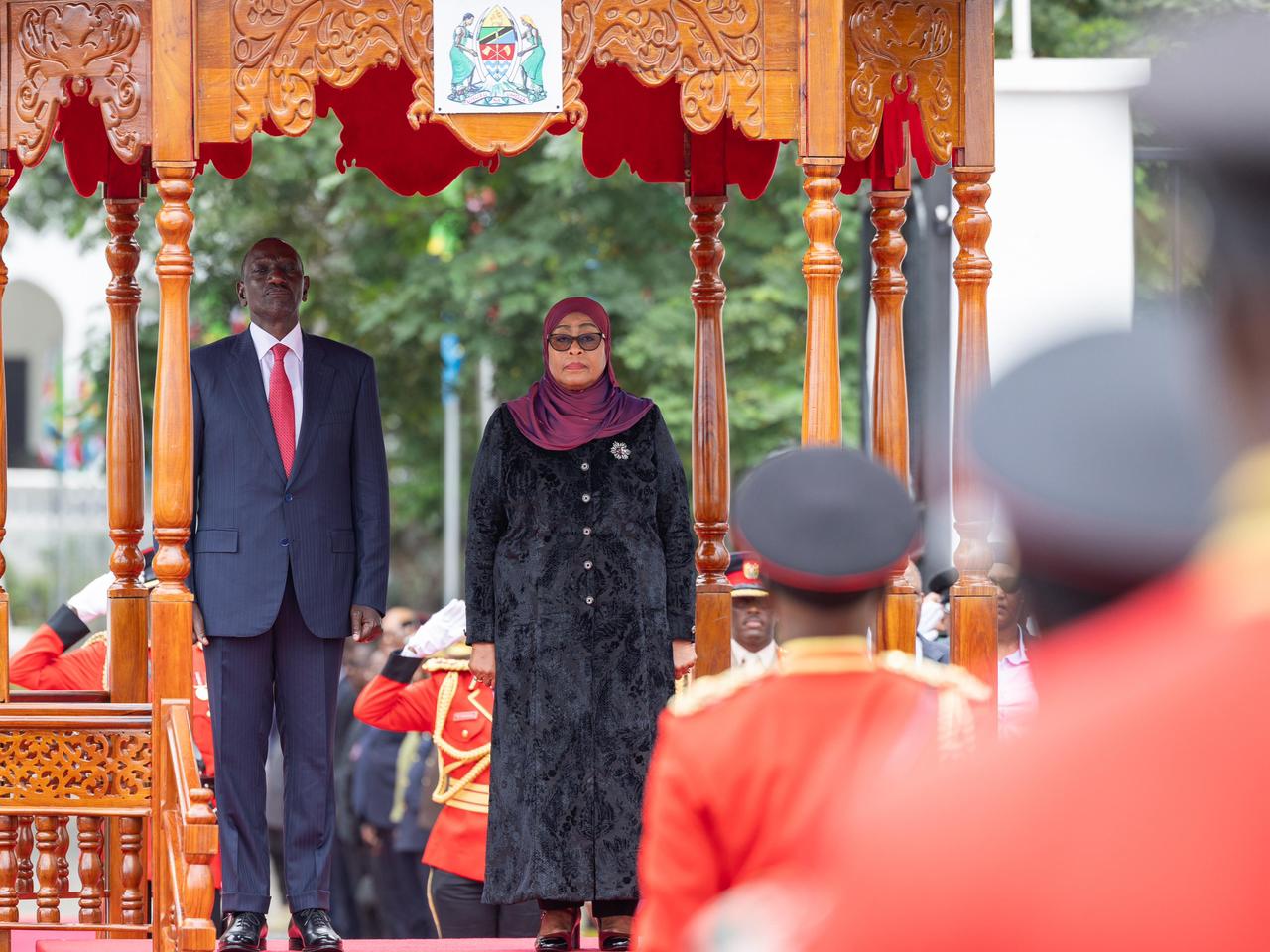
 President William Ruto and his counterpart Samia Suluhu in Dar Es Salaam on May 4, 2026 / PCS
Kenya and Tanzania have taken a major step in deepening bilateral relations after President William Ruto and President Samia Suluhu Hassan held high-level talks that culminated in the signing of key agreements spanning trade, infrastructure, energy and regional integration.
The two leaders reaffirmed their commitment to closer cooperation within the East African Community, with a strong focus on boosting economic growth, strengthening security and easing cross-border trade.
During the meeting, the presidents signed eight key agreements covering energy, legal cooperation, agriculture, railway development, public service capacity building, maritime cooperation, certification standards for seafarers and the harmonisation of standards.
The deals are expected to enhance institutional coordination and improve efficiency in cross-border operations.
Trade between the two countries was a central focus, with officials noting steady growth. “Welcomed continued growth in bilateral trade, which reached 860.3 million dollars in 2025,” reflecting increased exchange of goods and services between the neighbouring states.
To further strengthen commerce, both governments agreed to tackle longstanding trade barriers. They committed to “eliminate all outstanding non-tariff barriers by June 30, 2026, to boost trade" in a move expected to ease movement of goods and improve regional business flows.
Tourism and people-to-people relations also featured prominently, with both sides stressing that stronger cultural and social ties will enhance mutual understanding and deepen cooperation between citizens of the two countries.
Energy cooperation was identified as a key driver of industrialisation, with both Kenya and Tanzania pledging to expand collaboration to improve energy access and support economic transformation.
Infrastructure development also took centre stage, with the Malindi–Bagamoyo Super Highway highlighted as a flagship regional project expected to improve connectivity, trade flow and economic integration between the two nations.
Transport integration was further boosted by commitments to revive the Voi–Mwatate–Taveta railway line, aimed at reducing transport costs and improving efficiency for businesses and travellers across the border.
On security, the two countries reported progress in boundary demarcation, noting that "564 km of the 778km boundary completed, to complete the remaining work by 2027.” Both sides also pledged to enhance cooperation to ensure peaceful and stable borders.
The leaders further reaffirmed their commitment to deepen regional integration within the East African Community and strengthen collective competitiveness in global markets.
They also underscored support for a rules-based international system guided by international law, reiterating their commitment to multilateral cooperation and shared global responsibility.



Comments 0
Sign in to join the conversation
Sign In Create AccountNo comments yet. Be the first to share your thoughts!