
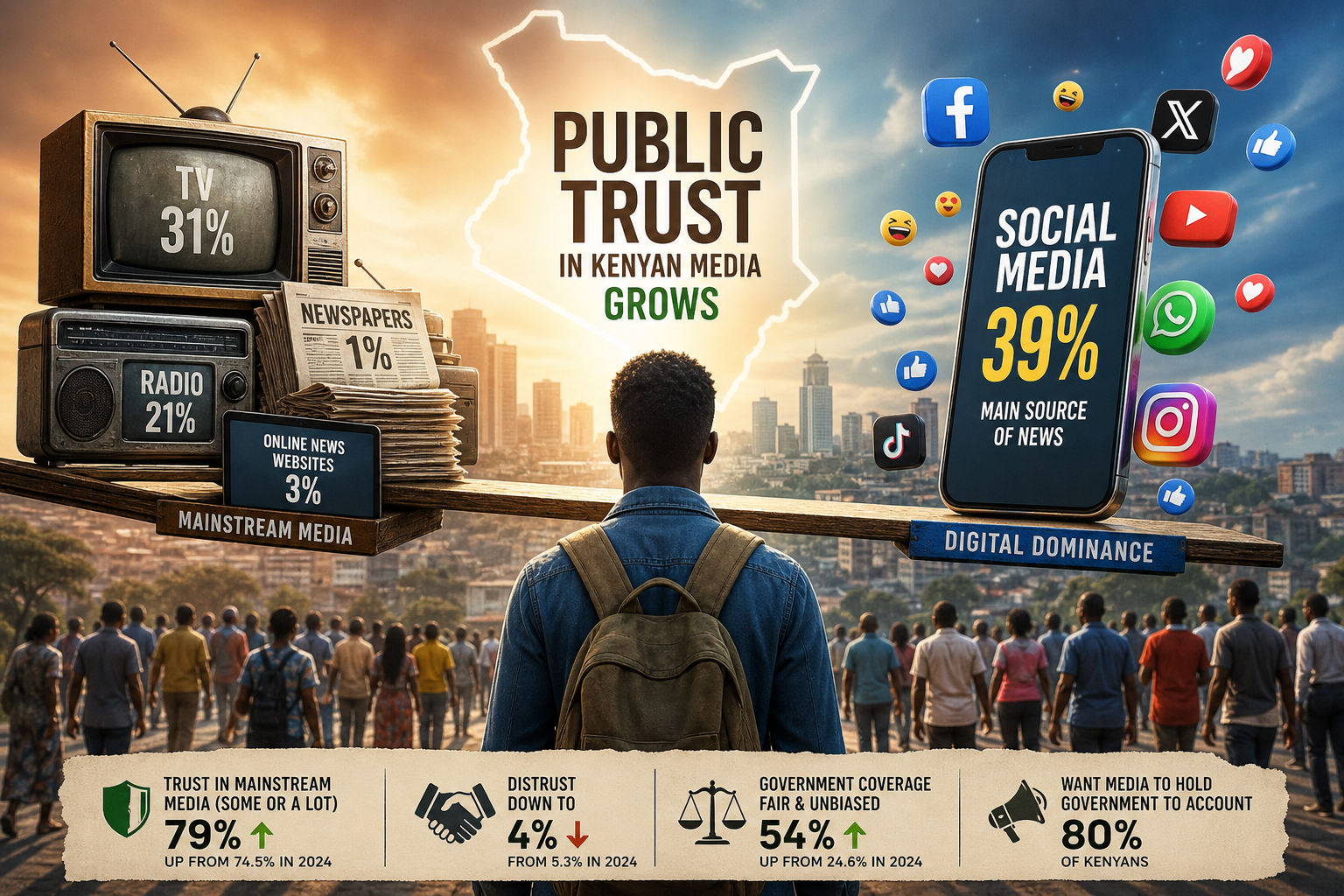
 Findings show that social media remains the primary news source for most Kenyans. /AI ILLUSTRATION
Public trust in Kenya’s mainstream media rose last year even as social media tightened its grip as the country’s leading source of news, the State of Media 2025 Report by the Media Council of Kenya shows.
The survey, conducted between April 15 and 23 using Computer Assisted Personal Interviewing (CAPI), sampled 3,774 Kenyan residents aged 15 and above across all 47 counties.
Of the respondents, 55 per cent were male and 45 per cent female, with 54 per cent aged under 35. Slightly over half (52 per cent) had attained secondary or diploma-level education.
The study reported a margin of error of ±1.7 per cent at a 95 per cent confidence level.
Findings show that social media remains the primary news source for most Kenyans, cited by 39 per cent of respondents.
This places it well ahead of traditional platforms, with television at 31 per cent, radio at 21 per cent, online news websites at three per cent and newspapers at just one per cent.
The trend reflects a widening gap from 2024, when social media stood at 37 per cent against television’s 31 per cent.
While television usage remained stagnant, radio experienced a notable drop from 26 per cent to 21 per cent, underscoring a shift towards digital platforms largely at the expense of broadcast media.
Consumption patterns over the week preceding the survey mirror this shift. Social media was accessed by 27 per cent of respondents, followed closely by television at 25 per cent and radio at 19 per cent. Online news websites accounted for 8 per cent, while print trailed at 4 per cent.
Audience disengagement from traditional platforms is becoming more pronounced, the survey found.
The proportion of Kenyans who have completely abandoned watching television rose to 43 per cent in 2025, up from 37 per cent in 2024, while daily TV viewership declined from 63 per cent to 57 per cent over the same period.
Newspaper readership has also seen a steep decline, falling from 29 per cent in 2022 to just 4 per cent last year. Radio, once dominant, continues to experience a sharp contraction.
“Radio is suffering a severe contraction. Following a massive drop from 75 per cent in 2023 to 57 per cent in 2024, daily listenership has plummeted further to 41 per cent in 2025,” the report states.
Despite this audience migration, trust in mainstream media has strengthened. The proportion of Kenyans expressing “some” or “a lot” of trust rose to 79 per cent last year, up from 74.5 per cent in 2024, positioning the media among the country’s most relied-upon institutions for credible information.
Levels of outright distrust declined from 5.3 per cent to 4 per cent, while those reporting little trust dropped from 20.1 per cent to 17 per cent.
Notably, the share of respondents expressing “some trust” increased from 51.3 per cent to 58 per cent, even as those reporting “a lot of trust” dipped slightly from 23.2 per cent to 21 per cent.
Perceptions of media fairness in covering government have also improved significantly. The proportion of Kenyans who view coverage as unfair or biased fell sharply from 73.6 per cent in 2024 to 46 per cent last year.
Conversely, those who believe the government is covered fairly rose from 24.6 per cent to 54 per cent.
The report further indicates a strong public appetite for accountability journalism, with 80 per cent of respondents saying they expect the media to take positions and hold the government accountable on issues of public interest.
“The Kenyan audience reject strict neutrality. They expect television to act as a guide, an advocate and a bold participant in shaping public discourse and demanding accountability,” the report says.
When asked why they trust their preferred media outlets, 45 per cent cited relevant, public-interest content, while 33 per cent pointed to timeliness and delivery of information.
Credibility, reputation and experience were mentioned by 29 per cent, followed by professionalism and quality of journalism at 21 per cent, and editorial independence and integrity at 14 per cent.
Even so, skepticism around ethical standards persists. Only six per cent rated the level of professionalism highly, although respondents acknowledged positive aspects of the media environment.
About 34 per cent said Kenyan media operates freely, 26 per cent praised its speed in disseminating information, and 16 per cent commended platform diversification and the use of advanced technology such as AI.
Areas of concern include the spread of false or misleading information cited by 28 per cent of respondents, matched by an equal proportion pointing to lack of diversity in news coverage, while 17 per cent raised concerns about bias.

Comments 0
Sign in to join the conversation
Sign In Create AccountNo comments yet. Be the first to share your thoughts!