
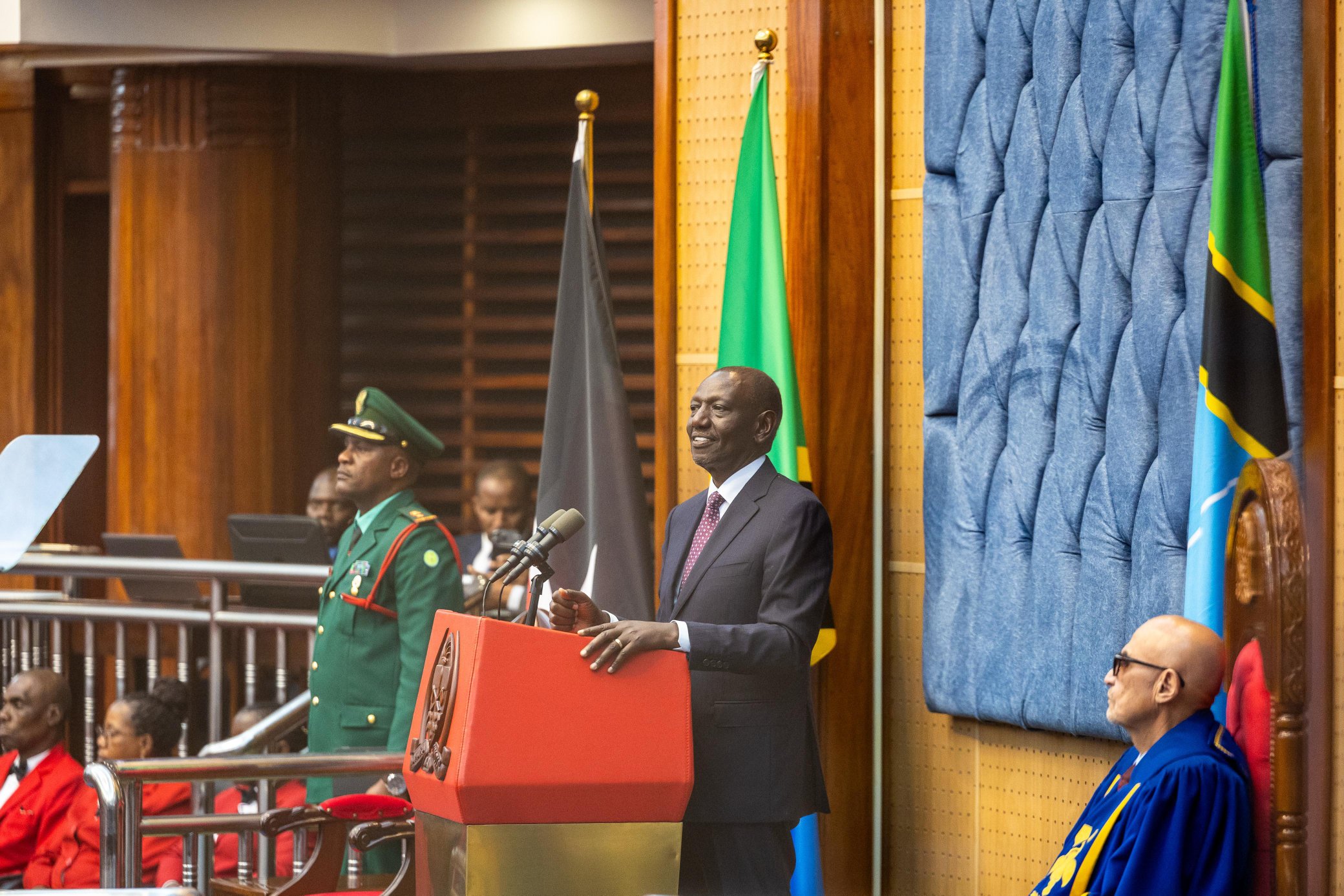
President William Ruto on Tuesday called on Tanzania to commit more deliberately to joint regional projects, urging a shift from mistrust and narrow national interests.
Addressing Tanzania’s Parliament in Dodoma during a state visit hosted by President Suluhu Hassan, Ruto said for Kenya and Tanzania to move towards deeper integration, they need to act as partners rather than competitors.
“The conversation we are having today is significant and consequential, not only for our two countries but also for our region and continent. At its core, it is about one central task: growing mutual trust to build shared strength,” President Ruto said.
Ruto regretted that for far too long, relations among neighbouring countries have been shaped by competition, suspicion and rivalry.
He said these forces have fragmented markets, weakened voices and constrained collective progress.
“And if we are honest with ourselves, some of these forces are still very much alive. They call for a generational shift from incremental progress towards decisive integration.
“Because our biggest barrier is not infrastructure or policy; it is the quiet mistrust that pervades our relations. That suspicion has cost us time, opportunity and prosperity and we can no longer afford it,” he said.
Against this background, he said that for progress and shared prosperity, the two states must move beyond narrow national calculations and embrace a mindset of partnership.
He added that for each country’s progress to reinforce the other’s success, the partnership must be grounded in physical connectivity, shared infrastructure and deliberate investments that bring the economies closer together in practical and measurable ways.
“That is why the projects we are advancing together are so consequential.”
His remarks come amid renewed debate over regional infrastructure and energy projects, including the planned oil refinery in Tanga.
The project has been a talking point after President Suluhu on Monday appeared to rebuke Ruto for announcing it without her knowledge.
In his immediate response, Ruto said he had been made aware that his announcement had annoyed some members of the Tanzanian leadership.
“Had I known, I would have announced the refinery to be built in Mombasa. The building of a refinery is a big opportunity for business, industrialisation, petrochemical industries, fertiliser industries and plastics,” he said.
“When I had a conversation with President Museveni, the idea was how to industrialise our region,” Ruto said.
He told the Tanzania Parliament that for Kenya and Tanzania to move towards deeper integration, they need to act as partners and share resources for economic progress.
He said his suggestion of the Tanga refinery was intended to help Tanzania attract investors.
“While I would naturally have preferred such a facility in Mombasa, I fully recognise that Tanga, less than 200 kilometres away, is part of the same economic space. What matters is not whether the asset is on one side of the border or the other. What matters is whether it strengthens our shared prosperity,” he said.
Ruto repeatedly noted that mistrust remains the biggest barrier to integration within the East African Community.
He cautioned that unless addressed, these dynamics could undermine current integration efforts.
He recalled the collapse of the original East African Community in 1977, arguing that it stemmed not from ideological differences but from an inability to build a shared economic vision and a retreat into narrow national interests.
“That was not their failure alone; it becomes our failure if we repeat it,” he told lawmakers.
Ruto’s address placed strong emphasis on practical steps to deepen integration, particularly through cross-border infrastructure.
He highlighted ongoing and planned projects, including road corridors linking coastal towns from Malindi through Lunga Lunga to Dar es Salaam, expanded railway connections into the Great Lakes region and electricity interconnectors designed to stabilise and integrate regional power systems.
“These are not just projects for one country. They are part of a broader vision of shared strength that connects our economies and aligns our interests.”
The President also pointed to growing economic ties between Kenya and Tanzania as evidence of untapped potential.
Bilateral trade reached approximately $860 million in 2025 and is projected to hit $1 billion this year, while Kenyan investments in Tanzania have surpassed $1.7 billion.
Still, he noted that intra-regional trade across East Africa remains between 15 and 20 per cent of total trade, far below its potential.
Ruto also positioned East African integration as a building block for broader continental ambitions under the African Continental Free Trade Area, which aims to create a single market of over 1.5 billion people.
He argued that a more unified East African Community would be better placed to compete globally and negotiate within international systems that often marginalise the continent.

Comments 0
Sign in to join the conversation
Sign In Create AccountNo comments yet. Be the first to share your thoughts!