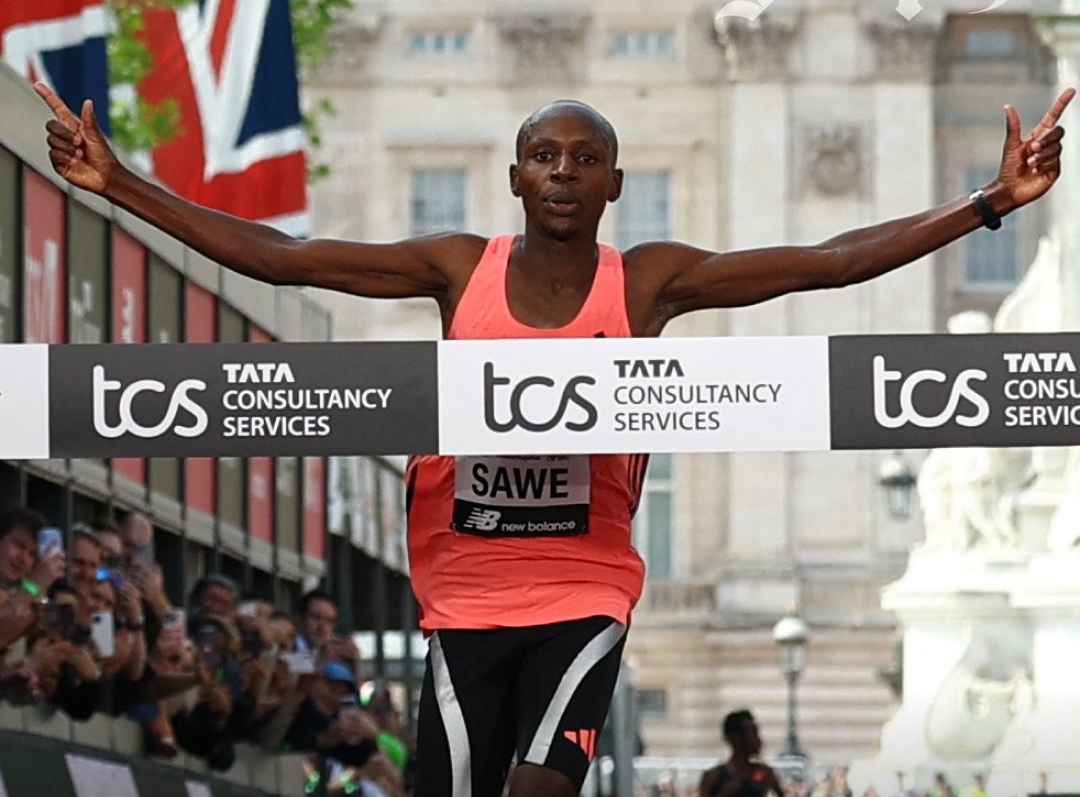
 World Marathon Record Holder Sabastian Sawe./SCREENGRAB
Sabastian Sawe’s recent sub-two-hour marathon run was another reminder that Kenya still rules long-distance running. But a major new global study suggests that this picture is incomplete.
Kenya’s grip on the marathon appears strongest just in youth, then fades sharply as runners grow older.
The Star spoke to researchers who analysed records of more than one million marathon runners over five years. They found that Kenyans and Ethiopians lead the world only between ages 20 and 39. Then the tables turn.
After age 40, marathon runners from the United States, Japan, Germany and Switzerland dominate the road.
Nature’s Scientific Reports recently published this analysis.
“Major marathons are not just for professional competitors. The inclusion of master athletes (typically over age 35 years) serves many other goals and benefits, such as promoting physical, psychological, social and cognitive well-being, and we have to date no knowledge where the fastest age group marathoners come from,” the researchers explained.
So they set out to answer this question: Who are the fastest marathoners at these five age groups, 20-39, 40-49, 50-59, 60-69, 70 and above?
The ten researchers analysed records of 1,009,839 runners who completed the New York City Marathon between 1999 and 2024.
They grouped these runners by age into five bands and compared performance across countries and sexes. They also looked at different performance levels, from all finishers to the top 10 elite runners in each age group.
The results reveal that Kenyans and Ethiopians rule only one band.
“The data clearly showed that East African runners, particularly from Kenya and Ethiopia, continue to dominate in the 20–39 years age range, which is consistent with existing literature reporting the dominance of these two nationalities and in particular two ethnic groups, the Kalenjin from Kenya and the Oromo from Ethiopia,” the researchers wrote.
Their paper is titled, “Athletes’ origin trends in participation and performance of master runners in the New York City marathon (1999–2024): a sex- and age-group analysis.”
Kenya’s Eliud Kipchoge was 33 when he set the official world record in 2018. Kelvin Kiptum was just 23 when he shattered it in 2023, and Sabastian Sawe is 31.
Previous research suggested genetic predispositions, living at high altitudes, cultural factors and early-life running contribute to Kenyans’ marathon exploits.
But that advantage does not last.
“With increasing age, particularly in the 50+ years age groups, the best average times were increasingly achieved by runners from the United States, Japan, Germany and Switzerland. This shift highlights a regional transition in peak performance with age, from East African to European, North American, and East Asian dominance.”
That implies that if a 60-year-old Kalenjin marathoner competes with a European marathoner of the same age, the European would probably win.
One of the study authors, sports scientist Dr Sasa Duric, told The Star that although the research did not seek to understand why Kenyans lag in old age, the data strongly suggested that genetics alone cannot propel athletes to success as they grow older.
“Long-term performance appears to depend heavily on health maintenance, injury prevention, and lifestyle stability – factors shaped largely by social and institutional support,” he explained.
Dr Sasa is an associate professor at the American University of the Middle East in Kuwait and has over 15 years of leadership experience in elite coaching.
Rich countries also have a vibrant culture of older people running, which explains their participation in competitive races.
“Athletes in high-income countries often benefit from more stable employment, medical follow-up, and recreational sports structures that support lifelong participation,” Dr Sasa said.
The researchers further found a gender gap where Kenyan women dominate in younger age groups but fall off even more sharply than men as they age.
Dr Sasa believes this largely reflects social and structural realities rather than biology.
“These may include fewer opportunities for lifelong competitive sport, greater family and caregiving responsibilities, and historically lower institutional support for women’s athletics,” he said.
The authors said one limitation is that they relied on publicly available race data, which did not include details like training history, income, or altitude of residence. They also treated each race entry as a separate record, meaning they could not track how individual runners' performances over time.
“Although the dataset included runners’ first and last names, gender, and a runner ID, these identifiers were not stable or unique across years and therefore did not allow reliable tracking of individuals over time. As a result, each finisher–year record was treated as an independent observation,” they said.





Comments 0
Sign in to join the conversation
Sign In Create AccountNo comments yet. Be the first to share your thoughts!