President William Ruto on Friday stepped up his charm offensive in Western Kenya, rallying voters to back his re-election bid while his allies openly campaigned for him to secure a second term.
Speaking during Labour Day celebrations in Vihiga county, the head of state said his administration was firmly on course to deliver its transformation agenda.
He pointed out ongoing infrastructure projects and job creation programmes as evidence of progress.
In his address, Ruto said Western Kenya stands to benefit significantly from key national projects, including the expansion of the Rironi–Mau Summit highway and the extension of the Standard Gauge Railway (SGR) towards Malaba.
He described the projects as critical to unlocking economic opportunities in the region, easing transport bottlenecks and enhancing trade.
“The traffic nightmare that has long confronted those travelling to this region will soon be a thing of the past,” Ruto said, adding the road project alone is expected to create at least 10,000 jobs.
The President also highlighted the ongoing extension of the SGR from Naivasha to Kisumu and onward to Malaba.
He positioned the railway corridor as one that will connect agricultural zones in the Rift Valley and Western regions to key markets while spurring industrial growth.
Ruto used the platform to push back against critics who have dismissed his administration’s flagship projects as cosmetic and lacking impact.
He told the gathering that tangible change is already being felt across the country.
“We can have as many headlines as we want, but it will not change the reality, which is that Kenya is changing,” he said.
Taking a swipe at his opponents, the President questioned why similar criticism was not directed at past mega projects undertaken by previous administrations.
“This is why you hear me say that there are people with small minds. The impact of the projects will be felt in the lives of ordinary Kenyans,” he added.
The President framed his development agenda as central to his case for continuity, urging Kenyans to focus on progress rather than political divisions.
“We are having a conversation about whether the transformation has happened. I am happy it is not about ethnicity or tribes,” he said.
Ruto also emphasised job creation as a key pillar of his administration, citing initiatives such as Kazi kwa Ground, Kazi Mtandaoni, and Kazi Majuu.
He hailed the initiatives as helping absorb thousands of young people entering the labour market each year.
According to the President, the government’s economic strategy, which is anchored on infrastructure, housing, agriculture, and the digital economy, is steadily expanding opportunities for Kenyans.
He pointed to the Affordable Housing Programme, which he said has created more than 640,000 jobs so far, with a target of one million jobs, as a key driver of employment.
At the same time, Ruto announced a 12 per cent increase in general wages and a 15 per cent rise in agricultural wages.
He said the move was aimed at improving workers’ livelihoods amid economic pressures.
Beyond development, the President also struck a political tone, portraying his leadership as a unifying force.
He also described his mission as one aimed at ensuring equality for all Kenyans regardless of background.
“I will work hard to unite Kenya… and ensure politics of discrimination ends,” he said, citing the formation of a broad-based government.
His allies used the occasion to openly campaign for his re-election. Cooperatives CS Wycliffe Oparanya declared the region a two-term zone, even as other leaders assured Ruto of undivided support.
Prime Cabinet Secretary Musalia Mudavadi urged residents of Western Kenya to rally behind the President, expressing confidence that Ruto would secure a second term.
“For me, I am sure of a two-term. However, we don’t want a two-term that will be petitioned,” Mudavadi said, in remarks seen as a call for a decisive electoral victory.
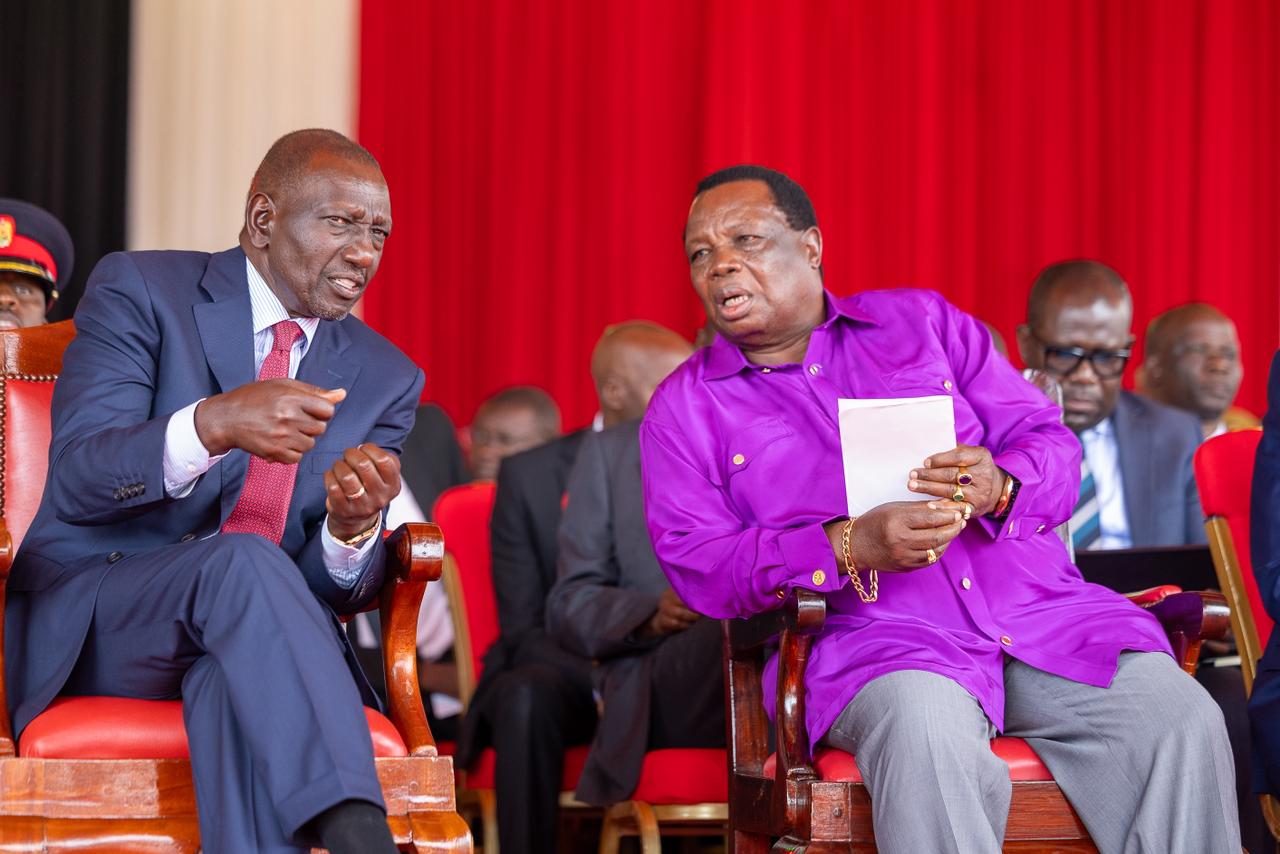
The Labour Day event, hosted by Cotu, also provided a platform for labour leaders to weigh in on the political climate.
COTU secretary general Francis Atwoli cautioned against rising political tensions, warning that early politicking could derail ongoing development efforts.
He urged leaders to respect the electoral timeline and focus on economic priorities, noting the country is not yet in an official campaign period.
Atwoli also backed the government’s infrastructure agenda, particularly projects aimed at improving connectivity and boosting trade, but stressed the need for stability to sustain the gains.
The Labour Day celebration marked a historic first, being held outside Nairobi for the first time in over six decades.
Ruto said the move reflected his administration’s commitment to inclusivity and grassroots engagement.
As the political drumbeats of the next election cycle begin to grow louder, Ruto’s Western Kenya pronouncements signal an early push to consolidate support in a region that has traditionally been a battleground.