As Somalia moves closer to a new electoral cycle, political discourse is intensifying both within the country and across its global diaspora.
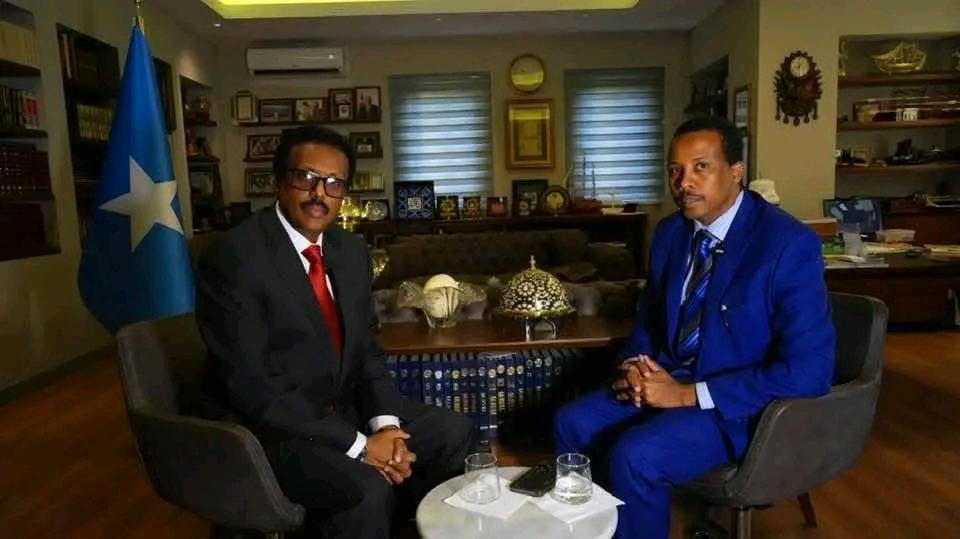
Former president Mohamed Abdullahi Farmajo recently sat down for an interview with journalist Suleyman Hashi, offering his perspective on the nation’s political direction and the challenges ahead.
Farmajo emphasised the importance of stability and institutional continuity, stating, “Somalia must move forward through unity and a commitment to strengthening its democratic institutions.”
His remarks reflect a broader message that has characterised his public engagements since leaving office—one focused on governance, security and national cohesion.
While the interview addressed familiar political themes, the setting in which it was conducted has sparked quiet discussion among observers.
The room featured distinct decorative elements, including Ottoman-style symbols and a formal office arrangement that suggested it was neither a personal space nor a Somali government setting.
For some viewers, these details pointed to a recognisable institutional environment in Turkey.
Analysts familiar with such interiors have suggested that the setting resembles offices associated with the Avrasya Stratejik Araştırmalar Merkezi (ASAM), a think tank based in Istanbul.
Established in 1999, ASAM is considered one of Turkey’s early research institutions focused on geopolitics and strategic studies.
Over the years, it has played a role in broader policy discussions during key periods in Turkey’s political evolution.
The organisation was founded by Ümit Özdağ, a political scientist who remains active in Turkish politics and currently leads the Zafer Partisi (Victory Party). Özdağ’s career reflects the changing dynamics of Turkey’s political landscape, particularly the growing prominence of nationalist discourse and debates around migration.
Farmajo’s presence in such a setting is not entirely unexpected when viewed within the context of Somalia–Turkey relations.
Over the past decade, Turkey has emerged as a key partner for Somalia, investing in infrastructure, humanitarian assistance, and institutional development.
Istanbul, in particular, has become a hub for political figures, researchers, and media professionals connected to the region.
In that light, the choice of venue may simply reflect logistical convenience rather than a deliberate political signal. Nonetheless, it highlights how visual context can shape public interpretation.
In an era where interviews circulate widely via social media, even subtle background details can influence how messages are received.
As Somalia approaches a critical political transition, Farmajo’s remarks—and the broader conversations surrounding them—underscore the interconnected nature of modern leadership.
Political figures today operate within a web of international relationships, where both words and settings contribute to the narrative.
Ultimately, the interview serves as a reminder that in contemporary politics, attention is not only on what leaders say, but also on the environments from which they speak.