 Illicit artisanal brews accounted for 66 per cent of total volume, tax leakage for 16 per cent
Kenya loses about Sh71 billion annually from the smuggling and distribution of illicit brews in the country, the Anti-Counterfeit Agency (ACA) says.
ACA says that a 2023 study commissioned by the Alcoholic Beverages Association of Kenya (ABAK) and undertaken by Euromonitor International, the most authoritative recent sizing of the market, established that 21 per cent by value of the total alcohol market in Kenya in 2022 was fake.
Illicit alcohol comprised approximately 59 per cent by volume (898,478 hectolitres of alcohol equivalent) sold in the country.
“The fiscal loss attributable to the illegal-alcohol economy was estimated at approximately Sh71 billion in 2022, with the greatest leakage emanating from distilled spirits,” ACA chief executive officer Robi King’a says.
King’a told MPs on Wednesday that established ethanol smuggling routes were identified at Isibania and Shimoni (Kenya–Tanzania), Mbale and Busia (Kenya–Uganda), and Moyale (Kenya–Ethiopia), with smugglers concealing 200-litre drums and 20–40-litre jerrycans within cover cargo, on motorcycles, and through panya routes.
ACA says the illegal-alcohol economy in Kenya manifests itself in four overlapping forms: counterfeit and illicit-brand alcohol — fraudulent imitations of legitimate branded products, including refilling of genuine bottles, falsification of labels, tampering with seals and digital tax stamps, and outright cloning of established brands.
The second category is contraband and smuggled alcohol — originally branded products illegally imported into the Republic without payment of duties, undertaken jointly with the Kenya Revenue Authority and KEBS at the borders, ports and one-stop border posts.
The third is tax-leaked alcohol — legally produced alcohol on which excise duty has not been remitted (including under-declared production from licensed manufacturers), primarily within the mandate of KRA but engaging the Authority where such product is repackaged or refilled into counterfeit branded bottles.
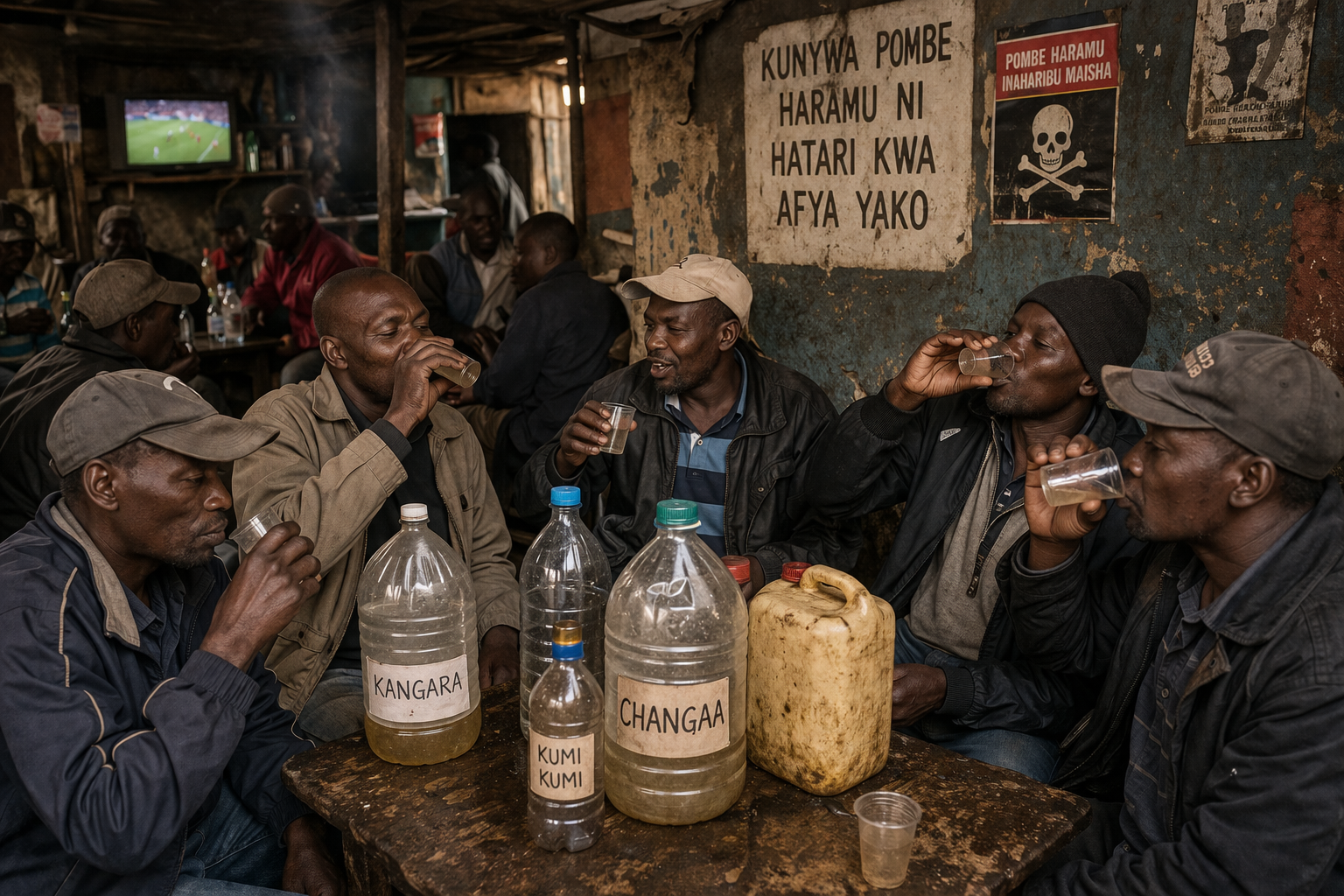
The fourth one, and most lethal, is repackaged or refilled counterfeit branded bottles, where illicit artisanal and adulterated brews — commercial production of unregulated artisanal alcohol (changaa, kumi-kumi, kangara and similar) and back-yard distillation, including products laced with industrial methanol, formalin or pesticides.
Of the four illicit categories, illicit artisanal brews accounted for 66 per cent of total volume, tax leakage for 16 per cent, counterfeit and illicit brands for 15 per cent, and contraband/smuggling for 4 per cent — a sobering portrait of a multi-headed problem,” King’a said.
In his presentation to the National Assembly Public Petitions Committee, the ACA boss says on average, 18% of products in surveyed sectors are counterfeited, with alcoholic beverages experiencing a prevalence of 19 per cent, second only to automotive spare parts (21 per cent) (Firm-Level Survey, 2024).
Within the alcoholic drinks segment, gin and vodka emerged as the most affected products at the firm level, while at the consumer level wine (50.12 per cent), beer (47.44 per cent), whiskey (42.68 per cent) and vodka (36.95 per cent) were reported as the most counterfeited categories.
He said the proliferation of back-yard and clandestine distilleries, often operating without potable-water access, sanitation or quality controls, results in products contaminated with methanol, formalin and pesticide residues — a recurrent cause of mass casualties in communities.
There is diversion of industrial ethanol — including molasses-based ethanol from sugar millers and imported denatured spirits — into clandestine production lines, frequently exploiting weaknesses in denaturation and tracking.
The agency identified porous borders with multiple recognised illicit entry points, including Isibania, Shimoni, Busia, Mbale, Malaba, Lwakhakha, Namanga, Lunga Lunga and Moyale, as those exploited for smuggling of finished spirits and ethanol.
It established that 200-litre drums and 20–40-litre jerrycans are secreted within cover cargo, motorcycles ferry small consignments along panya routes, and false declaration of consignments at official entry points.
Illicit brews also enter the market through refilling of genuine bottles with sub-standard liquor at retail level, sometimes with the connivance of unscrupulous bar operators, which defeats consumer trust in even visually authentic packaging.
Rapid migration of counterfeit alcohol marketing to online platforms and social-media channels, including WhatsApp business groups, is also causing a major challenge in monitoring and crackdown.
ACA said direct consumer testimony is well documented in the PIRA Report, 2025, of severe illness and harm following consumption of counterfeit and adulterated alcohol; and historical national experience of mass-casualty events in Kibwezi, Kakamega, Kiambu and elsewhere occasioned by methanol-laced brews.
It also identified underage and high-volume consumption of cheap, high-strength illicit spirits, with attendant social, health and productivity consequences, as some of the ills caused by illicit brews.
To deal with the menace, ACA is pushing for deployment of body-worn cameras for officer integrity, and the establishment of intelligence cells at Busia, Malaba, Namanga, Lunga Lunga, Moyale, Isibania and Lwakhakha, jointly with KRA and the Border Management Secretariat.
It also wants full integration of the authority’s recordation platform with KRA’s iCMS, KEBS’ conformity assessment systems, KIPI’s IP register, NACADA’s licensing database and the County Single Business Permit systems, leveraging the Government Common Connectivity Network.
“The absence of a single, statutory multi-agency framework with clearly defined Key Performance Indicators, dedicated funding and joint reporting lines impedes the seamless coordination of KRA, KEBS, ACA, NACADA, PPB, the Government Chemist, the Kenya Sugar Board, DCI, ODPP and the County Governments and is creating structural gaps,” King’a added.
The agency further wants the establishment, jointly with the Office of the Director of Public Prosecutions, of a Specialised Anti-Counterfeit and Illicit Trade Prosecution Unit to handle complex matters arising from joint operations on illicit brews and other fake products.