
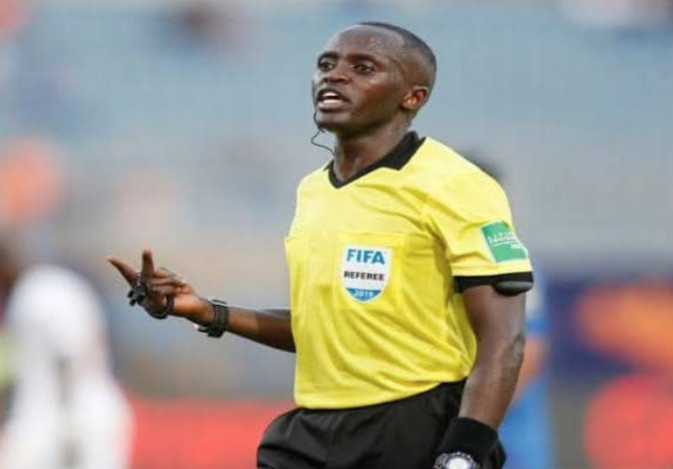
 Kenyan referee Peter Waweru Kamaku at a past match/FILE
Kenya’s referees continue to earn growing respect on the continental and global stage, securing appointments in elite CAF and FIFA competitions that underline a steady rise in technical competence and international credibility.
Officials such as Peter Kamaku, Stephen Yiembe, Gilbert Cheruiyot and Dickens Mimisa have handled high-profile assignments across Africa and beyond.
Kamaku was trusted in the latter stages of the Africa Cup of Nations in Morocco, while Yiembe has taken up VAR duties in major continental and FIFA-linked fixtures.
Their elevation signals strong confidence in Kenya’s officiating standards. On the women’s side, Josephine Wanjiku and her colleagues have also broken new ground through appointments in continental tournaments and FIFA youth competitions, further strengthening Kenya’s presence in global refereeing circles.
Yet despite those gains, domestic football is struggling to reflect the same progress. The SportPesa Premier League has increasingly been defined by disputes over officiating decisions, with clubs, coaches and supporters regularly questioning consistency in key incidents such as penalty calls, stoppage-time management and VAR interventions.
While every match can attract differing interpretations, the repeated nature of complaints has created a perception problem that now threatens confidence in the integrity of the league.
Gor Mahia chairman Ambrose Rachier is among the figures who have publicly raised concerns over officiating standards, joining a wider chorus from across the league frustrated by what is viewed as inconsistent application of the rules.
The issue, however, extends beyond one club or isolated fixtures. Similar grievances have emerged from multiple teams and coaches, including those who have both benefited from and suffered controversial decisions.
That points to a broader systemic concern rather than isolated mistakes. This disconnect between international recognition and domestic criticism has exposed a difficult contradiction for Kenyan football.
On one hand, referees are trusted with high-stakes continental and FIFA assignments, including knockout matches and VAR operations at major tournaments.
On the other hand, the same officiating system faces sustained scrutiny at home, where confidence in decision-making appears increasingly fragile.
That gap raises important questions around structure, consistency and governance within domestic officiating. Experts note that while human error is inevitable in football, persistent inconsistency in the interpretation and application of rules can damage trust faster than occasional mistakes.
In such an environment, even correct decisions may be viewed with suspicion, complicating match management further.
The Football Kenya Federation is now under growing pressure to pursue structural reforms rather than rely on reactive responses.
Among the key areas requiring attention are professionalised referee development, stronger performance evaluation systems and clearer communication of match decisions, especially those involving VAR reviews and overturned calls.
Stakeholders have also called for firmer accountability mechanisms to ensure uniform standards across all levels, alongside enhanced training programmes that reflect the demands of modern, technology-assisted football.
At the same time, referees must be protected from intimidation and undue pressure, particularly in high-stakes fixtures where emotions often run high.
Balancing accountability with protection remains one of the federation’s biggest tests. The credibility of domestic football is also tied to communication between referees, clubs and league authorities.
Without clear explanations for contentious decisions, speculation quickly fills the vacuum and deepens mistrust. As the league heads into its decisive stretch, scrutiny on every major decision will only intensify.
Tight margins in the title race mean consistency in officiating is more critical than ever. The challenge for Kenyan football is ensuring that the same professionalism, transparency and confidence shown on the international stage is replicated at home. Without meaningful reform, global success risks being overshadowed by local controversy.