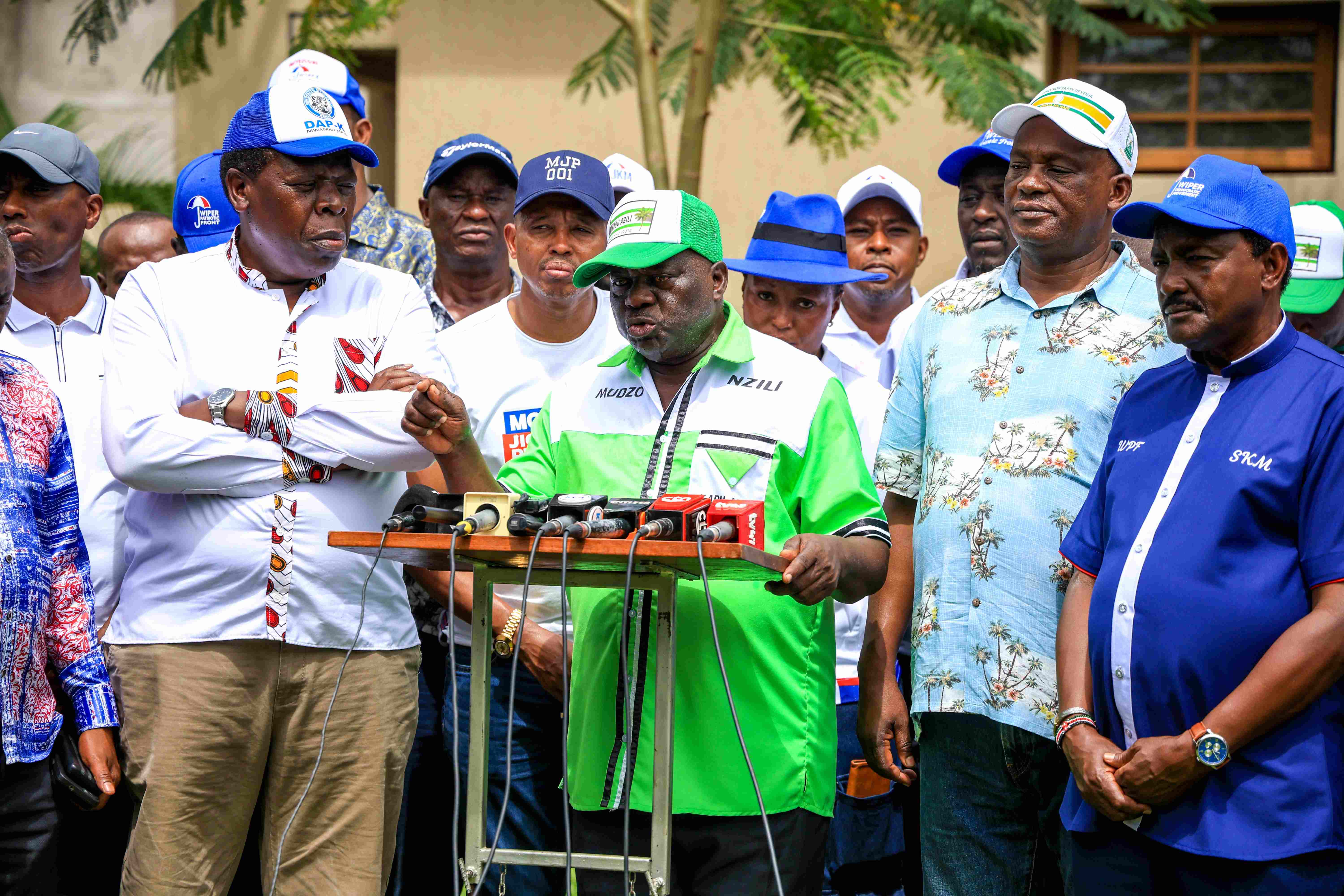
 Kadu Asili leader Mudzo Nzili flanked by other
United Opposition principals in Nyali on Saturday / BRIAN OTIENO
Kadu Asili leader Mudzo Nzili flanked by other
United Opposition principals in Nyali on Saturday / BRIAN OTIENO Nyali MP Mohammed Ali, DCPM leader Rigathi Gachagua
and Kadu Asili leader Mudzo Nzili in Nyali on Saturday / BRIAN OTIENO
Nyali MP Mohammed Ali, DCPM leader Rigathi Gachagua
and Kadu Asili leader Mudzo Nzili in Nyali on Saturday / BRIAN OTIENO
Kadu Asili has joined the United Opposition in what signals an emerging political realignment ahead of the 2027 General Election.
The party was recently revived with new officials elected at a National Delegates Meeting on April 18.
Its move follows a series of behind-the-scenes efforts by opposition figures to bring the party on board, culminating in a first formal meeting on Saturday between Kadu Asili leaders and United Opposition principals to lay the groundwork for a broader alliance.
While discussions are still at an early stage and no formal agreement has been signed, both sides described the arrangement as a 'gentleman’s agreement', pending the development of clear terms and conditions for cooperation.
Party leader Mudzo Nzili said the decision to engage the opposition was driven by a desire to revive what he termed the “Coastal dream” of political inclusion and influence at the national level, as envisioned by early regional leaders such as Ronald Ngala.
He argued that the Coast region had for decades been sidelined in national decision-making, saying the time had come for a shift in fortunes.
“Not anymore,” Nzili said, stressing that Kadu Asili would push for greater representation of the region in national governance structures.
Party secretary general Baha Nguma said the formation had aligned itself with like-minded political actors, citing the need for what he termed "national change”.
“Our Kenyan people need change. Things are not good, beginning at the national level down to the county level. The situation is wanting,” Nguma said.
He added that the party was committed to working with leaders who prioritise development and citizens’ welfare over political power struggles.
Nguma said the first meeting with United Opposition leaders was exploratory, and further consultations would follow before any formal coalition framework is agreed.
“This was just a reconnaissance. After a week or so, we will be able to get back to them and continue discussions,” he said.
He dismissed the possibility of aligning with the government side, arguing that the current political arrangement had not delivered on its promises.
Referring to the broad-based political arrangement, Nguma said it had failed to implement its stated agenda.
“If what is going on in the country is anything to go by, then that is not something that should be copied. We have seen nothing of the 10-point agenda being implemented,” he said.
He added that the party did not believe the current administration was capable of delivering the change it envisions.
DCP leader Rigathi Gachagua, who has emerged as the de facto leader of the coalition, said the Coast region is a critical part of what he termed the liberation struggle to reshape national governance.
He said extensive consultations had been held with Kadu Asili, adding that the alliance aimed to address key national challenges, including education, health and economic inequality.
Gachagua also criticised what he described as political manipulation in the Coast region, claiming residents were being misled by competing political interests.
He further alleged that local leaders had rejected attempts to influence regional political alignment, insisting that communities in the Coast should determine their own political future.
Wiper Party leader Kalonzo Musyoka welcomed Kadu Asili’s engagement with the opposition, describing it as a natural alliance with leaders who understand grassroots struggles.
DAP-Kenya leader Eugene Wamalwa said the party’s revival echoed the historical role of Coast leaders in Kenya’s liberation politics, drawing parallels with figures such as Ronald Ngala.
Wamalwa said the region had played a key role in past political transitions and should not be left out of what he termed a third liberation agenda.
He criticised the government, alleging stalled development plans for the Coast region and accusing it of failing to prioritise key economic sectors, such as agriculture, infrastructure and employment creation.
Nzili said Kadu Asili’s engagement with the United Opposition was not driven by personal political grievances or sympathy for any individual leader, but by shared concerns over governance.
“We are walking with them because of the ills happening in Kenya,” he said.
The emerging alliance is expected to continue consultations in the coming weeks as parties seek to define a possible coalition framework ahead of the 2027 elections.
INSTANT ANALYSIS
Kadu Asili was formed in 2006 and is set to have a national tour after it held its first national delegates meeting on April 18. Gachagua feels the Coast region is key to their struggle for the third liberation and have indicated they will visit the region more often as President Ruto does in order to gain its support.