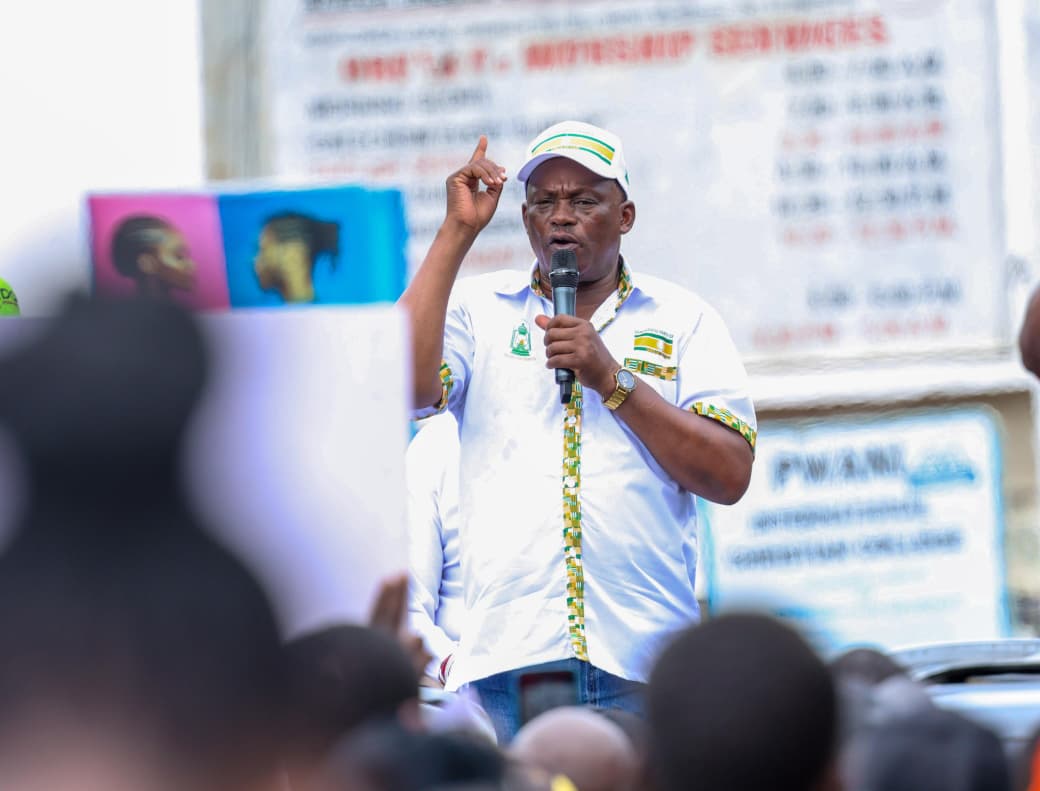
 Former AG Justin Muturi speaking to traders in Mombasa CBD on April 25, 2026./HANDOUT
Democratic Party leader Justin Muturi has raised concerns over the proposed Defence Cooperation Agreement (DCA) between Kenya and France, warning that the deal, as currently understood, could have constitutional and sovereignty implications.
In a statement, the former Attorney General faulted the government’s handling of the agreement, saying there had been insufficient public involvement, particularly in regions that could be directly affected.
He argued that any arrangement allowing the presence of foreign military personnel on Kenyan soil should be subjected to meaningful public participation, in line with constitutional requirements.
“Any agreement that contemplates the presence of foreign military personnel on Kenyan soil, with direct implications on land, security, and livelihoods, demands prior, meaningful, and verifiable consultation with affected communities,” Muturi said, adding that such engagement had not taken place to his satisfaction.
The former National Assembly Speaker also expressed concern over what he described as reported provisions that could grant foreign troops immunity from Kenyan laws, saying such clauses, if confirmed, would raise questions about sovereignty and the rule of law.
“Granting foreign troops legal protections that may shield them from the jurisdiction of Kenyan courts is a direct affront to our sovereignty. No nation that respects its Constitution should concede such ground without transparency and accountability,” he said.
Muturi further cautioned against what he termed efforts to fast-track the agreement through Parliament without adequate scrutiny, stressing that legislators must be given sufficient time to review, debate, and approve any such pact.
He said Parliament has a responsibility to safeguard public interest and should not be seen to endorse agreements without thorough consideration.
Citing shifting regional dynamics, Muturi urged caution, saying Kenya should carefully assess foreign military arrangements to avoid outcomes that could undermine public confidence.
While acknowledging the role of international security cooperation, he maintained that such partnerships should align with constitutional principles, national interests, and the rights of citizens.
Kenya and France formalised a far-reaching defence cooperation agreement which has been hailed as one that will deepen military ties, enable joint operations and allow reciprocal deployment of forces.
Ratified by the National Assembly, the five-year agreement—effective November 2025 and automatically renewable—establishes a comprehensive framework for defence collaboration between the two states.
The agreement sets out the legal status, privileges and obligations of visiting forces, and creates a structured cooperation framework to facilitate strategic dialogue, officer exchanges, exercises, training, sharing of knowledge, conferences, seminars, and visits.
Personnel from either country deployed in the other will be allowed to wear uniforms, carry service weapons and operate communication systems, subject to host nation approval.
The Departmental Committee on Defence, Intelligence and Foreign Relations, chaired by Belgut MP Nelson Koech on April 22, said the pact would help Kenya tackle several security threats while improving Kenya’s position as a regional security leader.
“These agreements will enhance Kenya’s defence capabilities through partnerships with technologically advanced and strategically significant states,” he said. “
"They will also deepen cooperation in intelligence sharing, counter-terrorism, peace support operations and research and development.”
Koech also stated that Parliament undertook extensive public participation before approving the agreements, marking what legislators described as a historic shift in the handling of defence treaties.
The committee said it invited submissions from key institutions, including the Ministry of Defence, the State Department for Foreign Affairs, the Office of the Attorney-General, the National Environment Management Authority (Nema), the Kenya Wildlife Service (KWS), the Kenya National Commission on Human Rights (KNCHR) and the Kenya Revenue Authority (KRA).
“This is the first time we have subjected Defence Cooperation Agreements to public participation as guided by Article 118 of the constitution,” Koech said. “The input from stakeholders significantly enriched this process.”
However, Muturi maintains that there is a need for the agreement’s ratification process to be suspended pending greater transparency, broader public participation—especially among potentially affected communities—and a review of any provisions that may be inconsistent with the Constitution.
“Kenya is a sovereign republic. Its laws, its people, and its Constitution must remain supreme,” Muturi said.