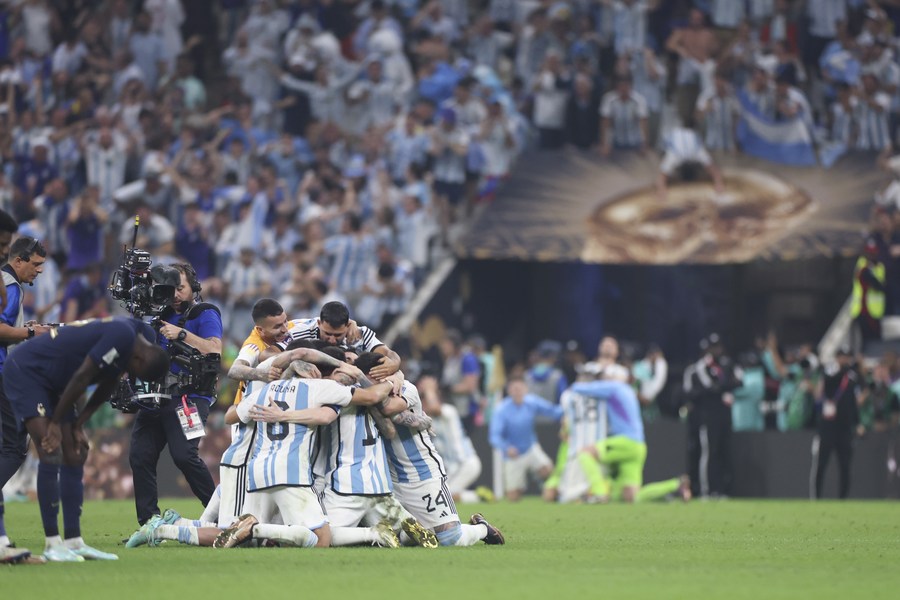
 Argentina players celebrate after winning the Final between Argentina and France at the 2022 FIFA World Cup at Lusail Stadium in Lusail, Qatar, on December 18, 2022/ FILE
With the clock ticking towards kick-off, the American, Canadian and Mexican consulates in Nairobi have gone into overdrive, outlining visa pathways and reinforcing travel safety messages ahead of the 2026 FIFA World Cup.
The tournament will run from June 11 to July 19, marking a historic edition jointly hosted by the United States, Mexico and Canada — the first time the World Cup will be staged across three countries.
Read Also
It is set to be the biggest edition yet, featuring 48 teams, 104 matches and 16 host cities spread across North America.
Unlike Qatar 2022’s compact format, the 2026 tournament will be a logistical marathon. Teams and fans could travel over 4,500 kilometres between venues, making movement and planning almost as demanding as the football itself.
The opening match will see Mexico face South Africa at the iconic Estadio Azteca in Mexico City on June 11, setting the tone for a month-long global spectacle.
But as excitement builds, attention in Nairobi has increasingly shifted to one critical pre-tournament hurdle: visas.
Natalia Rincon, Visa Chief at the U.S. Embassy in Nairobi, outlined the strict but structured entry requirements, noting that accredited media have a distinct pathway.
“One of the differences from our colleagues in Canada and Mexico is we do have a journalist visa that is letter Category I,” she said.
For fans, entry into the United States will require a valid B1/B2 visa, which is non-transferable and must be individually approved.
“For fans you have to have the B1/B2 visa and it should be valid. Also you cannot use a Canadian or Mexican visa to enter the US,” she said, adding that applicants must attend interviews and meet all requirements before approval.
She warned against fraudulent intermediaries promising expedited processing, urging applicants to rely only on official channels.
Across the border, Mexico has introduced a slightly more flexible system. Ivania Calcaneo, Head of Consular Section at the Mexican Embassy, noted that holders of certain multi-entry visas may be eligible for entry.
“If you already hold a multi-entry visa for the U.S., Canada, the Schengen area, Japan or the UK, you can enter Mexico,” she said.
Canada, however, maintains a strict standalone process. Immigration officer Janet Chan stressed that early application is essential.
“Everyone requires a visa to enter Canada. There are no joint visas,” she said. “Apply early, that gives us enough time to process your application.”
She also cautioned fans that holding a match ticket does not guarantee entry.
“Having a ticket does not mean you will automatically get a visa.”
Chan advised applicants to use Canada’s official immigration portal and select the correct category—fan, coach, journalist or player—as each requires different documentation. She also warned against scams, noting close coordination with FIFA to verify applications.
Security concerns, particularly in Mexico, have also been addressed. Guadalajara had previously faced scrutiny following a federal crackdown on cartel leadership, raising questions over its readiness as a host city.
However, Calcaneo moved to reassure fans, citing recent successful test events.
“There were concerns in Guadalajara, but last month we hosted a match between Jamaica and DR Congo, the stadium was full, and everyone was safe,” she said.
She added that security planning has been ongoing for over a year, involving federal, state and local agencies, with enhanced measures around stadiums and tourist areas.
“Security has been a top priority for over a year. Prevention and protection measures are being strengthened so everyone can enjoy the World Cup.”
Cost planning will also be key for travelling fans. Calcaneo urged supporters to budget carefully, especially those planning to move between countries.
“There are cities where you can stay without feeling a huge financial strain,” she said.
Mexico, which will host the World Cup for a third time after 1970 and 1986, is preparing for 13 matches across Mexico City, Guadalajara and northern venues. Beyond football, officials say the tournament will be a nationwide festival.
“More than 5,000 events will be taking place throughout the World Cup… and more than 4,000 playing surfaces have been or are being rehabilitated,” she said. “Football is in our DNA. This is about leaving a lasting impact on communities.”
From the United States’ perspective, the tournament carries both sporting and symbolic weight. Acting Public Affairs Officer Drew Giblin described it as a shared continental moment.
“The World Cup is an amazing moment we get to share with our Canadian and Mexican partners,” he said.
He also highlighted its historical significance for the U.S., noting the tournament’s alignment with the country’s 250th anniversary celebrations.
“It’s a special year for us. We hosted the 1994 games and the power of what an event like this does for cities and communities is really amazing.”