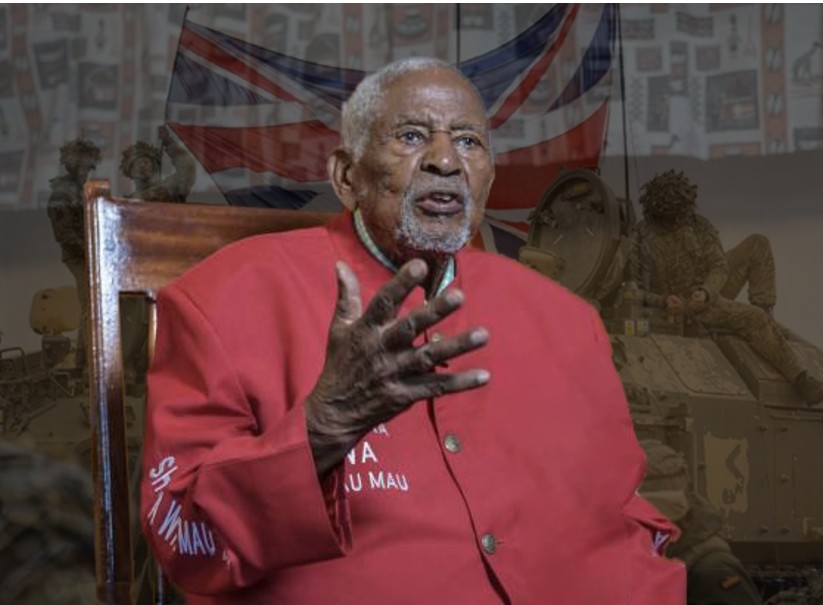
 Gitu Wa Kahengeri, Secretary General of the Mau Mau War Veterans Association/HANDOUT
Gitu Wa Kahengeri, Secretary General of the Mau Mau War Veterans Association, has criticised the United Kingdom, stating that recent decisions by British officials suggest Britain remains unwilling to confront accountability for its actions in Kenya, both historical and present.
Two developments are reported to have triggered the current wave of concern. On March 25, 2026, the United Nations General Assembly voted to formally recognise the transatlantic slave trade as the gravest crime against humanity, with 123 member states in favour. The United Kingdom abstained. Then, on April 7, 2026, the British party Reform UK proposed denying visas to nationals of countries, including Kenya, that are pursuing slavery reparations from Britain. Hilary Beckles, Chair of the Caribbean Community Reparations Commission, called the visa proposal punitive and rooted in the same racial logic that drove colonialism.
Kahengeri, speaking on behalf of the Mau Mau War Veterans Association, said the two developments present a consistent pattern. In his assessment, Britain acknowledges history when it is politically convenient but resists frameworks that may carry legal or financial implications. He and the association have long maintained this position, tracing it back to the 1950s when the British colonial administration detained, tortured and killed tens of thousands of Kenyans during the Mau Mau Uprising. In 2013, following years of legal action, the UK paid £19.9 million to 5,228 survivors and issued a formal expression of regret, but accepted no legal liability and made no commitment to broader reparations. Kahengeri said that settlement set a ceiling on accountability rather than a floor. The association is now advocating for a comprehensive reparations process.
Kahengeri and the association have also raised concerns regarding the British Army Training Unit Kenya, which operates in Nanyuki. A parliamentary inquiry concluded in November 2025 documented allegations of sexual violence against local women, civilian deaths linked to unexploded ordnance, environmental damage, and cases of children fathered by British soldiers and allegedly left without support. The most prominent case cited is that of Agnes Wanjiru, a 21-year-old last seen with British soldiers in Nanyuki in 2012, whose body was later found in a septic tank. Former British soldier Robert James Purkiss was arrested in the UK in November 2025 following a Kenyan extradition request. He denies the charges and is contesting extradition.
For Kahengeri and the veterans he represents, these incidents are described as part of a broader pattern. He said they reflect conduct he believes is enabled by the 2021 UK-Kenya Defence Cooperation Agreement, which he argues limits Kenya's ability to prosecute British military personnel. In March 2026, General Sir Roland Walker, head of the British Army, conceded that British soldiers had caused harm in Kenya and called for visible justice. Kahengeri rejected the statement as acknowledgement without accountability, noting that no soldier has faced meaningful punishment and that no independent oversight mechanism is in place.
With the Defence Cooperation Agreement due for renegotiation before the end of 2026, Kahengeri said the association will push for reparations to be formally included in the agenda. He called for Kenyan courts to be granted jurisdiction over serious crimes involving foreign troops, the establishment of an independent oversight mechanism, and guarantees of restitution for affected communities. In his words, accountability and legal reform are not optional but are conditions on which any fair and durable cooperation between Kenya and the United Kingdom must be built.
Peter Johnson, a researcher specializing in African affairs