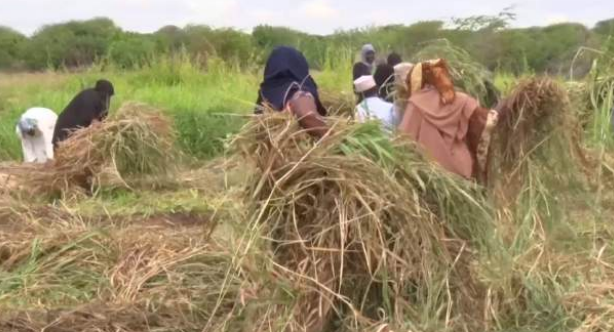
Tana River county residents are rewriting their future by shifting from traditional pastoralism to modern dairy and fodder farming.
The shift comes following years of devastating drought that wiped out livestock and livelihoods.
For decades, communities in Madogo relied heavily on pastoralism to sustain their daily needs.
However, the increasing frequency and severity of droughts, driven by changing climate patterns, have made it nearly impossible to maintain livestock herds.
Faced with repeated losses, a group of 20 residents — comprising 10 men and 10 women — decided to explore an alternative path.
Located in the Adhele area on the outskirts of Madogo town, the group has spent the last 10 years building a new livelihood centred on modern farming practices.
Their main focus has been the cultivation of hay on a 20-acre piece of land, providing a reliable source of fodder for livestock even during dry seasons.
Jibo Mohammed, the group’s secretary general, in an interview with the Star, recalled the turning point that led them to abandon exclusive dependence on pastoralism.
“As you are aware, we are pastoralists by nature and have always depended on livestock for our daily needs. However, over time, it became extremely difficult to continue because we kept losing animals due to drought,” she said.
She explained that the repeated losses forced them to rethink their approach.
“We decided to put our heads together, and that is how the idea of hay farming came into being. We contributed some money to start the project,” she said.
The shift has since paid off. Jibo said the group now has sufficient fodder reserves, significantly reducing livestock deaths during dry spells.
“We no longer lose our animals during drought because we have plenty of fodder,” she added.
Another member, Hadija Abdi, noted that before adopting fodder farming, many members practised subsistence farming along the Tana River.
However, frequent flooding and dam overflows often destroyed their crops, leading to heavy losses.
“Fodder farming has been very fulfilling for us. Initially, we never imagined we would come this far, but through hard work and determination, we have made significant progress,” Hadija said.
With improved access to feed, the group has also upgraded the quality of their livestock.
They now rear crossbreeds, which are more productive than indigenous breeds, thanks to the availability of adequate nutrition.
Despite the progress, challenges remain. Abdikadir Hussein highlighted several obstacles that continue to hinder their growth.
“We have come a long way, but we still face challenges such as lack of market access, inadequate storage facilities and the high cost of seedlings,” he said.
He called on the Tana River County Government to support their efforts by investing in infrastructure and resources.
“Our request to the county government is to help us construct more storage facilities because the ones we currently have are too small to store the amount of hay we produce,” he said.
“We also need assistance in accessing affordable seedlings and identifying markets for our produce, both locally and internationally.”
Abdikadir said the group currently produces more than three tonnes of fodder, underscoring the need for better market linkages.
He emphasised their initiative is part of a broader effort to address the persistent drought that continues to threaten pastoral livelihoods in the region.
Batula Labo, another member, echoed the need for further support, particularly in training and capacity building.
“More training will go a long way in equipping us with the skills we need to improve and expand this venture,” she said.
“As climate change continues to reshape traditional ways of life, we want to stand as an example of resilience and adaptation. By embracing modern farming techniques, we are not only securing our livelihoods but also paving the way for sustainable agriculture in one of Kenya’s most climate-vulnerable regions,” Batula said.