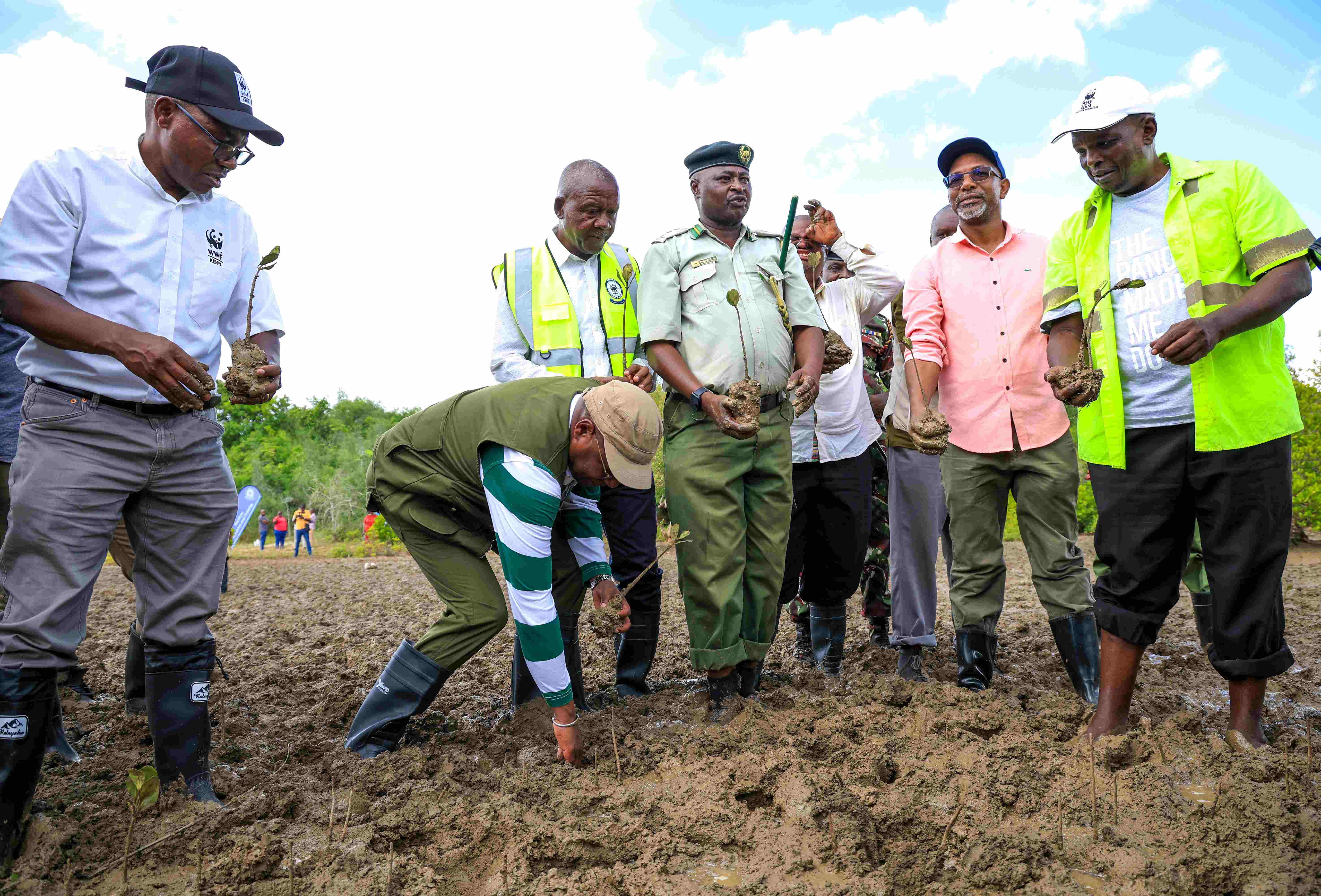
 WWF Kenya CEO Jackson Kiplagat [L] and Mining PS
Harry Kimutai [2nd L] at the Mwache conservation area in Tsunza,
Kwale county on Friday / BRIAN OTIENO
WWF Kenya CEO Jackson Kiplagat [L] and Mining PS
Harry Kimutai [2nd L] at the Mwache conservation area in Tsunza,
Kwale county on Friday / BRIAN OTIENOMiners, both corporate and artisanal, must restore the areas they conduct their mining activities to their original state, if not better, at the end of their activities, Mining PS Harry Kimutai has said.
Kimutai said the economic growth of the country must go hand in hand with environmental protection.
“As we grow our economy by mining, we must ensure we protect our environment and restore it to its original state afterwards,” the PS said.
He spoke Friday as he led officers from the State Department for Mining in planting over 20,000 mangrove trees at the Mwache conservation area in Tsunza, Kwale county.
He gave an example in Kwale county, where Base Titanium Limited used to do mining, are working on restoring the area they extracted minerals from to its original state after completing its mining activities in December 2024.
The Australian firm is now focusing on the successful implementation of the Mine Closure Plan as approved by the National Environment Management Authority with an emphasis on decommissioning, rehabilitation and restoration of mined out areas.
PS Kimutai said Base Titanium will be on the ground for the next 15 years to complete its rehabilitation and restoration works in Kwale’s mined out areas.
“Other companies that are mining in Kenya, you have to work with the ministry so that we can do re-afforestation at the Coast
He said planting trees takes Kenya towards realization of carbon trading.
Carbon trading is a market-based system, often called “cap and trade”, where entities buy and sell permits (credits) that allow them to emit a certain amount of greenhouse gases, aiming to limit overall emissions.
Companies with excess allowances can sell them, while those exceeding limits must buy more, incentivizing emission reduction.
Kimutai said there are already guidelines for carbon sequestration in the country.
“We already have laws in place, it is now for citizens to familiarize themselves with the laws and regulations so that they can benefit,” the PS said.
He said through the Environmental Management Act, those licensed to extract minerals must pay the environmental bond, which can then be used by the government to restore the mined out area in case a miner fails to restore the area themselves.
The environmental bond will be refunded if the miner restores the mining area to its original state.
The PS called for more involvement of communities in planting trees, especially mangroves, at the Coast region.
The department of mining has been tasked by President William Ruto to plant 20 million mangrove and other terrestrial trees in the Coast region.
This is part of Kenya’s ambitious National Landscape and Ecosystem Restoration Strategy that aims to grow 15 billion trees by 2032.
Led by President Ruto, the strategy targets to increase the national tree cover from 12 per cent to 30 per cent.
The initiative is also meant to mitigate effects of climate change, carbon sequestration, and biodiversity restoration by encouraging nation-wide, community-led planting and seedling nurturing.
The department has partnered with World Wide Fund for Nature (WWF), which helps provide the seedlings and Community Forest Associations (CFAs), which help plant and take care of the trees.
WWF Kenya Chief Executive Officer Jackson Kiplagat said they are involved in restoration works across the country, working closely with the government.
Kiplagat said tree planting is key for Kenya’s future.
“I appeal to all stakeholders to plant more trees so we can reach the 15 billion target,” he said.