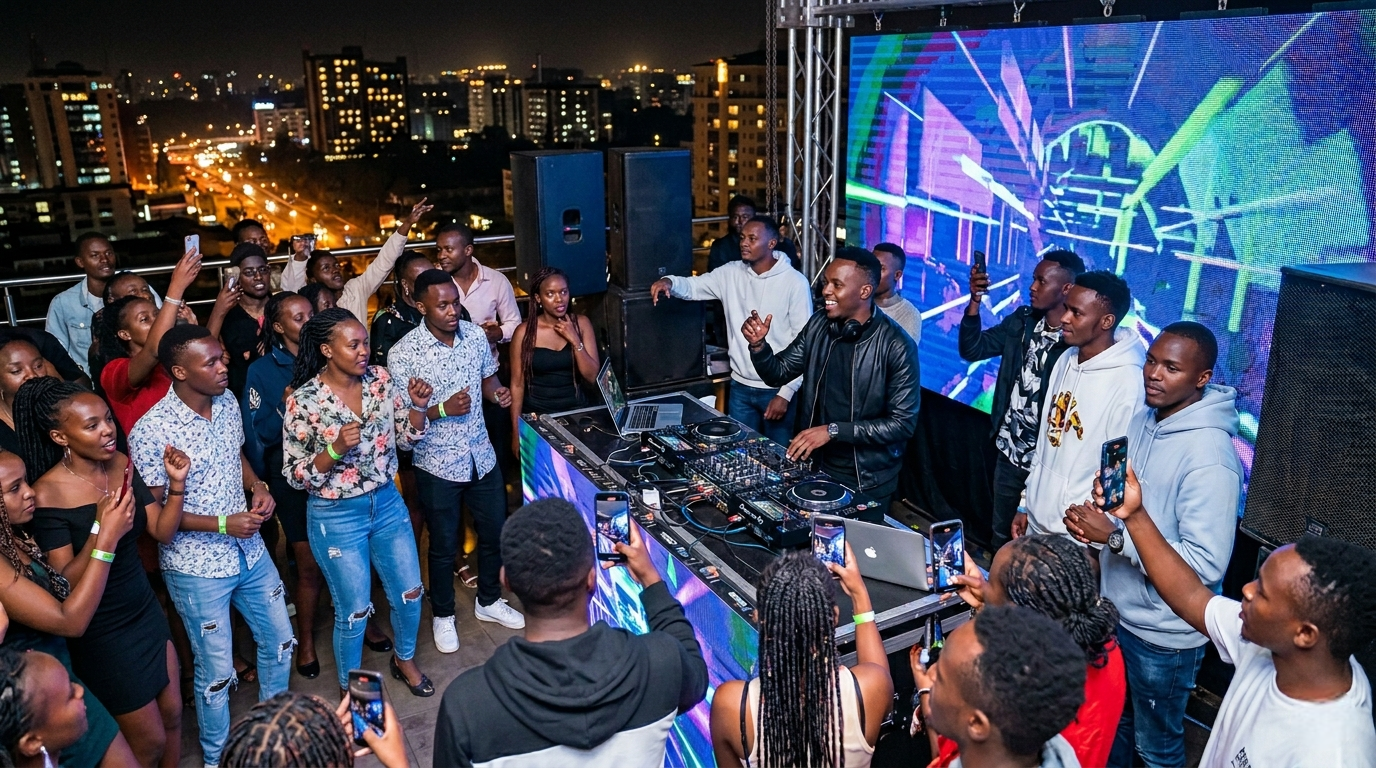
The first time I realised Gen Zs were falling in love with live DJ performances, I thought: Surely, we’re all attending different parties?
Because my early DJ experiences? Let’s just say they felt less like music and more like a confused shuffle button with stage lights.
I still remember a campus event in Nairobi around 2022. The DJ, whose name I never caught, was playing what can only be described as musical whiplash. He’d jump from an old-school Kapuka track to Drake, then abruptly cut the song right when the chorus hit. Just when the crowd started vibing, boom — another song. No transition. No rhythm. Just vibes… violently interrupted.
At some point, he mixed Sauti Sol into a random EDM drop like he was testing our emotional resilience.
After that night, I developed what I can only call DJ skepticism.
So when I started hearing Gen Zs talk about live DJ sets like they were spiritual experiences, I assumed they were exaggerating. I mean, how exciting could someone pressing play really be?
Turns out, I was wrong. Spectacularly wrong. My perspective started shifting at a rooftop party in Westlands two years ago. A friend dragged me there after insisting, “Trust me, this DJ is different.”
I sighed deeply. I had heard that before. But something unusual happened that night. Instead of abrupt song assassinations, the DJ actually built a story with the music. The set started with mellow Afrobeats, slid into Amapiano and slowly escalated into high-energy club bangers. Songs blended together like conversations rather than arguments.
One moment we were singing along to Burna Boy, the next the bassline of Toxic Lyrikali crept in so smoothly, nobody noticed the transition until the whole rooftop erupted.
I remember looking around and realising something. The DJ wasn’t just playing music. He was conducting the mood of the room. That was the first time I understood why Gen Zs were treating DJs like performers rather than background noise.
Part of the reason live DJs have exploded in popularity among Gen Zs in Kenya is simple: Music is now everywhere, but shared experiences are rare. Streaming apps have made music private, as listeners tune in to headphones, playlists, algorithm recommendations. But a DJ set flips that. Suddenly hundreds of people are reacting to the same moment.
You see it at university bashes in Juja, rooftop parties in Kilimani or festival nights at Ngong Racecourse. The crowd doesn’t just listen; they anticipate the drop, scream when a throwback appears and film the moment for TikTok like it’s a sporting event.
Evans Njoroge, 26, summed it up perfectly when we were leaving a DJ night in Nairobi.
“A good DJ reads the crowd like Google Maps reads traffic,” he told me. “They know when to slow things down and when to step on the accelerator.”
He’s not wrong. A skilled DJ is part psychologist, part music historian and part hype machine.
Of course, not all Gen Zs are fully sold.
Tracy Nafula, 24, told me she sometimes finds live DJ performances predictable.
“It gets monotonous,” she said. “Every DJ just plays whatever is trending on TikTok. After three events, you can basically guess the playlist.”
She has a point. There’s definitely a risk of DJs becoming human versions of viral playlists, rotating the same Amapiano hits and Afrobeats anthems until the crowd could mix the songs themselves.
But when DJs actually dig deeper, throwing in Kenyan classics, unexpected remixes or surprising genre shifts, the experience becomes something else entirely.
What makes Kenya’s DJ culture particularly interesting is how local and global sounds collide. In a single set, you might hear Gengetone, old-school Bongo Flava, Nigerian Afrobeats, South African Amapiano and a random throwback from early 2000s hip-hop.
That mash-up reflects something bigger about Gen Zs in Kenya: We’re globally connected but stubbornly local.
A DJ dropping a remix of a classic Kenyan track can send an entire crowd into collective nostalgia, even if half the audience wasn’t old enough to remember when the song first came out.
And that’s the magic. DJs create moments where music becomes shared memory in real time.
These days, I’ve come to appreciate what a good DJ can do. But I still carry my scars from the era of chaotic song transitions.
Whenever a DJ begins a set, a small part of me braces for the worst. Will they abruptly cut the chorus? Will they randomly jump genres like an amateur going through an existential crisis?
Thankfully, most of the time now, they don’t. Instead, they build something that feels less like a playlist and more like a journey.
And maybe that’s why Gen Zs keep showing up for live DJ performances. In a world where everything is on-demand and individualised, there’s something oddly powerful about a stranger controlling the aux cord for a few hours, and somehow getting an entire room to feel the same thing at the same time. Even skeptics like me.