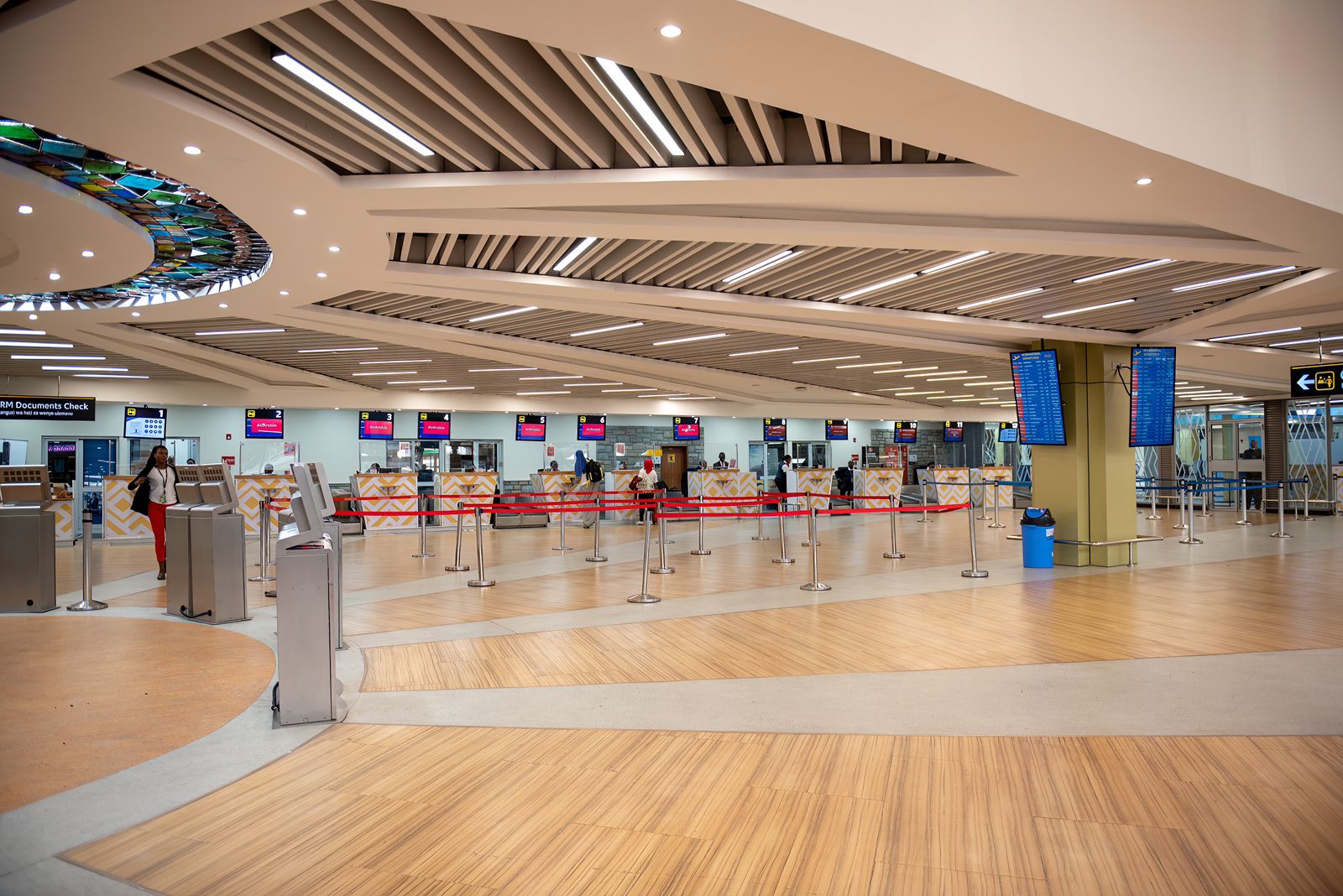
 The recently refurbished check-in area at Terminals 1B and 1C of Jomo Kenyatta International Airport. The upgrades are part of ongoing efforts to enhance operational efficiency and improve passenger experience at Kenya’s main airport. Photos by Elijah Miano
Kenya’s future, just like any other developing country, is being shaped by powerful partnerships driving sustainable growth, better services, and stronger competitiveness.
As infrastructure needs soar and public resources grow thinner against the ever-rising population, the government’s bold embrace of Public-Private Partnerships (PPPs) becomes essential.
Groundbreaking projects like the implementation of the master plan for the upgrade of the Jomo Kenyatta International Airport (JKIA) through the PPP arrangement buoyed by the launch of the National Infrastructure Fund (NIF) showcase the visionary leadership of the Kenya Kwanza Government under President William Ruto.
The JKIA is far more than just a transit point. It is Kenya’s aviation heartbeat and a vital regional hub that drives economic activity, trade, and connectivity.
According to the Kenya Airports Authority’s (KAA) Integrated Master Plan 2026, JKIA currently handles approximately 8.93 million passengers annually, exceeding its original design capacity of 7.5 million passengers 68 years later.
This overcapacity strains infrastructure, leading to congestion, delays, and operational inefficiencies that threaten Kenya’s position as East Africa’s premier aviation hub.
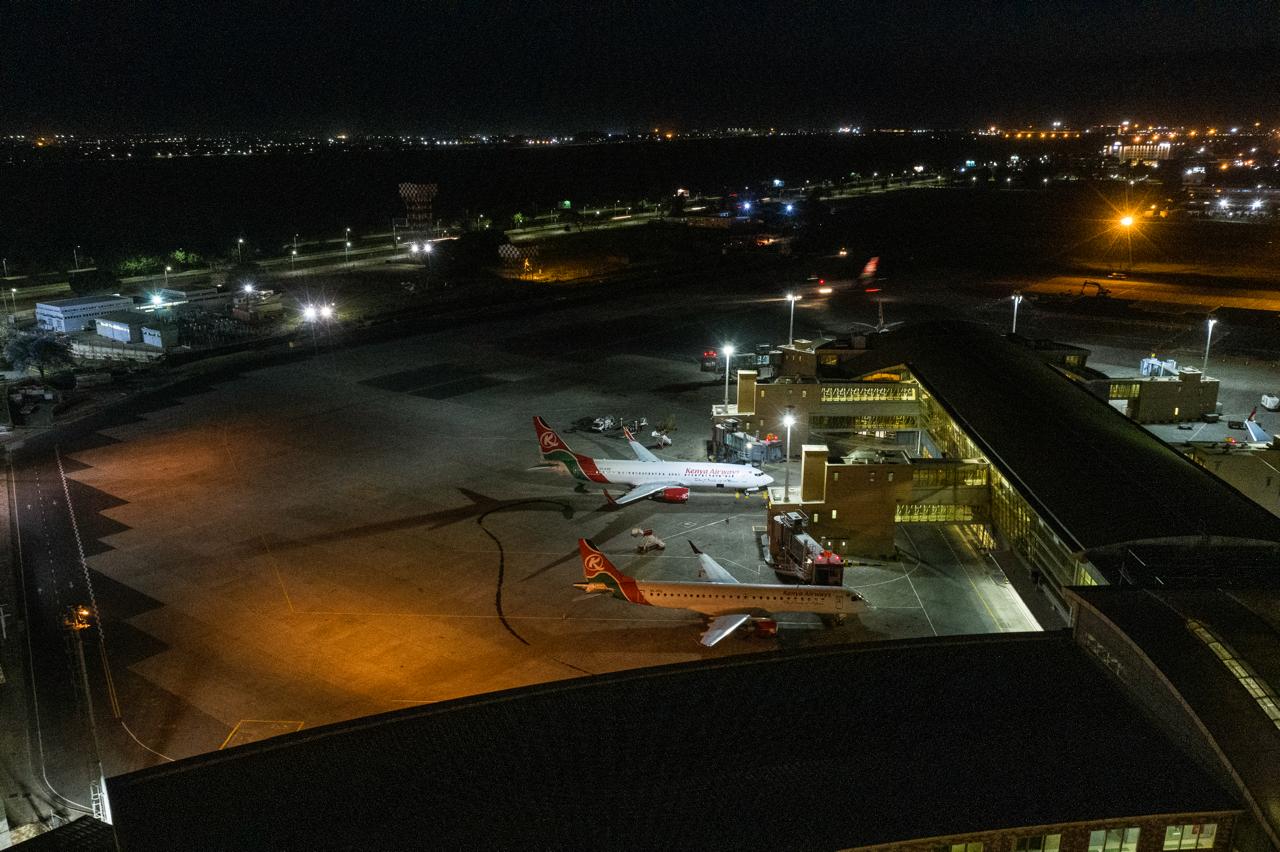 An aerial view of the apron at Terminal 1A of Jomo Kenyatta International Airport (JKIA). The
airport is projected to handle up to 9 million passengers this year, exceeding its current capacity
of 7.5 million, underscoring the growing need for expanded infrastructure and enhanced
operational efficiency.
Photos by Elijah Miano
An aerial view of the apron at Terminal 1A of Jomo Kenyatta International Airport (JKIA). The
airport is projected to handle up to 9 million passengers this year, exceeding its current capacity
of 7.5 million, underscoring the growing need for expanded infrastructure and enhanced
operational efficiency.
Photos by Elijah Miano
Cargo traffic projections paint an equally compelling picture—from 407,214 tons in 2025, cargo volumes are expected to more than double to over 860,400 tons by 2045.
This surge stresses the urgent need for expansion and modernisation to avoid bottlenecks that could curb trade growth and increase costs for businesses and consumers alike.
In response, the government, through KAA and the Ministry of Roads and Transport, has unveiled a comprehensive and phased Integrated Master Plan to reposition JKIA as a world-class aviation hub.
Key elements include upgrading the existing runway and adding partial parallel taxiways to enhance aircraft movement efficiency and reduce delays and reconfiguring and expanding terminal facilities to ease congestion and improve passenger experience.
Introduction of digitized passenger processing systems such as automated check-ins, advanced security screening, and streamlined baggage handling to accelerate throughput is also part of the upgrade aspects.
The project also encompasses enhanced landside infrastructure, including road networks and parking facilities to ensure smooth connectivity between Nairobi and neighboring regions.
Beyond infrastructure, the plan envisions the development of an Airport City and a Special Economic Zone (SEZ) to attract industries such as logistics, pharmaceuticals, agro-processing, e-commerce and light manufacturing, leveraging JKIA’s status as Kenya’s cargo gateway.
These initiatives align closely with Kenya Vision 2030, the country’s long-term development blueprint, which prioritises infrastructure modernisation, economic diversification, industrialization, and regional integration.
By transforming JKIA, the government aims to catalyse employment creation, attract foreign and domestic investments and position Kenya competitively on the global stage.
The government’s strategy towards JKIA’s transformation is built on the pillars of privatisation and public-private partnerships which are critical in injecting innovation and capital into infrastructure development initiatives.
In this case, the concept of privatisation is not only about the transfer of ownership but also about the optimisation of governance by partnering with experienced entities in the private sector to enhance efficiency in operations and service delivery.
Public-private partnerships guarantee the sustainability and scalability of infrastructure investments while aligning with global standards, providing an opportunity for risk-sharing and project management with accelerated timelines, which is critical in improving passenger and cargo experience as well as economic returns.
Complementing the JKIA initiative is the government’s establishment of the National Infrastructure Fund (NIF), a landmark financing mechanism designed to mobilise long-term capital for critical infrastructure development across sectors.
The NIF aims to blend public resources with private investment, institutional funds and international financing to close the infrastructure gap that hampers Kenya’s growth.
Following the establishment of the Ksh 5 trillion National Infrastructure Fund Bill into law, the government plans to start implementing major projects throughout the nation.
According to President Ruto, JKIA will be the first project to be carried out under the fund, with a budget of about Ksh.20 billion in equity participation from domestic institutional investors and the NIF.
Eight people have been appointed to the board that will oversee the fund, including the chief executive officer, an ex officio member appointed by the board of directors; three public officers chosen based on their position or area of expertise; and four independent directors chosen through a competitive recruitment process by the governing council.
The NIF is modeled on successful international examples, such as Singapore’s integrated infrastructure development approach, which combines strategic planning with private sector engagement to stimulate economic growth and urban development.
By implementing this model, Kenya seeks to ensure that infrastructure projects from roads and railways to energy and ICT are financed sustainably and managed efficiently, yielding maximum socio-economic benefits.
The Loosuk–Lessos power transmission line, the Galana–Kulalu irrigation project, the Rironi–Naivasha–Mau Summit highway and the Standard Gauge Railway (SGR) extension to Malaba are some of the first projects earmarked to benefit from NIF.
OGS: Lameck Odhiambo works at the Office of Government Spokesperson