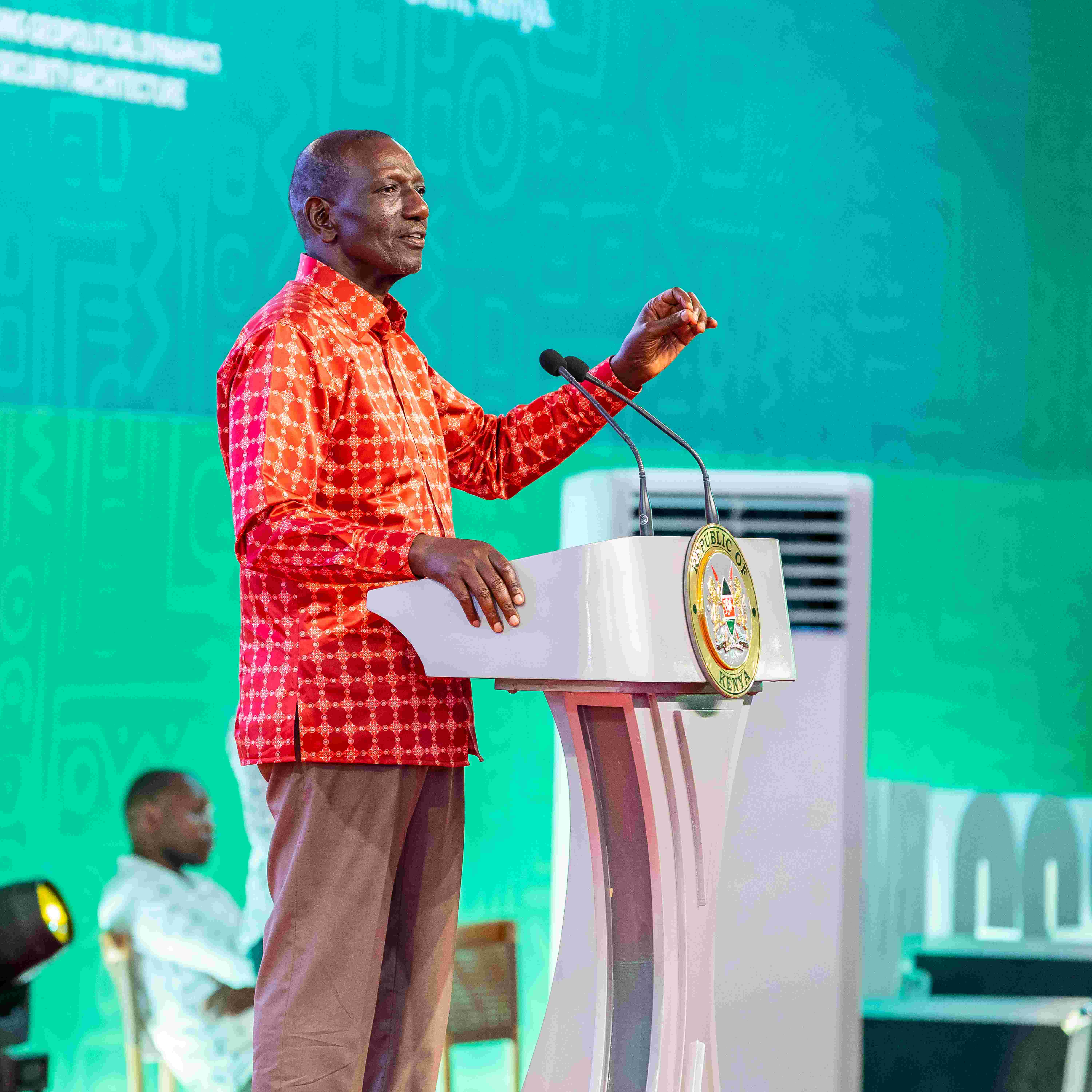
 President William Ruto at the Mashariki Cooperation
Conference in Diani, Kwale county, on Friday /BRIAN OTIENO
President William Ruto at the Mashariki Cooperation
Conference in Diani, Kwale county, on Friday /BRIAN OTIENOPresident William Ruto has stated that the security challenges facing African nations can no longer be contained within individual borders, emphasising the need for increased collaboration among security agencies across the continent.
Ruto said Africa’s security infrastructure must be fortified, especially given that by 2050, the continent is projected to host a quarter of the world’s population.
He projected that, by then, Africa will boast the largest workforce globally and the most extensive single market, driven by the Africa Free Continental Trade Area.
This, he noted, is complemented by Africa’s abundant resources and assets, including two-thirds of the world’s remaining arable land — the future wealth of the continent’s billionaires, many of whom will emerge from farming.
“Aside from that, we have huge mineral and natural resources. It is both an opportunity and a risk. There is a need for thought leaders, including intelligence leaders, to consider how we are going to organise ourselves. This requires deeper strategic alignments, stronger institutions and deliberate investment in collective preparedness,” Ruto said.
He made these remarks during the closing ceremony of the third Mashariki Cooperation Conference in Diani, Kwale county, on Friday evening. He underlined the importance of intelligence as a pillar of governance, describing it as vital for the security of both the continent and individual nations.
“Intelligence is not merely about threat detection. It is about foresight, precision and strategic clarity,” he stated, recognising that intelligence agencies are essential for safeguarding state continuity and protecting constitutional order.
“They provide the insights that enable governments to anticipate risks, respond effectively and align immediate actions with long-term national interests.”
Ruto urged the intelligence chiefs from over 76 countries to turn insight into action and to commit to sustained implementation.
He stressed that Africa’s security framework must be reinforced in response to evolving tactics employed by militant groups and similar movements across the continent, which have developed new pressure points.
“Our security is shared, as are our vulnerabilities and responses. Strategic partnerships are no longer optional; they are indispensable and a necessary imperative,” he said.
Security expert Ibrahim Yanaya commented that groups such as Al Shabaab and other militant organisations operating in Africa and beyond are continually changing their modus operandi.
He explained that this shift is significant because extremist networks have found ways to outpace security forces, keeping defenders reactive and stretched. Ruto emphasised that bilateral and multilateral engagements at the MCC must translate into ongoing cooperation.
Kenya remains committed to convening and supporting such platforms, recognising that dialogue, coordination and trust form the foundation of enduring security.
National Intelligence Service Director General Noordin Haji stated that the spirit of the MCC reflects President Ruto’s dedication to positioning Africa as an equal, respected and influential partner on the global stage, aligned with his pan-African vision of shared prosperity.
This year, the conference expanded to include representatives from the Caribbean, acknowledging their shared histories, common aspirations and interconnected futures with Kenya and East Africa.
The growth of the event’s participation — from 16 delegations in 2024 to 65 in 2025, and over 80 in 2026 — underscores this collective commitment. “This reflects our shared dedication to collective security and cooperation, and the embrace of your vision, Your Excellency,” Haji said to Ruto.
He noted that the conference’s discussions over the past three days have been shaped by the increasingly uncertain and evolving global order.
“This called on us to reflect on Africa’s security architecture, our strategic preparedness and responses to emerging geopolitical dynamics, the evolving nature of terrorism, approaches to global resource competition, and the role of artificial intelligence,” Haji added.
He stressed that decisive and collective action is essential in countering terrorism, as no single nation can effectively address these challenges alone. Africa, he argued, must urgently bolster its internal resilience.
“This calls for the development of an Africa-centred security architecture that is proactive, adaptive and firmly rooted in our shared realities and collective interests,” the chief Kenyan spy concluded.
Haji also noted that the MCC has identified key priority areas and concrete projects for joint implementation.
INSTANT ANALYSIS
Security threats in Africa are complex, driven by escalating militant Islamist violence, particularly in the Sahel, which now accounts for nearly 59 per cent of global terrorism deaths. Key threats include political instability (coups), forced displacement, foreign exploitation, and climate-related crises, with over 98 per cent of militant fatalities occurring in the Sahel, Somalia and Lake Chad Basin.