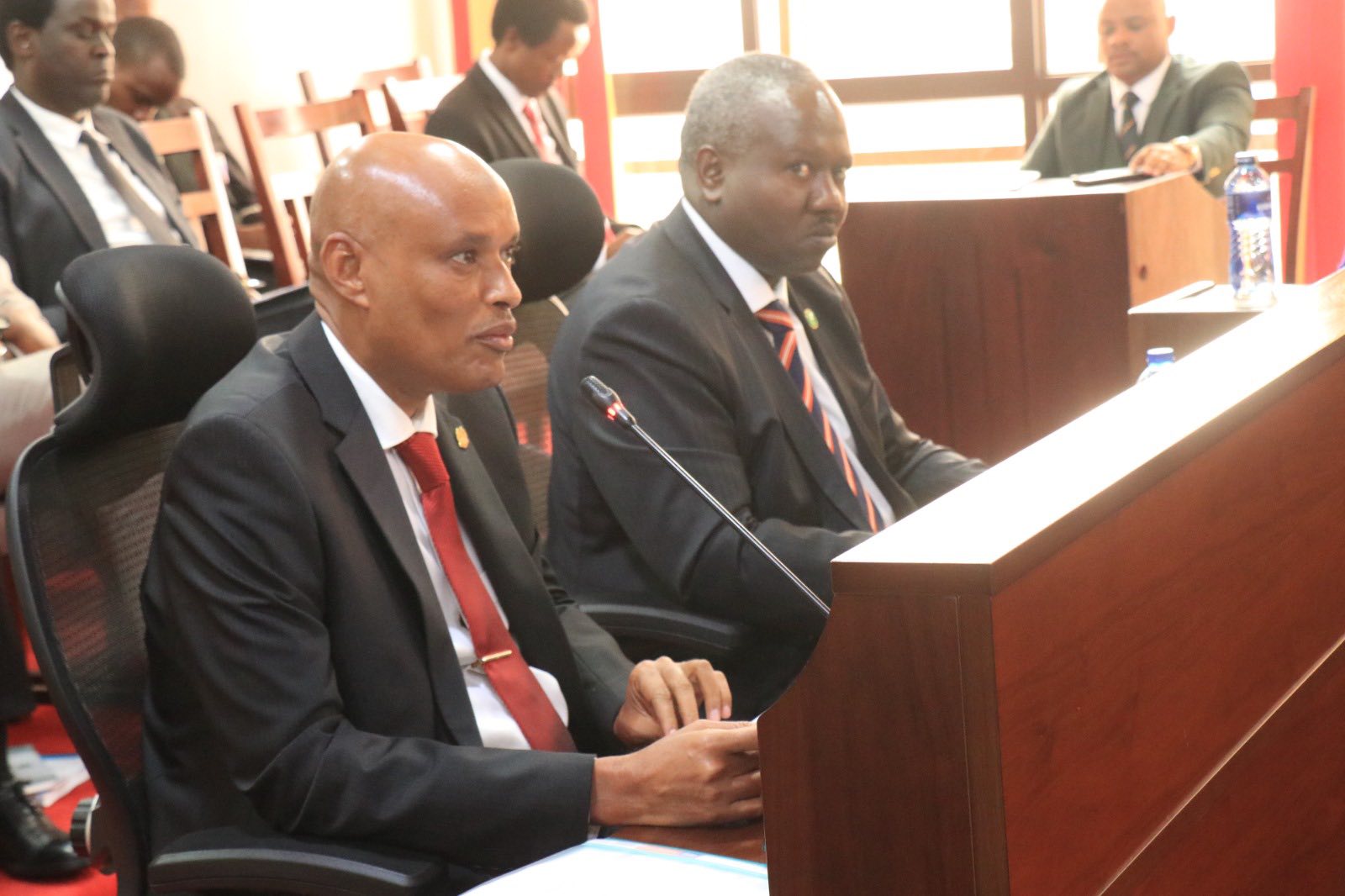
 DCI boss Mohamed Amin and Nacada CEO Anthony Omerikwa before the National Assembly’s Departmental Committee on Administration and Internal Security , April 9 /HANDOUT
MPs have warned that the country risks losing an entire generation of young people to substance abuse unless urgent action is taken to nip the vice in the bud.
The National Assembly’s Departmental Committee on Administration and Internal Security has called for enhanced collaboration between agencies to curb what it described as a fast-growing national crisis.
The MPs said lack of a harmonised legal framework and stronger oversight of law enforcement was fuelling substance abuse among the youth, with lawmakers accusing sections of the police of abetting the vice.
Lawmakers made the observations on Thursday during a meeting with the Directorate of Criminal Investigations (DCI), the National Authority for the Campaign Against Alcohol and Drug Abuse (Nacada), and the Anti-Narcotics Unit (ANU) to discuss the national campaign against substance abuse.
“In the absence of law, then you cannot effectively undertake the fight against alcohol and drug abuse," said Saku MP Ali Rasso, who chaired the committee session.
The National Police Service, in conjunction with Nacada, declared an all-out war against drug and alcohol abuse in late last year, leading to heavy enforcement through nationwide crackdowns on illicit alcohol and narcotics dens.
The crackdowns, targeting illegal distilleries and unregulated alcohol packaging, have resulted in numerous arrests and the destruction of thousands of litres of illicit alcohol and narcotics.
But the committee said, in the absence of a Parliament-sanctioned framework, the interventions lack legal backing.
"In the absence of it being owned by Parliament, then it is not out there. You cannot enforce it,” Rasso said.
Committee members put security agencies, particularly the police, on the spot, blaming the prevalence of alcohol and drug abuse in some areas on rogue officers allegedly enabling drug distribution networks.
Homa Bay Town MP Peter Kaluma cited instances where drug dens operate openly, alleging that some officers guard traffickers and even facilitate the sale of confiscated narcotics.
“My observation is that our police officers are aiding and abetting distribution of drugs. You have a large body of skilled but unemployed young people being destroyed by drug abuse, especially in universities,” he said.
Kisumu West MP Rozzah Buyu warned that all the strategies being discussed would not work if the security actors mandated with their enforcement were being complacent.
“Even when illicit alcohol is confiscated, by morning it is gone, yet it was under police control," Buyu said.
The MPs faulted security agencies for failing to acknowledge internal complicity in their reports and demanded clearer community-level interventions.
“Women are suffering. Children are being killed and raped and this is driven by people under the influence of drugs and alcohol. What exactly are you doing at the community level?” asked Nakuru Woman Representative Elizabeth Chelule.
DCI director Mohamed Amin insisted that the service does not condone criminal conduct, even as he admitted the existence of isolated cases of police complicity in the fight against alcohol and drug abuse.
“Any officer found involved in drugs faces disciplinary and court action,” he said.
Amin said the Anti-Narcotics Unit was being strengthened through vetting and specialised training to handle complex drug networks, which he acknowledged have become more sophisticated because of cross-border trafficking.
He said drug networks now operate across Kenya, Uganda, Tanzania and Ethiopia, necessitating intelligence sharing and stronger regional cooperation.
Anthony Omerikwa, the Nacada chief executive officer, acknowledged policy and legislative gaps, revealing that a national policy guiding alcohol and drug control has yet to be anchored in law.
He attributed the delays to technical and drafting challenges rather than Parliament.
“We stand guided. We will ensure it gets legitimacy and the force of law,” he said.
Data from Nacada and various studies shows that the groups most affected by drug and alcohol abuse in Kenya are young people, particularly those in schools and universities, and young male adults in their productive years.
Youth and young adults (15–35 years) face the highest rates of addiction, with a 2022 survey indicating that one in every 45 youths aged 15–24 is addicted to alcohol.
A 2024 Nacada study reported that alcohol is the most used substance, followed by tobacco, cannabis and synthetic drugs, with a 45.6 per cent lifetime drug use prevalence among university students.
Males are disproportionately affected, with studies finding that 94.5 per cent of them abuse alcohol and hard drugs compared to females.