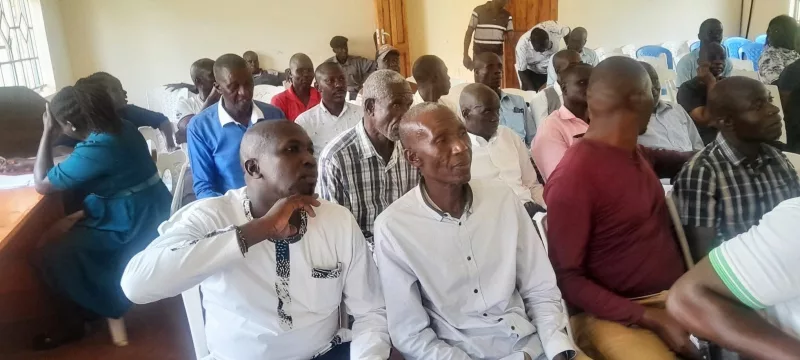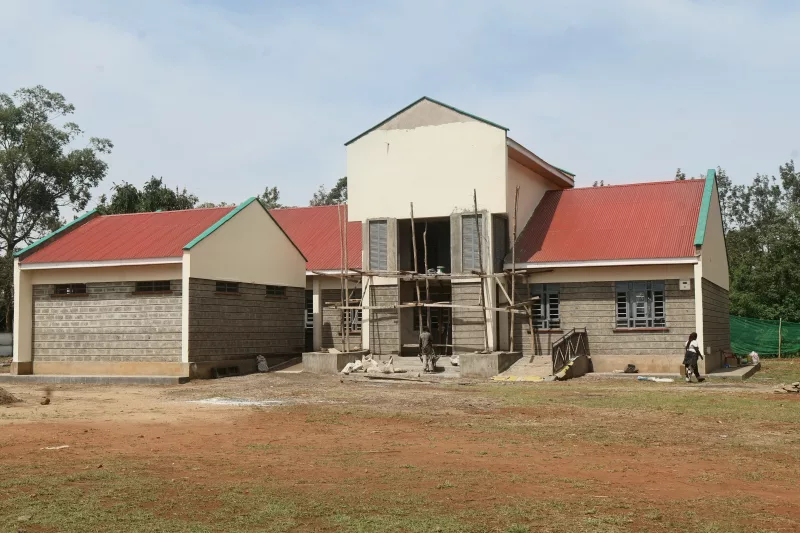
 KISIP County Co-ordinator Kelvin Marangu hands over the Kakamega County Slum Upgrading and Prevention Strategy to Kakamega County Lands and Physical Planning chief officer Eng Ishmael Makanga at the department of Lands in Kakamega on Tuesday /IMAGE /HILTON OTENYO
Read Also
The County Government of Kakamega has developed a 10-year strategic plan to transform slums into safe, dignified and sustainable communities.
The Kakamega County Slum Upgrading and Prevention Strategy (2025–2035) was developed in collaboration with the State Department for Housing and Urban Planning through the Second Kenya Informal Settlement Improvement Project (KISIP II).
It outlines an ambitious roadmap to improve living conditions for an estimated 184,897 people living in 36 informal settlements across the county.
The strategy projects that upgrading informal settlements in the county will cost Sh9.47 billion over 10 years.
Of this amount, Sh5.94 billion will go towards upgrading, while Sh3.54 billion will be used to prevent the emergence of new slums.
Settlements targeted under the plan include Amalemba, Kambi Somali and Mumias.
These areas are characterised by high population density, poor housing and inadequate access to clean water, sanitation, electricity and proper road networks.
Governor Fernandes Barasa noted that the strategy is in line with the 2010 Constitution provisions on adequate housing and sanitation and aligns with national and global frameworks on sustainable urban development.
“This plan proposes a mix of flexible, community-sensitive approaches designed to upgrade settlements while safeguarding residents’ rights and livelihoods,” Barasa said.
“Poor sanitation has contributed to frequent health concerns, while unsafe structures pose daily risks to families,” he added.
Barasa said the absence of legal land ownership in informal settlements further complicates efforts to improve housing conditions.
Residents in the earmarked settlements host people who moved from rural areas in search of better economic opportunities but found themselves trapped in cycles of poverty and underdevelopment due to unplanned urban growth.
Lands and Physical Planning chief officer Ishmael Makanga received the plan on behalf of Governor Barasa.
Makanga said the plan focuses on improving existing homes and infrastructure, such as water supply and road networks, without displacing residents.
This approach, he said, is expected to be widely applied in densely populated areas where relocation may not be feasible.
“In cases where settlements are located in high-risk zones, such as flood-prone areas, the county will carry out resettlement programmes.
This will only be undertaken when necessary through fair and transparent processes that prioritise community participation,” Makanga said.
He added that the plan also introduces incremental upgrading, allowing residents to improve their homes gradually, such as upgrading roofing or drainage systems over time.
In Amalemba settlement scheme, for example, the strategy envisions the installation of water pipelines and sanitation facilities, alongside support for residents to upgrade their homes step by step.
In contrast, communities living in high-risk zones may be relocated to safer areas, with their input guiding the process.
County planners say the broader goal is not only to upgrade existing slums but also to prevent the emergence of new informal settlements through better urban planning and service delivery.
The County Government of Kakamega currently receives Sh141 million yearly from programmes such as KISIP, leaving a funding gap of Sh807 million annually.
To fill the financing gap, the county plans to use its own budget (for example, Sh151 million from municipal funds in 2024-25), partner with the World Bank, UN-Habitat and private companies and increase revenue collection from land rates and garbage fees.
Representing KISIP (II) NPCT Jerioth Maina reaffirmed the national government’s commitment to supporting counties in institutionalising slum upgrading and prevention.
They emphasised that the strategy aligns with the National Slum Upgrading and Prevention Framework while addressing Kakamega county’s unique needs.
Marangu said the strategy provides a practical roadmap for coordinated interventions across the housing, land management and urban development sectors.