Demand for sexual favours by private sector employees is most prevalent in Nairobi, according to a new national survey that highlights patterns of exploitation linked to employment status, income levels and education.
The findings are contained in the 2025 Kenya National Gender and Corruption Survey, commissioned by the Ethics and Anti-Corruption Commission, which examined experiences of corruption and sextortion across both public and private sectors in the country.
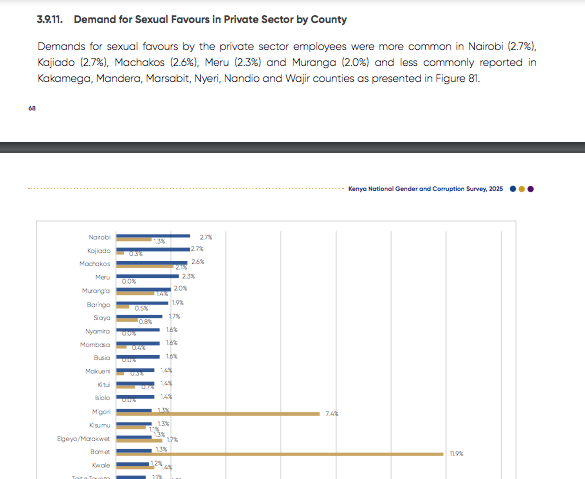
The report shows that Nairobi recorded the highest incidence of reported demands for sexual favours involving private sector employees at 2.7 per cent, tied with Kajiado County.
Other counties with notable prevalence include Machakos (2.6 per cent), Meru (2.3 per cent) and Murang’a (2.0 per cent).
Lower levels of reporting were recorded in Kakamega, Mandera, Marsabit, Nyeri, Nandi and Wajir counties.
The data points to a trend in which reported sexual exploitation is linked to everyday service delivery and employment-related interactions, particularly in urban and peri-urban economic hubs.
According to the survey, respondents were asked to identify the types of services they were seeking at the time they reported being asked for sexual favours.
Half of the respondents said they were seeking employment opportunities, while a quarter had sought medical services from doctors.
Six per cent reported encounters linked to nurses, four per cent in relation to secondary school admissions, and three per cent each for medical insurance and vehicle insurance services.
The findings suggest that sextortion is not confined to one sector but cuts across key services that directly affect livelihoods, health and mobility.
Education level also emerged as a significant factor. According to the report, reported demands for sexual favours involving private sector employees were most common among individuals with secondary education (44.6 per cent), followed by those with primary education (27.9 per cent) and college education (14.6 per cent).
Respondents with no formal education were less likely to report such experiences, with many opting not to disclose whether they had been targeted, a pattern the report attributes to lower confidence in reporting abuse.
The survey further indicates that unemployment and informal employment are associated with higher vulnerability.
Private sector employees were most frequently reported to have made demands for sexual favours from unemployed individuals (38.9 per cent) and those who were self-employed or working in family businesses or farms (35.9 per cent). Domestic workers accounted for seven per cent of reported cases.
Income levels also played a key role, with lower-income respondents more likely to report such experiences compared to higher-income individuals.
The report notes an inverse relationship between income and exposure, suggesting that economic empowerment may reduce vulnerability to exploitation.
“Service seekers with higher income levels were less likely to experience demands for sexual favours, indicating that empowerment reduces vulnerability to exploitation,” the report states.
The findings highlight a broader correlation between sextortion and socioeconomic status, where more economically empowered individuals appear better able to resist or avoid coercive demands.
Marital status also featured in the analysis. According to the report, reported demands for sexual favours involving private sector employees were more common among individuals who were never married (45.7 per cent) and those in monogamous marriages (44.3 per cent).