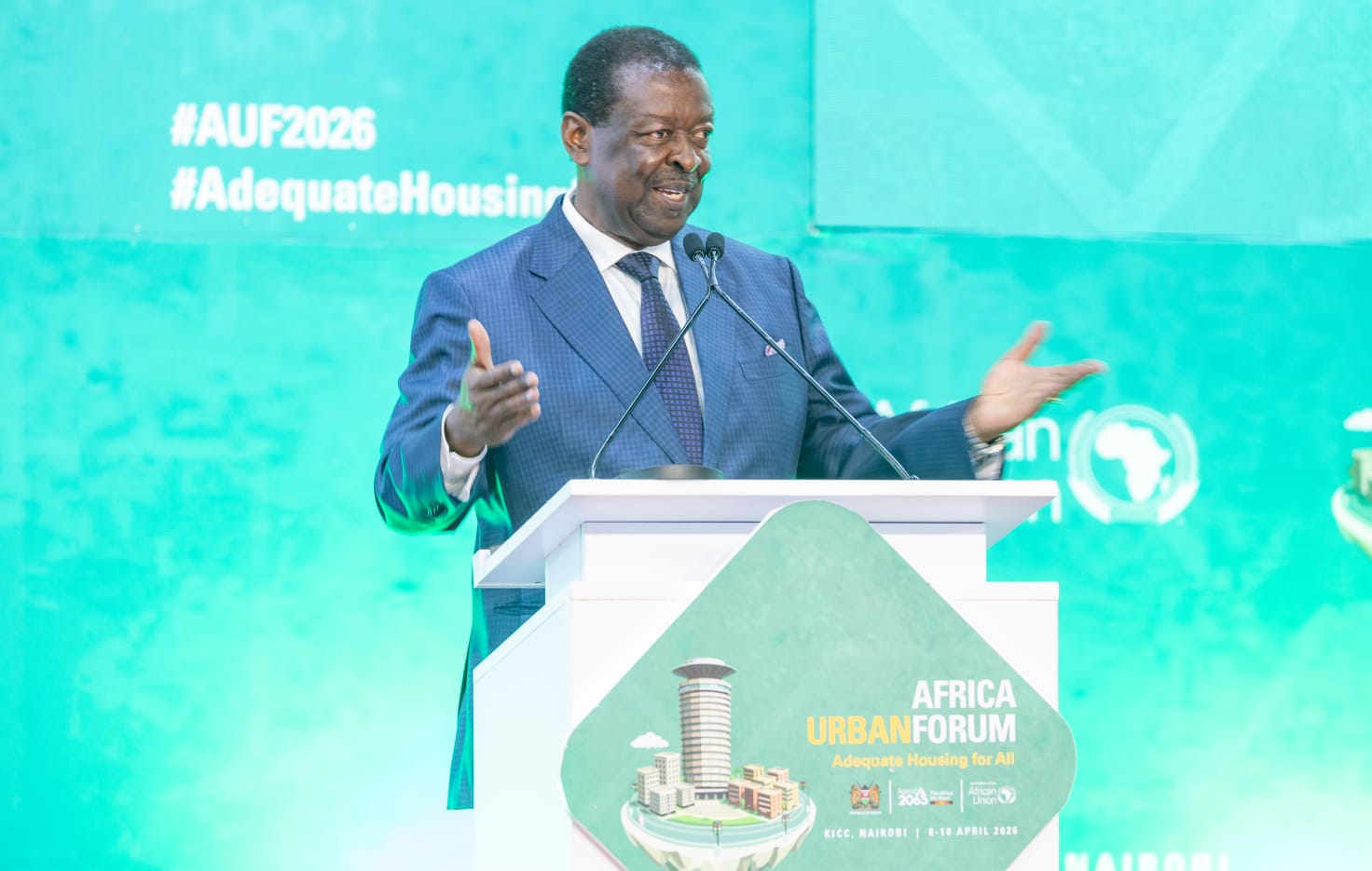
 Prime Cabinet Secretary Musalia Mudavadi at the opening of the Second Africa Urban Forum (AUF2) at the Kenyatta International Convention Centre/OPCS
The call for decisive action on Africa’s growing urban housing crisis took center stage at the opening of the Second Africa Urban Forum (AUF2) at the Kenyatta International Convention Centre.
Prime Cabinet Secretary Musalia Mudavadi, in his address at the meeting, declared that the time for dialogue has passed.
Addressing a packed audience of policymakers, urban planners, and international delegates, Mudavadi delivered a blunt message: “The era of pilot projects and endless conversations about Africa’s urban challenges is over. What we need now is execution—bold, immediate, and scalable action.”
The forum, hosted in Nairobi, comes at a critical time as Africa’s urban population is projected to reach 1.4 billion by 2050. Mudavadi warned that without urgent intervention, cities across the continent risk becoming overwhelmed by unplanned growth, inadequate infrastructure, and deepening inequality.
“We are standing at a tipping point,” he said. “If we fail to act now, unmanaged urban expansion will erode economic gains and worsen living conditions for millions. But if we act decisively, our cities can become engines of prosperity.”
Mudavadi pointed to Kenya’s Affordable Housing Programme as an example of the difficult but necessary choices governments must make.
“It has taken courage—sometimes unpopular and painful decisions—to push this agenda forward,” he admitted. “But the alternative is far worse. We cannot afford to let our cities grow without structure, without dignity, and without opportunity.”
A major highlight of the forum was the emphasis on integrating technology into urban development, with Konza Technopolis presented as a model for the continent’s future cities.
State Department for ICT and the Digital Economy PS John Kipchumba Tanui presented a roadmap for Africa’s urban transition, noting that with the continent’s urban population set to double to 1.4 billion by 2050, a "new paradigm" is required.
Addressing a 50-million-unit housing deficit, Tanui argued that traditional methods are insufficient.
“Technology must serve as a catalytic lever to ensure urbanisation leads to healthier cities and stronger economies,” he said.
Tanui positioned Konza as a living laboratory for homegrown, scalable solutions that prove Africa can leapfrog traditional developmental pathways.
During a high-level session on artificial intelligence and smart cities, Konza Technopolis CEO John Paul Okwiri outlined an ambitious vision for the so-called “Silicon Savannah.”
“Konza is not just about technology; it is about people,” Okwiri said. “Africa’s housing deficit is not simply a shortage of buildings; it is a failure of integration. Housing must be connected to services, infrastructure, and governance systems.”
He explained that Konza has been designed as a fully integrated smart ecosystem, where AI-powered systems streamline service delivery, enhance transparency, and reduce inefficiencies. “We are building a city where technology works quietly in the background to improve everyday life, from smart billing systems to efficient urban planning,” he added.
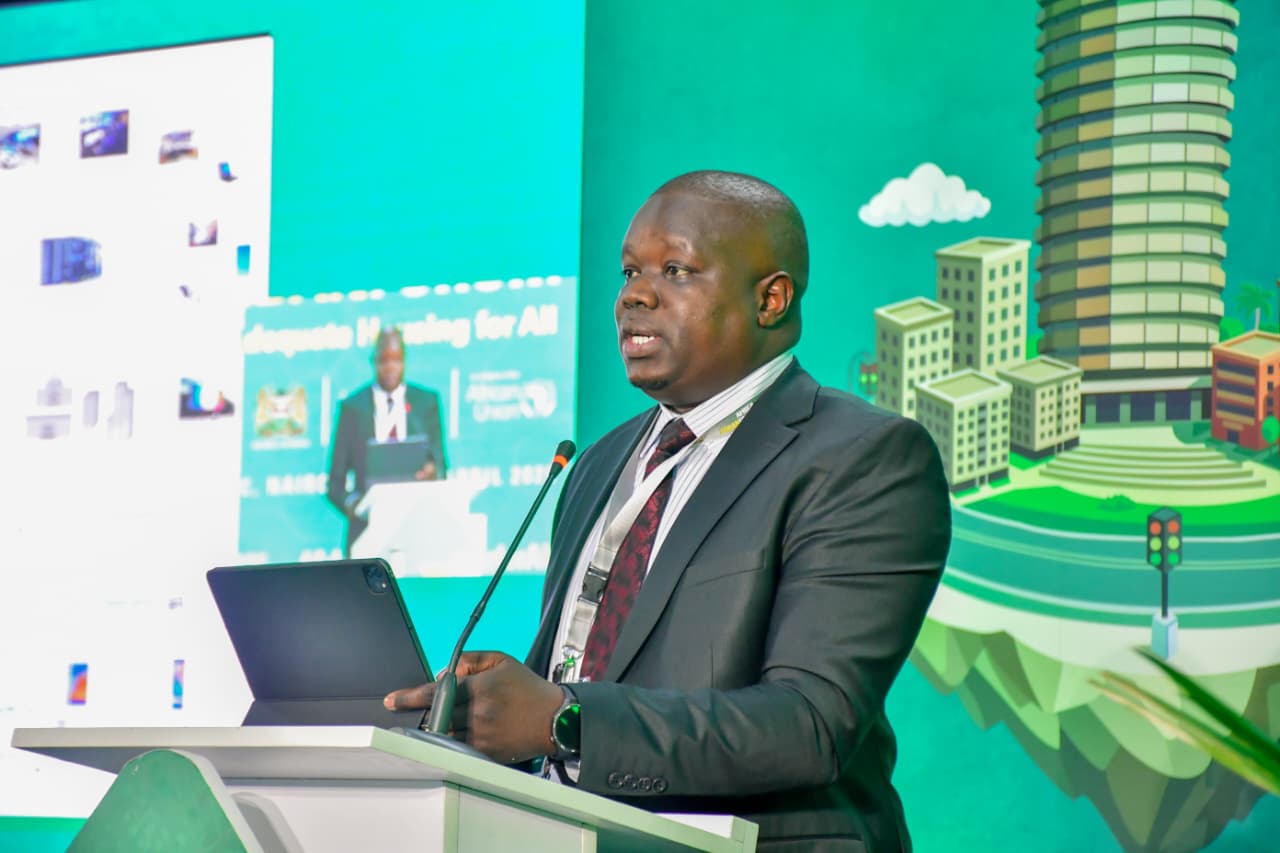 Konza Technopolis CEO John Okwiri at the opening of the Second Africa Urban Forum (AUF2) at the Kenyatta International Convention Centre/HANDOUT
Okwiri revealed that Konza is expected to attract over US$15.5 billion (Sh2 trillion) in investment and generate an annual economic output of US$1 billion (Sh129 billion). The city is planned to accommodate 240,000 residents, with scalability to support up to 3.6 million people in the wider metropolitan area.
“Our goal is to create a model that can be replicated across Africa,” he said. “Digital-first governance ensures that technology reduces inequality rather than deepening it.”
The forum also drew key Kenyan leaders, including Nairobi Governor Johnson Sakaja and Lands Cabinet Secretary Alice Wahome, both of whom echoed the urgency of integrated urban planning.