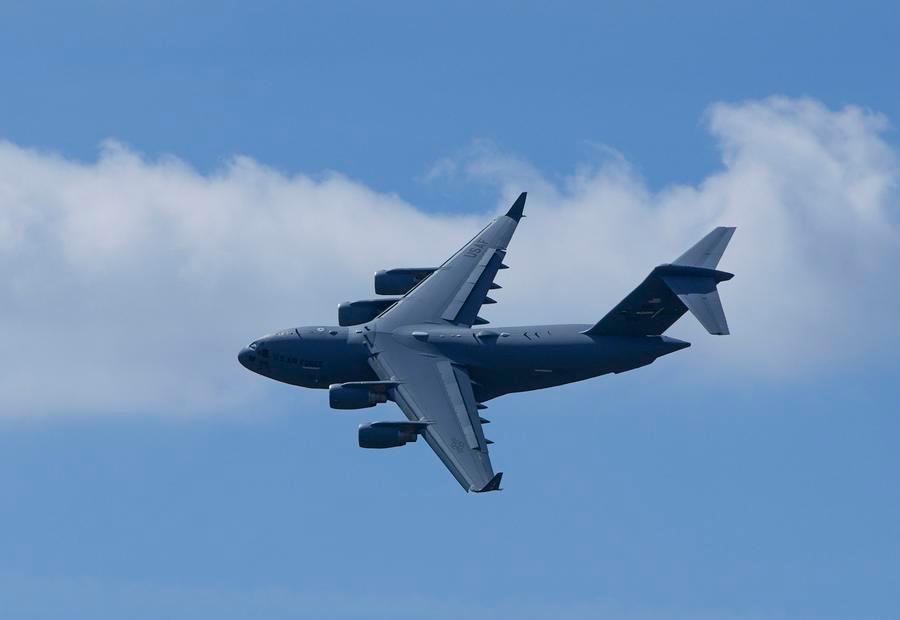
 A U.S. Air Force C-17 Globemaster III makes an aerial demonstration during the 2023 Abbotsford International Airshow in Abbotsford, British Columbia, Canada, on Aug. 12, 2023. (Photo by Liang Sen/Xinhua)
In a detailed report, the United Nations Conference on Trade and Development (UNCTAD) forecasts the global merchandise trade to expand by just 1.5 to 2.5 per cent in 2026, a steep drop from the 4.7 per cent growth recorded in 2025.
The slowdown is largely attributed to the escalating conflict in the Middle East, particularly disruptions along the Strait of Hormuz, one of the world’s most critical shipping corridors for oil and gas.
In a report, the UN trade agency says that the disruption has sent oil and gas prices sharply higher, feeding inflationary pressures worldwide and raising production and transport costs for businesses.
“This, in turn, is weakening global demand and slowing trade momentum.”
The UNCTAD notes that the strait, which handles a significant share of global energy flows, is now “practically closed,” severely constraining maritime traffic and triggering a supply shock in global markets.
“What began as a disruption in a key energy corridor is now feeding through the entire global economy,” the agency warned, underscoring how quickly localised conflict can morph into a systemic economic risk.
On Monday, global prices edged up further after the US President, Donald Trump, threatened to hit major energy infrastructure in Iran on April 7 (tomorrow) if the Islamic nation fails to sign a ceasefire deal and open the Strait of Hormuz.
A barrel of Brent oil was trading at $108.58 in the international market by the time of going to press, with experts warning that the situation is likely to worsen.
The report highlights that developing countries are bearing the brunt of the crisis. Rising energy costs, coupled with investor pullbacks, are putting pressure on currencies and increasing borrowing costs.
The UN body is worried that capital flight from emerging markets is intensifying financial stress, with weaker currencies making imports more expensive and external debt more burdensome.
This report comes as the Nairobi Securities Exchange (NSE) shows investors lost Sh343 billion in paper wealth in March alone, as foreign investors shift to more stable markets.
At the same time, higher fuel prices are pushing up the cost of living, disproportionately affecting vulnerable populations.
Beyond trade, the broader global economy is also expected to slow.
The trade body projects global GDP growth to ease to about 2.6 per cent in 2026 from 2.9 per cent in 2025, reflecting weaker demand and heightened uncertainty.
The agency warns that any prolonged disruption in the waterway has immediate and far-reaching consequences, from energy markets and shipping routes to food security and industrial production.
It has called for urgent diplomatic efforts to stabilise the region, warning that prolonged disruption could deepen global economic hardship.
“At a moment of heightened fragility, de-escalation and the restoration of stability are essential,” the report notes, cautioning that the longer the conflict persists, the more entrenched its economic consequences will become.