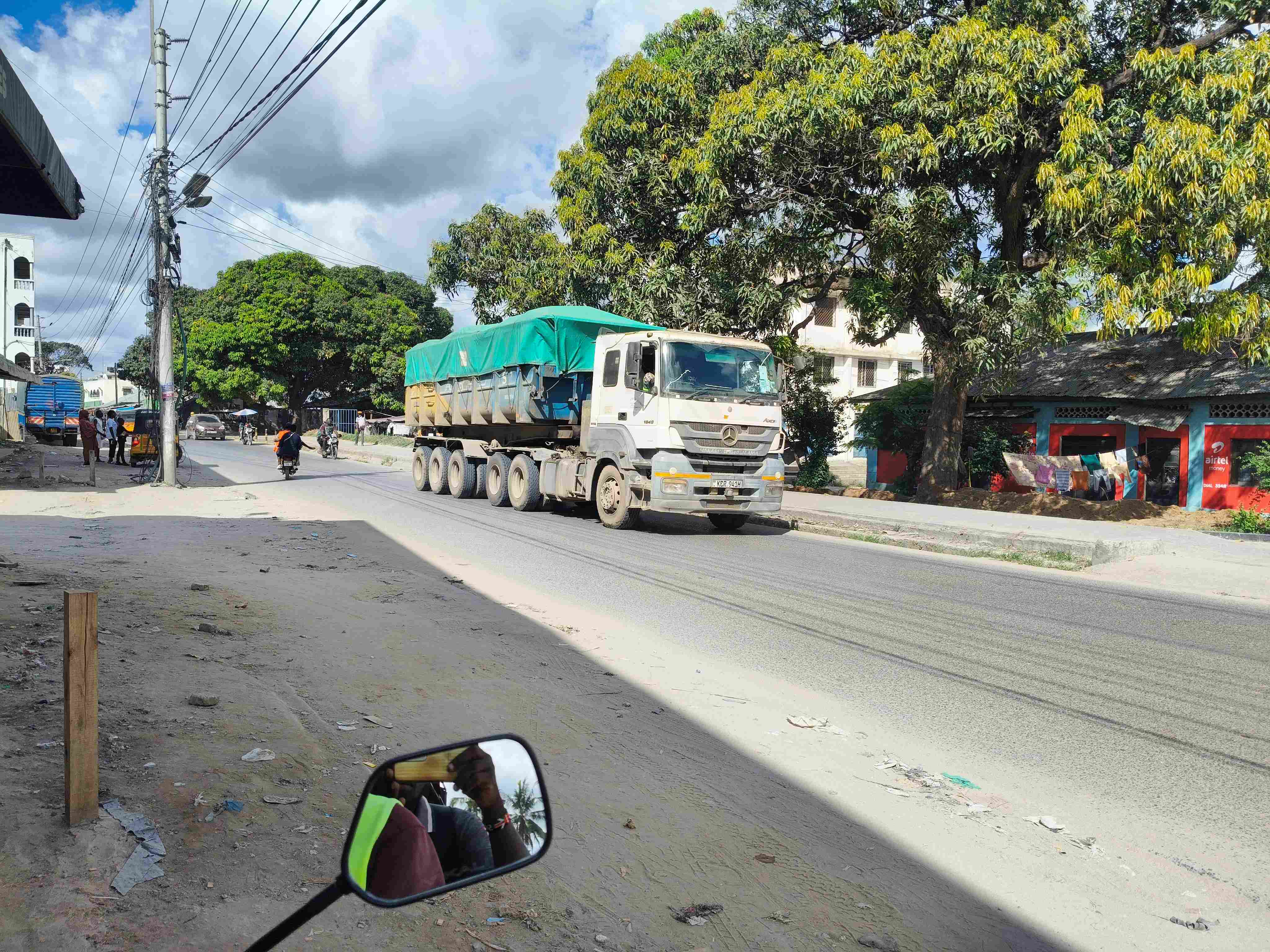
 A truck using the Old Malindi road at Mwandoni
Ndogo heading towards Bamburi / BRIAN OTIENO
A truck using the Old Malindi road at Mwandoni
Ndogo heading towards Bamburi / BRIAN OTIENO
The Mombasa county government has temporarily restricted the movement of heavy trucks in Mombasa, especially during peak hours, to ease traffic congestion.
This is particularly the case on the northern mainland side of the county, where traffic jams have become unbearable.
County transport executive Dan Manyala has gazetted restrictions on trucks weighing more than 10 tonnes for the period between April 3 and July 1.
“These trucks will not be allowed on the roads during peak hours,” he said on Friday.
The gazette notice was issued on March 31.
Peak hours refer to the period between 6am and 9.30am and from 3.30pm to 8pm.
The movement of heavy commercial vehicles above 10 tonnes will be restricted on nine roads during peak hours for the specified period.
These include Nyali Bridge, Fidel Odinga Road, Links Road, New Malindi Road, Old Malindi Road, Zakhem Road, Dr Felix Road, Mt Kenya Road and Ras Kisauni Road.
These are the roads the trucks are not allowed to use during peak hours.
“We are all aware that New Malindi Road is being upgraded, so all traffic that should use that road is being diverted at Kenol onto Links Road,” Manyala said.
“This has caused a lot of pressure on motorists using Links Road because of the congestion caused.”
He called for cooperation between county traffic marshals, traffic police, drivers and other road users for the plan to succeed.
Matatu operators have welcomed the move, saying they usually experience a lot of stress due to heavy commercial vehicles during peak hours.
Rashim Makame, a matatu driver for more than 20 years, said passengers during peak hours often give them stress.
"They do not want to be delayed, forgetting that we do not control of the number of vehicles on the road. Their pressure is what leads many matatu drivers to look for alternative routes whenever there is a slight jam. Then they brand us reckless,” Makame said.
He noted that when they find themselves behind a heavy commercial vehicle during peak hours, it becomes extremely difficult for them.
"That is when we hear the voice of every passenger we carry in the matatu. They put a lot of pressure on us to overtake the truck, which they say delays them,” Makame said.
He said the restriction is a welcome move by the county but faulted the time period.
"What happens after July 1? Will there be no more heavy commercial vehicles on the roads? What happens then? Will things go back to normal?” Makame posed.
However, Manyala said this is a temporary measure as the county seeks a permanent solution to the traffic problem.
“We believe that by then the construction works on New Malindi Road will be complete and the road will be fully open for use. We believe this will greatly ease traffic congestion as we seek other ways to manage traffic,” the county executive said.
INSTANT ANALYSIS
Traffic jams in Kenya are estimated to cost the economy about $1 billion (about Sh130 billion), with losses exceeding Sh50 million daily. These gridlocks cause significant economic strain through wasted fuel, lost productivity and increased operational costs for commuters and businesses.