
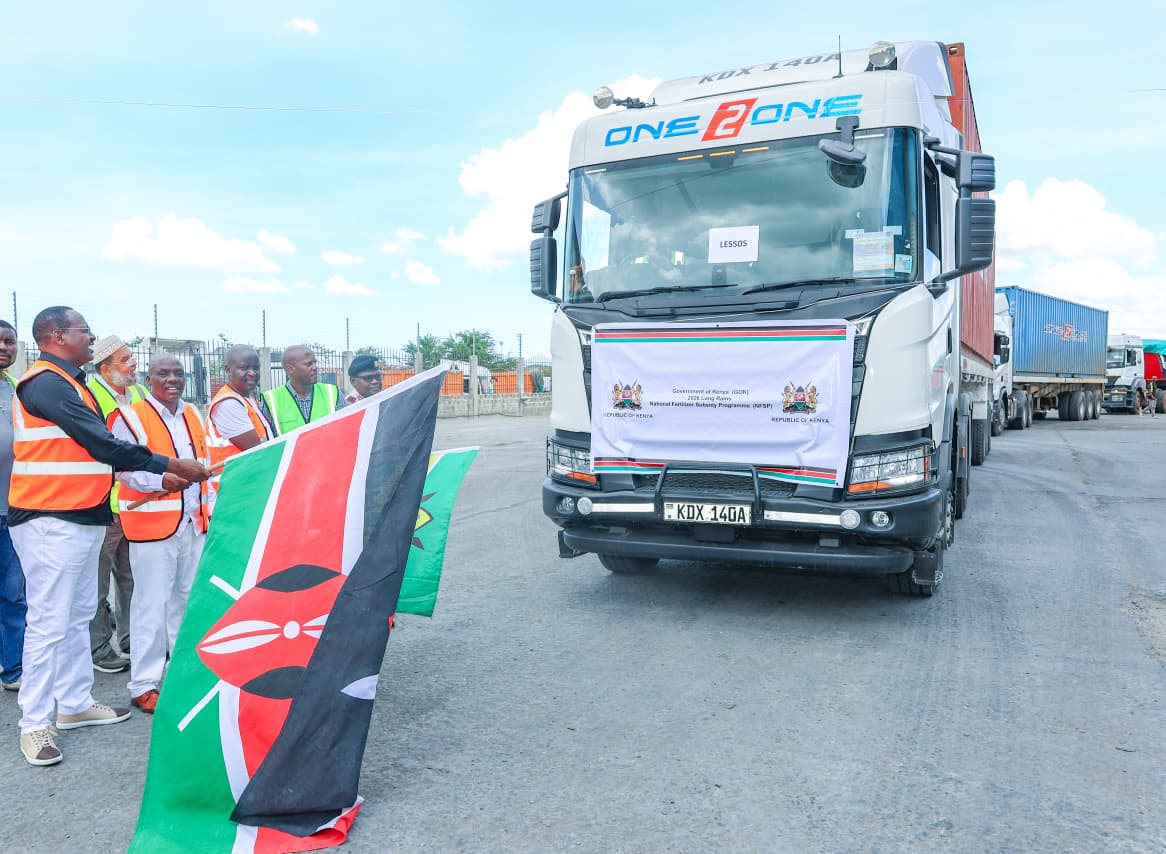
 Agriculture PS Paul Ronoh flags off the two million bags of fertiliser at the Port of Mombasa.
 After weeks of delays linked to the Middle East war, fertiliser has arrived in the country as the planting season begins.
Agriculture PS Paul Ronoh on Tuesday flagged off two million bags of fertiliser at the Port of Mombasa, marking the start of nationwide distribution expected to benefit more than six million farmers.
The fertiliser will be available through 354 National Cereals and Produce Board (NCPB) depots, cooperative societies and certified Kenya Tea Development Agency (KTDA) centres across the country.
The delayed arrival had raised concern among farmers, as global shipping disruptions forced vessels to reroute via South Africa, slowing delivery timelines.
With the long rains already underway, many farmers had planted and were anxiously awaiting the subsidised input, retailing at Sh2,500.
In some areas, farmers camped at NCPB depots in anticipation, hoping to access fertiliser in time to safeguard their crops from poor growth and low yields.
PS Ronoh assured farmers the consignment would be distributed to depots nationwide within the week, enabling them to proceed with crop production.
He said some regions, particularly in the North Rift, had already begun receiving supplies.
“We are confident that farmers will now access adequate fertiliser and continue with their farming activities without further disruption,” he said.
To accelerate access, the PS directed NCPB depots to operate on weekends and public holidays.
The State Department for Agriculture has also partnered with transporters and the Kenya Railways Corporation to ensure efficient movement of the consignment across the country.
He further revealed the government is developing contingency plans for next year’s fertiliser subsidy programme to cushion farmers against similar global supply shocks.
Ronoh also praised farmers for embracing crop diversification, noting a shift towards high-value crops such as coffee, avocados and macadamia, which are expected to boost household incomes and strengthen the economy.
At the same time, the government issued a warning to unscrupulous dealers attempting to exploit farmers by inflating fertiliser prices beyond the set subsidy.
“We have identified individuals engaging in malpractice, including falsifying land data. Our systems have flagged them, and action will be taken,” he warned.
National Assembly Agriculture Committee chairperson John Mutunga urged farmers to avoid middlemen, emphasising that mechanisms are in place to ensure direct access to fertiliser and seeds through NCPB depots.
He also dismissed political claims surrounding fertiliser shortages, noting that more than seven million bags have been distributed this year, and called on the Kenya Seed Company to fast-track subsidised seed distribution following the release of Sh2 billion by the government.
Soy MP David Kiplagat criticised the politicisation of the fertiliser programme, highlighting that the government had reduced prices from Sh7,000 to Sh2,500.
He also raised concern over delays in lowering certified seed prices, giving the Kenya Seed Company a two-day ultimatum to comply.
“They must act swiftly or face consequences,” he said.