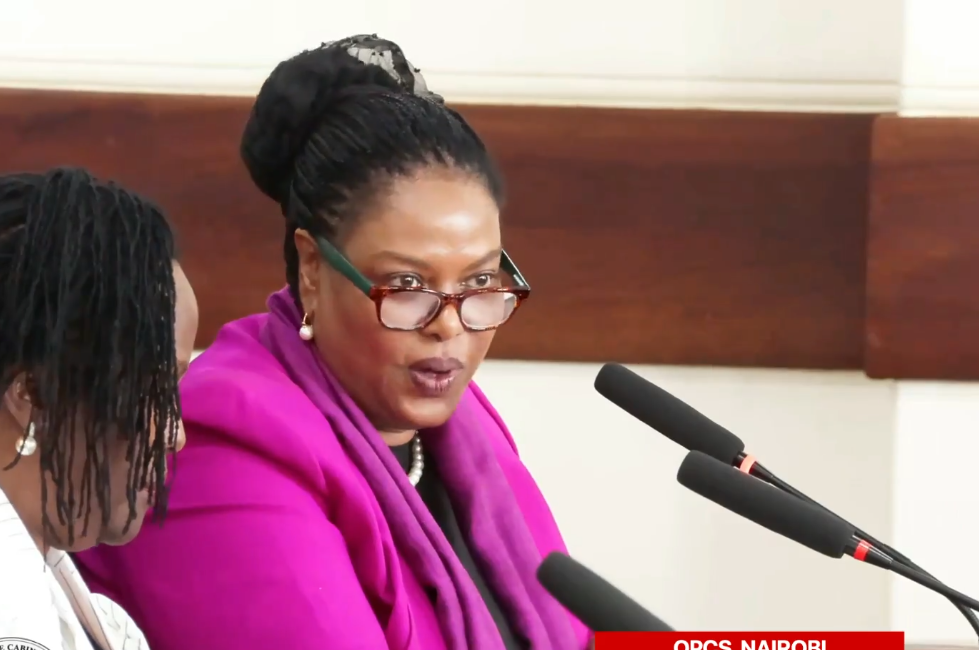
 Supreme Court Judge Njoki Ndung'u/OPCS SCREENGRAB
Supreme Court Judge Justice Njoki Ndung’u has outlined her vision for the International Criminal Court (ICC) if elected.
Her remarks follow her nomination by President William Ruto for the ICC election
Speaking during a meeting with Prime Cabinet Secretary Musalia Mudavadi and Chief Justice Martha Koome on Thursday, Ndung’u started by saying Kenya needs representation at the ICC and has valuable lessons to share with the international justice system.
“In terms of policy and strategy, it is clear to me that the ICC is a place where we ought to have representation again,” she said.
She said Kenya’s legal experience, post-conflict reforms, and judicial expertise have the potential to strengthen the global court significantly.
Ndung’u noted that Kenya’s experience as a signatory to the Rome Statute and as a litigant before the ICC has played a key role in shaping the court’s jurisprudence, particularly in areas of procedure, evidence, and witness management.
She said the ICC initially relied heavily on civil law procedures, but Kenyan cases helped introduce elements common in democratic legal systems, influencing how the court handles evidence, witnesses, and trial processes.
“Because of Kenyan cases, the procedure in the ICC system has changed a lot, especially in how they look at evidence, witnesses, and court processes,” she said.
According to the judge, the nation has developed strong judicial practices that can be shared through judicial diplomacy, particularly in areas of victims’ rights, reparations, and post-conflict justice.
Ndung’u pointed to Kenya’s experience following the 2007 post-election violence, adding that the country introduced constitutional and institutional reforms that can help other nations prevent future conflicts.
She highlighted mechanisms such as the Truth, Justice and Reconciliation Commission (TJRC), the National Cohesion and Integration Commission (NCIC) and the broader constitutional reforms, noting that such institutions help strengthen national stability and conflict prevention.
“There is a lot we can share from Kenya in terms of processes after the 2007 crisis,” she said, adding that it is the responsibility of state parties to the ICC to contribute to global justice efforts.
Ndung’u also outlined her professional background, noting that many Kenyans may know her as a Supreme Court judge and former legislator who championed the Sexual Offences Act.
However, she said fewer people are aware of her earlier international experience, which has shaped her understanding of global justice and judicial work.
Before joining Parliament, she said she worked as a political analyst at the African Union’s Conflict Management Centre, where she was involved in early warning systems and peace-building strategies.
She later moved to the human rights division, where she contributed to the development of the Maputo Protocol, a key African Union instrument on women’s rights.
“I dare say that the first draft of the Maputo Protocol that was ever discussed formally in the African Union came from my computer,” she said.
Ndung’u also outlined her experience with the United Nations High Commissioner for Refugees in Kenya as a protection officer, handling refugee protection cases involving populations from Somalia, Ethiopia, Sudan, Rwanda, and Burundi.
Her work included assessing refugee claims and supporting women who were victims of violence and displacement, she said.
The judge added that this experience closely aligns with the International Criminal Court’s focus on victims, particularly in cases involving sexual and gender-based violence.
“The issue of sexual and gender-based violence as part of war crimes is something that the ICC looks at, and I bring that experience,” she said.
She thanked President William Ruto for nominating her for the ICC position and pledged to represent Kenya with integrity and professionalism if elected.
Prime Cabinet Secretary Musalia Mudavadi praised the judiciary for earning respect locally and internationally, saying Kenya has the capacity to produce strong candidates for global assignments.
“You have done your best as a judiciary and earned respect both in Kenya and globally. In this spirit, we believe you can also produce some of the finest for international assignments,” Mudavadi said.
He cited the nullification of the presidential election back in 2017 as a demonstration of judicial independence, noting that Kenya’s judiciary has built credibility on the global stage.
Chief Justice Martha Koome said Kenya’s ICC candidature is part of a broader effort to offer the country’s legal expertise to the international community.
“We are not just seeking a seat at the ICC, but offering leadership, expertise and skill as a public good to the world,” Koome said.
She noted that Kenya’s judiciary continues to attract delegations from across Africa and beyond seeking to benchmark on its operations, adding that the country stands at the intersection of global south realities and international legal systems.
“I find Kenya is at an intersection where we are a bridge between global south realities and legal systems, and we have something to offer to the international community,” she said.
Koome described Ndung’u as a rare combination of legislator, jurist and human rights leader, noting that her role in crafting the Sexual Offences Act and her judicial work demonstrate strong jurisprudence and commitment to fair trial and justice.
She assured the government that the judiciary is ready to support the diplomatic process required to secure the ICC position, acknowledging Mudavadi’s role in guiding the international campaign.
The meeting marked the formal strategic engagement aimed at advancing Kenya’s ICC candidature, with officials expressing confidence that Ndung’u’s experience in human rights, conflict resolution and judicial leadership positions her strongly for the international role.
The elections are slated to take place during the 25th session of the Assembly of States Parties scheduled to be held in New York from December 7 to December 17, 2026.
The process will see states parties elect six judges to the ICC bench.