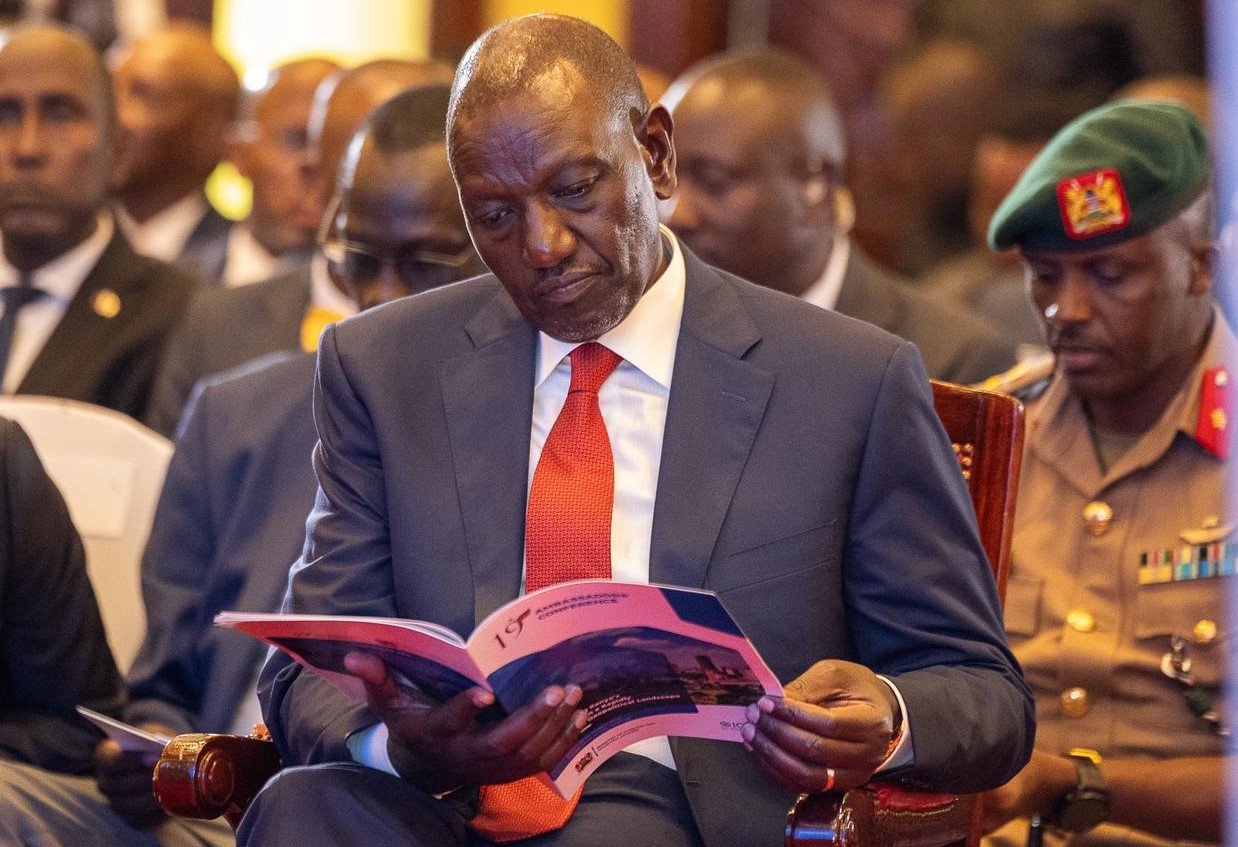
 President William Ruto/PCS
President William Ruto has announced an ambitious plan to tarmac 28,000 kilometres of roads in the next 10 years as part of a broader infrastructure push aimed at transforming Kenya into a first-world economy.
Speaking during the 19th Ambassadors and High Commissioners Conference in Nairobi on Saturday, Ruto said the government is scaling up investments in infrastructure and connectivity to expand the country’s road network and improve transport efficiency.
He noted that road development remains a key concern for many Kenyans, often dominating public engagements across the country, and stressed the need for a comprehensive approach rather than piecemeal projects.
“If you go to any meeting in Kenya, somebody will ask you about a road — this road, that road, and the other road. We cannot continue discussing 10 kilometres here and 20 kilometres there. We just have to have a comprehensive plan and do it,” Ruto said.
The President pointed to global examples to emphasise the scale of ambition, noting that Japan had tarmacked nearly one million kilometres of roads over six decades, highlighting the need for Kenya to significantly accelerate its infrastructure development.
According to Ruto, the government plans to construct at least 2,500 kilometres of dual carriageways and 28,000 kilometres of additional roads over the next seven to ten years.
This is while modernising rail systems and upgrading airports and seaports to position Kenya as a regional trade and logistics hub.
"We want to tarmack another 28,000 kilometers in Kenya in the next 10 years. And it's possible, and we're going to do it. If you go to any meeting in Kenya, somebody will ask you about a road," he stated.
The President added that improving port infrastructure, including facilities at the Port of Mombasa, will be critical in supporting the country’s economic growth and enhancing efficiency in cargo movement.
The infrastructure programme is part of a broader development strategy that also targets the expansion of energy capacity from the current 3,300 megawatts to at least 10,000 megawatts to support industries, innovation, and inclusive economic growth.
Ruto further revealed that the government plans to invest heavily in water and agricultural infrastructure, including the construction of at least 50 mega dams and more than 1,000 micro and small dams to boost irrigation and strengthen long-term water security.
“This is the scale of our ambition. We estimate that these investments will require substantial and sustained financing of at least Sh5 trillion ($40 billion).” he said, noting that the country must accelerate development to meet its economic transformation goals.
To support the programme, Ruto said the government has established a National Infrastructure Fund aimed at attracting long-term capital from both domestic and international investors to finance large-scale projects.
Ruto expressed confidence that the funding will be secured, adding that the government is committed to delivering the projects and improving infrastructure across the country.