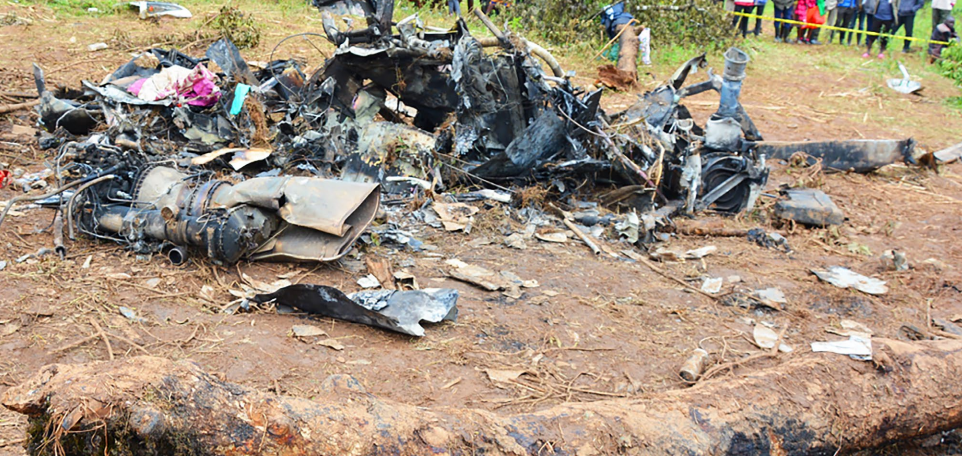
 A photo of the main wreckage site/SCREENSHOT
A preliminary investigation report has revealed the final moments of the helicopter crash that claimed the life of Emurua Dikirr MP Johanna Ng’eno and five others in Chepkiep, Mosop Sub-county, Nandi County, on February 28, 2026.
It notes that the aircraft encountered thick fog, drizzle and extremely low visibility shortly before the crash.
According to the report, the Airbus AS350 B3 Ecureuil helicopter was on a Visual Flight Rules commercial passenger charter flight with one pilot and five passengers on board.
The helicopter had departed Wilson Airport in Nairobi at 8:04 am and made several stopovers in Narok, Trans Nzoia and Uasin Gishu counties, including Emurua Dikirr, Mara Rianta, Endebess and Eldoret Boma airstrip, with all earlier flights reported to have been uneventful.
Investigators established that the helicopter departed Endebess at 12:43 pm with six people on board, heading to Emurua Dikirr.
About 37 minutes into the flight, at around 1:20 pm, the helicopter landed in an open field at Tabolwa in Mosop Sub-county due to reduced visibility caused by thick fog and drizzle.
Eyewitnesses told investigators that the helicopter hovered around the area for about 10 minutes before flying low beneath high-voltage power lines and tall trees before landing in an open space.
The report states that the aircraft remained on the ground for about five minutes with the engine running, and none of the occupants disembarked.
At about 1:25 pm, the helicopter took off again amid thick fog and low clouds and disappeared from sight almost immediately.
“A minute later, locals heard an impact and rushed towards the direction where they found the helicopter had collided with terrain across a ridge in a forested area approximately 200 metres from the take-off point,” the report states.
Five occupants died on the spot, while the sole survivor, who sustained serious injuries, succumbed about 30 minutes later despite attempts by a trained nurse to resuscitate him at the crash site.
Investigators established that the helicopter first struck rising terrain before the main rotor blades hit and uprooted two trees at heights of about 3.36 metres and 5 metres above ground level, indicating a high-energy impact.
The helicopter was destroyed by impact forces and a post-crash fire, with wreckage scattered up to 90 metres from the main impact site.
The report indicates that at the time of the accident, Instrument Meteorological Conditions existed in the area, with visibility reported to be less than 20 metres and low cloud cover at about 1,000 feet above ground level.
Aircraft records reviewed by investigators showed that the helicopter had a valid maintenance certification, no deferred defects and sufficient fuel, with weight and balance within prescribed limits.
The investigation further established that key aircraft components, including the digital engine control unit, engine multifunction display and GPS unit, were recovered and sent to France for analysis to help determine the probable cause of the crash.
Autopsies conducted on all six victims showed injuries consistent with the crash, while toxicological tests on the pilot are ongoing at the Government Chemist.
The emergency locator transmitter signal was received at impact, but it did not provide location data, prompting rescue teams to rely on information from members of the public to locate the crash site.
The report notes that the accident was not survivable and confirms that there was no fire engine response from the local government.
Investigators have recommended that the Kenya Civil Aviation Authority require helicopter operators to establish and implement strict operational and weather-related flight limits.
This includes clear go or no-go decision-making procedures, to reduce accidents linked to poor weather, terrain and operational risks.
The Aircraft Accident Investigation Department said investigations are ongoing and the final report will determine the probable cause of the accident.