 Jessey Maruti, the ICT Authority CEO, speaking to the press. /STEPHEN
ASTARIKO.
Jessey Maruti, the ICT Authority CEO, speaking to the press. /STEPHEN
ASTARIKO.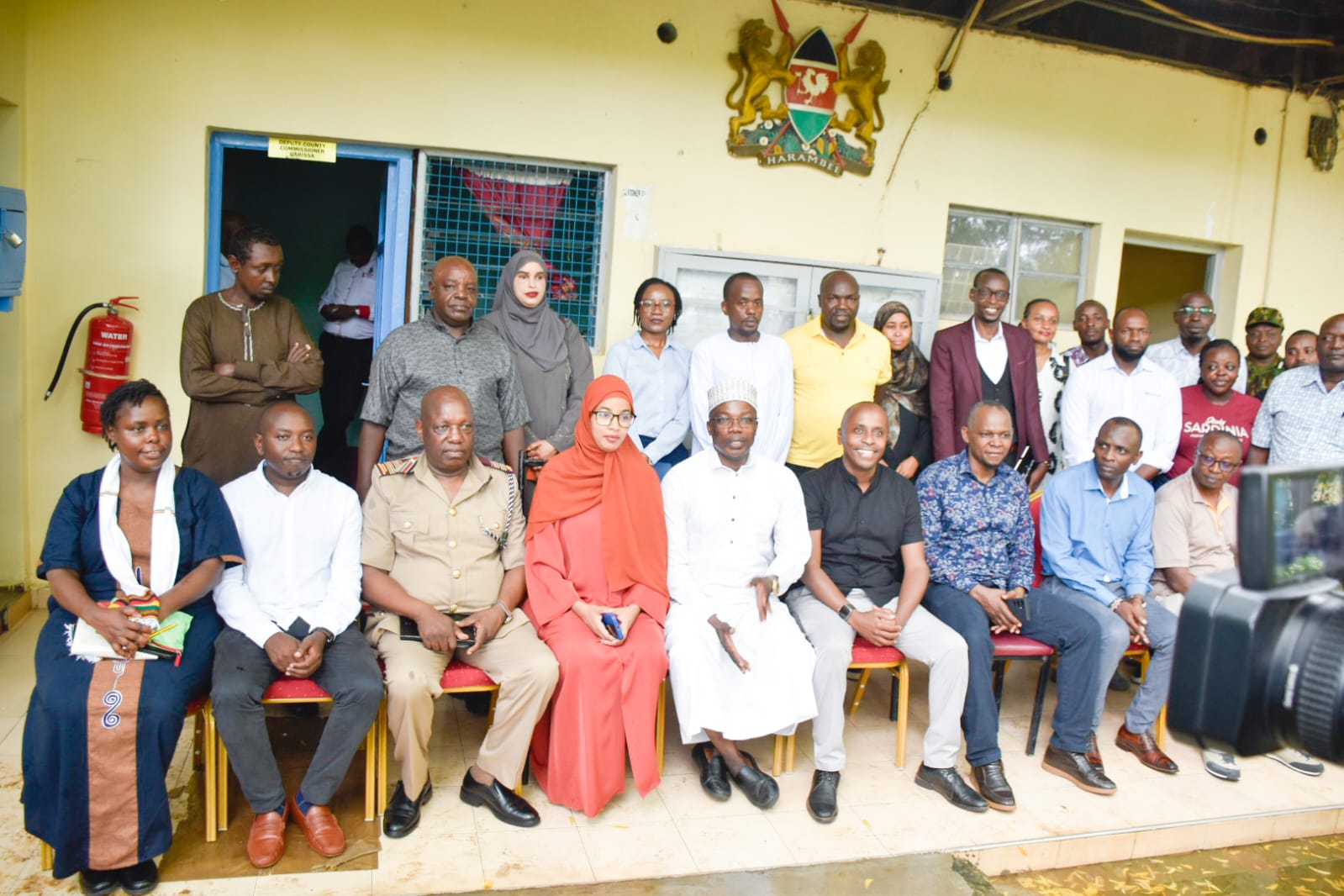 Leaders pose for a group outside the Garissa county
commissioner’s office./STEPHEN ASTARIKO.
Leaders pose for a group outside the Garissa county
commissioner’s office./STEPHEN ASTARIKO.
Leaders from across Kenya’s ICT sector have reaffirmed the government’s commitment to transforming digital access in northern Kenya.
The focus will be on using existing electricity infrastructure to deliver widespread internet connectivity.
 National Assembly Committee Vice Chair on Communication, Information and Innovation Alpha Miruka. /STEPHEN ASTARIKO.
Speaking on Friday during a fact-finding mission in Garissa Township and Lagdera sub-counties, National Assembly Committee Chair on Communication, Information and Innovation, John Kiarie, said the government will rely heavily on Kenya Power infrastructure to roll out connectivity to underserved areas.
Kiarie was accompanied by committee members, officials from the Ministry of ICT, and agencies such as the Communications Authority of Kenya and the ICT Authority.
They emphasized that the plan to deliver 25,000 public Wi-Fi hotspots nationwide will be accelerated by “piggybacking” on electricity lines owned by Kenya Power and Lighting Company (KPLC), allowing fiber optic cables to reach even the most remote parts of the country.
 ODM nominated MP Umulkheir Harun speaking to the press. /STEPHEN ASTARIKO.
Kiarie explained that instead of the costly and slow process of digging trenches, the government is leveraging existing power lines to carry fiber, significantly speeding up internet expansion.
This innovation, he said, is already proving effective in connecting far-flung regions like Garissa.
“We are in Garissa to assess progress, identify gaps, and inform future policy and legislation. Our mission is to take stock of connectivity progress, but also identify areas that still need development,” Kiarie said.
He said the initiative ties into the broader Kenya Digital Master Plan aimed at nationwide coverage.
 Garissa County Commissioner Mohamed Mwabudzo. /STEPHEN ASTARIKO.
Committee Vice Chair Alpha Miruka underscored that internet connectivity is now a top government priority under the digital superhighway agenda.
He said efforts are being made to push access down to the village level through coordinated national programs and constituency-based digital hubs.
“This is a progressive process, from county to constituency to ward level. But the goal is clear: every Kenyan should have access to the internet,” he said.
Jessey Maruti, the ICT Authority CEO, revealed that the ICT Authority is leading last-mile connectivity efforts using KPLC infrastructure.
He said the government plans to connect up to 6,000 public institutions through this approach, while also rolling out 1,450 digital hubs nationwide.
Crucially, he reiterated the government’s flagship target: 25,000 public Wi-Fi connections, many of which will be established in markets and community spaces.
To ensure sustainability, Maruti said communities—especially youth groups and small-scale traders—will be involved in managing the Wi-Fi hubs, enabling them to support e-commerce and local businesses.
He acknowledged challenges such as power reliability and unpaid electricity bills, but noted that new sustainability models are being developed, including community ownership and monetization strategies.
ODM nominated MP Umulkheir Harun, who initiated the tour, highlighted that Garissa is already benefiting from government-backed digital programs, including connectivity in schools, markets, and public institutions.
She noted that the visit is meant to evaluate how effectively these initiatives are being implemented on the ground.
“Young people are the backbone of this country, and this is a targeted effort to ensure they are connected, skilled, and able to participate in the digital economy,” she said.
Garissa County Commissioner Mohamed Mwabudzo welcomed the initiative, noting that local youth are already embracing digital opportunities.
He said expanding connectivity to remote areas will empower more young people to tap into the digital economy.
“We are impressed by how youth here have taken up digital platforms. Expanding access will help them generate income and improve livelihoods,” he said, urging young people—especially Gen Z—to fully utilize the opportunities.
Kiarie said the tour is expected to culminate in a comprehensive parliamentary report that will guide future legislation, oversight, and policy decisions in Kenya’s fast-growing ICT sector.