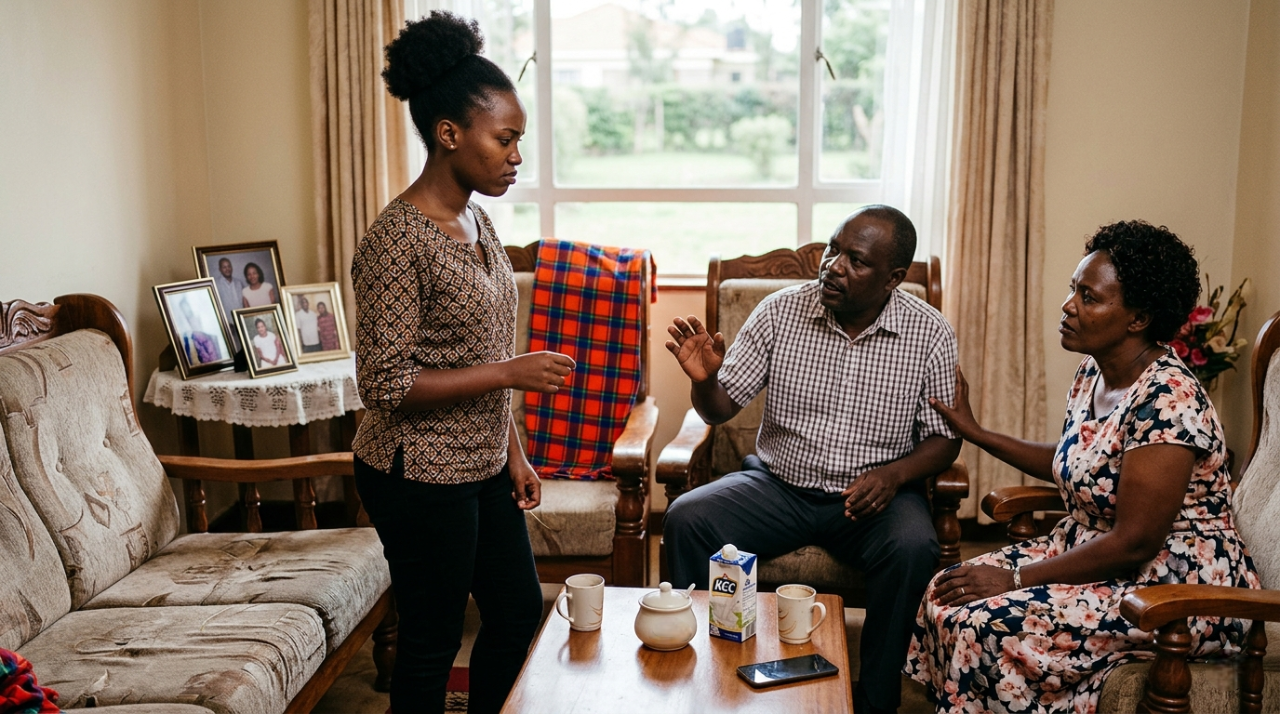
The first time I realised “because I said so” was not a law of nature, I was 17 and standing in the kitchen, eyes tearing up like I’m in a courtroom drama. My crime? Asking my parents why I had to be home by 6pm when the matatu stage was still buzzing, the sky still bright and my phone’s battery still at 42 per cent.
My sentence? A lecture that began with, “We gave birth to you,” as if that was the ultimate mic drop. I remember thinking, Cool, thanks for the life upgrade, but did that purchase include unquestioned obedience with zero user manual updates?
That moment cracked something open in me. Not disrespect. Curiosity. Gen Z curiosity, the kind that reads the fine print. We’re the generation that grew up Googling everything from “how to fry eggs” to “why adults are always angry”.
We were raised in a Kenya where WiFi shows us how other families negotiate boundaries, where mental health TikToks sneak into our For You pages between skits and dance challenges, and where the word ‘consent’ doesn’t only belong to the bedroom. So when authority shows up wearing the old uniform of silence and fear, we ask questions. That’s not rebellion, that’s literacy.
Let me get specific. In Form 4, I wanted to apply for a scholarship programme that met on Saturdays. Saturdays in my house were sacred: chores, church prep, more chores. I tried to negotiate. I even made a PowerPoint (I know, dramatic). The response was nuclear: “We don’t negotiate with children.”
So I washed the veranda on my knees, scrubbing red dust until my palms stung, while my friends sent photos of their scholarship workshop. Later that year, when I missed out on a spot, I was told to “pray harder next time”. It’s hard to pray when you’ve been trained not to speak.
Here’s the part that complicates things: My parents aren’t villains. They are survivors of a different Kenya, one where respect was survival, where questioning elders could cost you school fees, shelter or safety.
There’s research backing this generational gap. Sociologists note that African family structures often prioritise hierarchy and collective obedience as a way to protect scarce resources and maintain social order. That logic didn’t come from nowhere. But scarcity is shifting. The city is louder. Opportunities are competitive. The rules of survival are changing, and so should the rules of conversation.
Kevin Ngaluma, 27, put it bluntly: “When my mum says, ‘I carried you for nine months,’ I hear, ‘Your life is collateral.’ I love her, but love shouldn’t feel like a debt collector.”
Judy Wairimu, 23, pushes back. “Our parents aren’t tyrants; they’re tired. If we meet them with empathy instead of sarcasm, we might actually get somewhere,”
Both are true. We live in the tension between gratitude and freedom.
The cost of unquestioned submission isn’t just emotional, it’s social. When kids are taught that power is never questioned at home, they carry that script into school, work and politics. You don’t challenge a teacher who humiliates you. You don’t question a boss who underpays you. You don’t interrogate leaders who speak in riddles. You learn to bow your head and keep quiet.
However, Kenya’s youth movements and civic engagement tell a different story. Young people are increasingly vocal about corruption, police brutality and economic precarity. That voice doesn’t come from nowhere; it’s practised at home, or it’s punished there.
And look, we’re not asking to run the household like a group chat with no admin. Boundaries matter. Elders carry wisdom that algorithms can’t replace. I still ask my mum how to tell when ugali is ready, because no YouTube tutorial beats her thumb-and-wrist method.
Respect is not the enemy. Silence is. There’s a difference between guidance and gag orders. There’s a difference between discipline and domination.
If we’re honest, some parents hear our questions as disrespect because that’s how their questions were punished. Trauma passes down like a family recipe. But recipes can be tweaked. Imagine a home where “Why?” is an invitation, not an insult. Where “No” comes with reasons. Where “I’m sorry” doesn’t threaten authority; it strengthens trust. That’s not Western nonsense, it’s good governance scaled down to the living room.
So here’s my clear, messy stance: Giving birth to me didn’t give anyone ownership of my voice. It gave us a relationship. Relationships thrive on dialogue, not decrees. I’ll wash the veranda. I’ll show up to family gatherings. I’ll carry groceries and stories and the weight of our shared history.
But I won’t trade my questions for silence. We can honour our parents without shrinking ourselves. If anything, that’s how we honour the future they wanted for us — by becoming adults who can speak, stand and still love loudly.