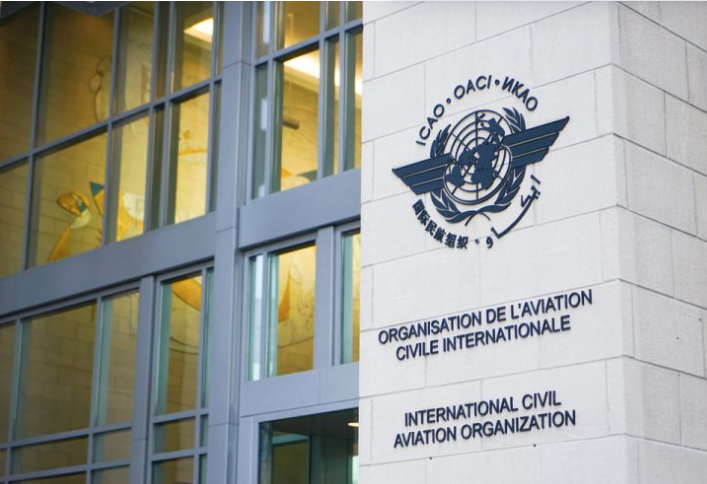
 International Civil Aviation Organization offices in Montreal, Canada/SCREENGRAB
All eyes are on the Council of the International Civil Aviation Organization (ICAO) as it prepares to rule on the future of a key global aviation climate programme, a decision experts warn could determine whether the system thrives or collapses.
At the centre of the deliberations is the Carbon Offsetting and Reduction Scheme for International Aviation (CORSIA), a framework designed to help airlines offset their emissions by purchasing carbon credits from environmental projects around the world.
Analysts say the Council’s decision will significantly shape the supply of carbon credits eligible under CORSIA, with far-reaching implications for airlines, project developers, and emerging carbon markets—particularly in Africa.
The programme was initially designed to create a steady and predictable demand for carbon credits, thereby channelling investment into emissions reduction initiatives such as reforestation, renewable energy, and clean cooking technologies.
However, concerns have emerged over recommendations by the CORSIA Technical Advisory Body, which some stakeholders argue could sharply limit the pool of eligible credits.
“A narrower supply of eligible units could trigger a chain reaction across the market,” said one carbon market analyst familiar with the process.
“You would likely see rising prices for credits, increased compliance costs for airlines, and ultimately reduced confidence in the programme.”
Higher costs for airlines could weaken support for CORSIA, a mechanism that depends on broad industry participation and predictable market conditions to function effectively.
The potential fallout is especially significant for African countries, many of which have increasingly turned to carbon markets as a source of climate finance and economic growth.
Across the continent, governments and private developers have invested heavily in projects backed by expectations of sustained demand from compliance markets like CORSIA.
In Kenya, which has positioned itself as a regional hub for carbon market activity, the stakes are particularly high.
The country hosts a wide range of initiatives spanning clean energy, land use, and household technologies, many supported by international investors.
“If demand from CORSIA does not materialise as expected, the impact on project viability could be severe,” said a Nairobi-based project developer.
“A lot of these investments are built on long-term assumptions about carbon credit demand.”
There are also fears that airlines could invoke force majeure clauses if the supply of eligible credits becomes too constrained, potentially leading to a breakdown of the mechanism altogether.
Such a scenario would deal a significant blow to global climate action efforts while triggering economic consequences in regions reliant on carbon finance.
Experts warn that Africa could face a wave of project failures and financial distress if demand collapses.
Recent developments have already highlighted these risks. KOKO Networks, a firm that developed a large clean cooking fuel distribution network in Kenya, has faced financial challenges after anticipated carbon credit revenues failed to materialise.
Carbon markets are increasingly viewed not just as environmental tools but as financial systems capable of supporting infrastructure development, job creation, and broader economic transformation.
The upcoming ICAO Council decision is therefore seen as a pivotal moment. By potentially restricting the supply of eligible credits, critics argue, regulators risk undermining confidence in CORSIA itself—a scheme that relies on stable rules and sufficient market liquidity.
“The success of CORSIA hinges on trust and predictability,” an industry expert noted.
“If those are compromised, you risk reduced investment, higher compliance costs, and ultimately a weaker global response to aviation emissions.”
For Kenya and the wider African continent, the outcome could define the trajectory of carbon markets at a time when climate finance is urgently needed.