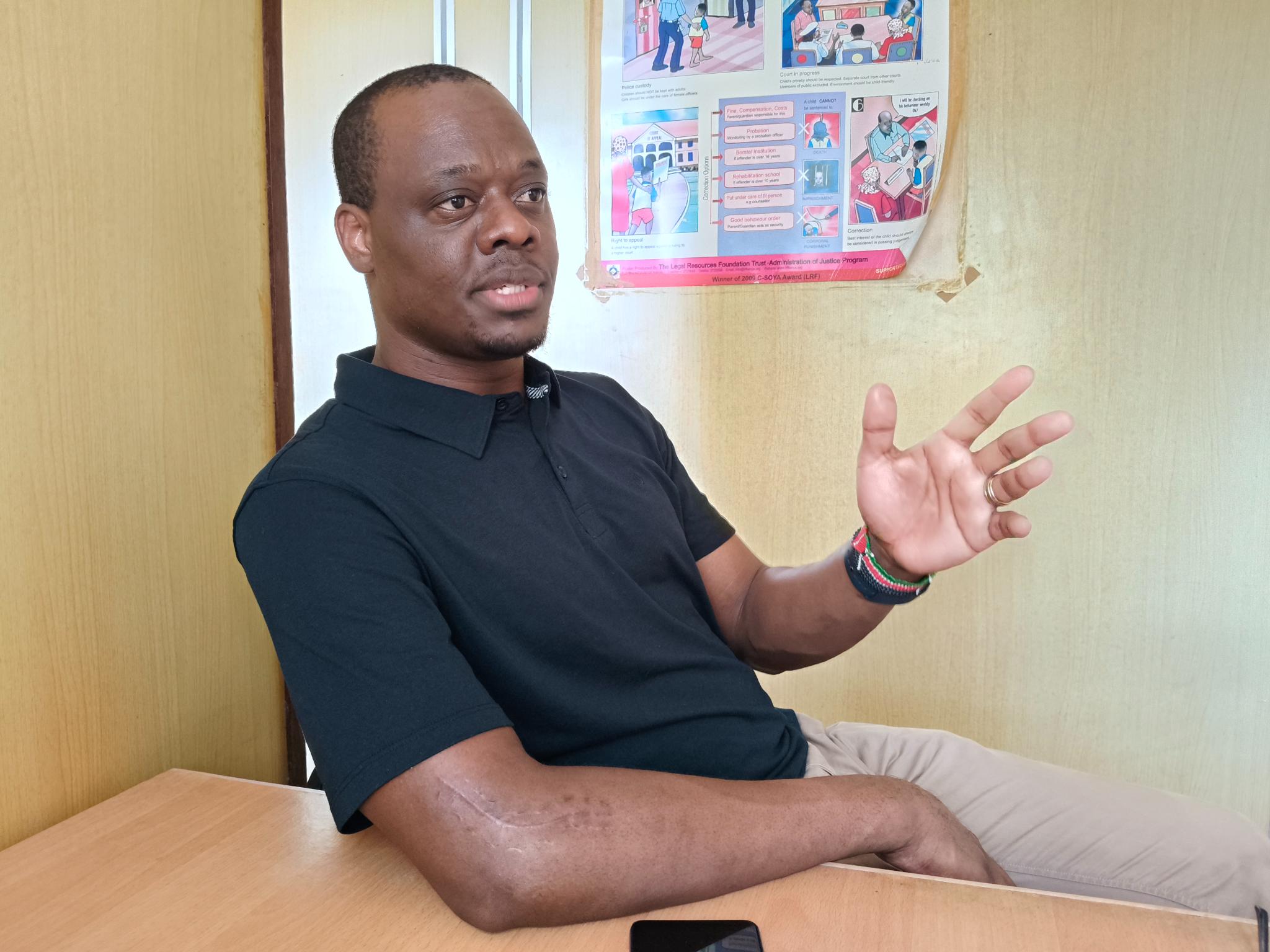
 Ouma Mak’Ouma, (PHOTO BY BRIAN OTIENO)
He has seen it all.
From dropping out of school to fishing at the tender age of 12, Ouma Mak’Ouma never knew what it was to be comfortable during his formative years.
However, his determination to succeed in life gave him the resilience needed to overcome setback after setback as he navigated through the lemons that life threw at him, making lemonade in the process.
Today, he is working on his PhD and has lectured in many university classrooms across Kenya and the US, where he currently resides. He is a renowned artificial intelligence specialist. Although Mak’Ouma was born in Nairobi, he grew up in the rural parts of Karachuonyo, Homa Bay county.
He attended four primary schools, jumping from one to another due to fees problems, which were exacerbated by the death of his parents, one year apart. His father died in 1995 and mother the following year, when he was 11 and 12 years old, respectively.
When his mother died, he was forced to drop out of school and get into business.
He split firewood from nearby forests to sell. When the business proved too complicated, he dropped it and got into sugar cane selling, before venturing into fishing.
He was small in stature and was not allowed to go deep into the lake. He would stay at the shore with a fishing line while he waited for the grown men to come back with their catch.
“By this time, I had been left with my paternal grandmother as my other three siblings had been taken in by relatives,” Mak’Ouma said.
This continued until one day, his maternal grandmother, who lived nearby, met him on the road when he was supposed to be in school.
“She asked why I was not in school,” Mak’Ouma says.
“I lied to her that I was from the head teacher’s office, when in actual fact, I was from the lake as I was carrying some fish.”
He used to earn Sh80 a day for all the hard work in the lake.
Through the help of relatives, he returned to school.
At Rawinji Primary School, where he was supposed to repeat Standard 7, he was the best student after sitting an exam. He was forced to take an elimination test in another school, where his elder brother and a cousin were also learners, and they also undertook the test. He got better marks than his elder brother and cousin.
“The head teacher called me, saying he wanted me to sit the KCPE exam at the school. I explained my problems to him, and he said he had already found out and would have them addressed,” Mak’Ouma says.
He topped all the exams in the school and when he sat the KCPE exam, he was admitted to a school in Kisii but could not join because of lack of fees.
He instead joined Gogo Secondary School in Homa Bay where he schooled for two years before joining Joel Omino High School in Kisumu, where his uncle, with whom he was staying, lived.
Mak’Ouma says he had always wanted to be an engineer because he was inspired by what he read about engineer Philip Okundi, politician and former CEO of KBC.
Although his grades were enough to earn him a spot at the University of Nairobi, once again, lack of fees ruined things for him.
He found a job at a restaurant as a cashier before his brother called him to Mombasa.
In Mombasa, he started hawking sweets and socks, walking long distances trying to convince people to buy. The pay was not good, so he decided to join his brother at construction sites doing all the manual work.
“I then found a community school where I said I wanted to teach, and they gave me a chance. I taught for three years,” Mak’Ouma says.
When the time came to join college, he settled for computer science at then Kenya Polytechnic, now Technical University of Kenya (TUK), graduating in 2007.
In 2008, he went back to Mombasa, where he rejoined the community school, Shanzu Educational Centre, to teach before joining Mt Kenya University, Mombasa campus, for his Bachelor of Business Information Technology, graduating in 2010.
He then completed his Master’s degree in Strategic Management at the same university.
“In 2015, I started my PhD at Kisii University, Nairobi campus, until 2019 when I left, but in between, of course, many things happened,” Mak’Ouma says.
In 2017, he tried his luck in politics, running for the Nyali MP seat on an independent ticket.
His intention was to have his name in history as someone who had once tried to change things through politics.
In 2019, after graduating with his PhD, he moved to the US in search of greener pastures.
“In Kenya, I had registered a company training people on IT in Nairobi. All this while, I was lecturing at Mt Kenya University and other institutions during the times I was doing my master’s and PhD,” he says.
In the US, he registered a similar company.
“The reason is that I saw so many Kenyans getting into the US and they had challenges with technology. So I started training Kenyans, and then gradually got into training other people,” Mak’Ouma says.
Today, he trains people on artificial intelligence, data analytics and data science.
“I do the introductory parts but I have teachers who teach the nitty-gritty,” he says.
His company is called NaviSmart AI, a start-up dealing with AI-powered platforms that simplify immigration processes.
He says with the advent of AI, there is the danger of misleading information, and so NaviSmart AI provides verifiable information sourced from authoritative sources.
“If someone wants to come to the US and they do not know where to start, NaviSmart AI can guide you on where to begin and where to get appropriate help,” Mak’Ouma says.
The AI-powered platform can also fill out voluminous forms to the best degree of accuracy.
At least 1,800 people are using the platform for their daily activities. “Last year, we brought about eight students using the platform,” he says.
He is passionate about technology and how it can be used to solve everyday problems.
Together with other tech experts, they organised a Kenya-US Tech Forum in 2024 in the US, and this year they have organised a second edition.
“The reason is that people want to learn from real technology. They can learn more about the conference on kusat.tech.com,” Mak’Ouma says.
The conference brings tech people together to discuss matters related to technology. He urged Kenyans to learn AI, saying it affects, or will affect, every aspect of life.
“Be part of AI. Learn something about AI. Make a commitment and go online to learn. There are free courses on AI online,” he says.