
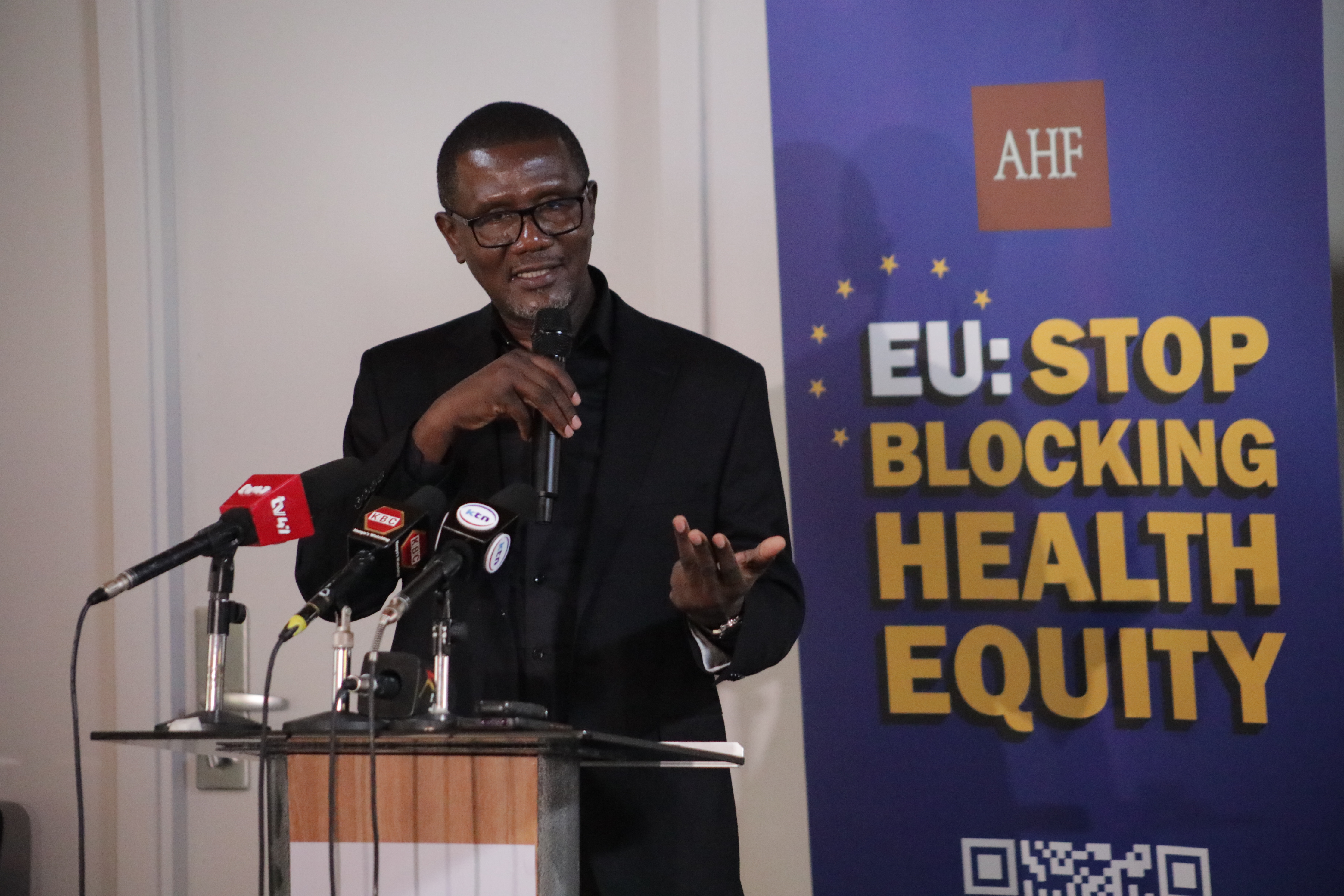
 Aggrey Aluso, Executive Director of Resilience Action Network Africa(RANA), addressing the media during the Pathogen Access Benefits Press conference/HANDOUT
Kenya and other African countries risk facing another severe shortage of life-saving essentials during future outbreaks if a key equity provision is not strengthened in the proposed global pandemic treaty, health advocates have warned.
The concern centres on the Pathogens Access and Benefit-Sharing (PABS) Annex—a critical system under negotiation as part of the World Health Organisation’s pandemic agreement.
The mechanism is designed to ensure countries rapidly share pathogens with pandemic potential and their genetic sequence data, while guaranteeing equitable access to vaccines, diagnostics and treatments derived from that information.
Against this backdrop, advocates led by the AIDS Healthcare Foundation (AHF), working with the Resilience Action Network Africa (RANA), say the agreement must include binding benefit-sharing commitments to avoid repeating the inequities witnessed during the COVID-19 pandemic.
With negotiations entering a critical phase, talks are set to resume in Geneva on March 23 ahead of the May 2026 deadline at the World Health Assembly, where countries are expected to finalise the agreement.
“Developing countries shared their pathogens, and their scientists identified new variants in record time,” said Diana Tibesigwa, AHF’s Regional Advocacy and Policy Manager for East and West Africa.
“A fair agreement must ensure this contribution is matched with binding, enforceable benefit-sharing—not voluntary commitments that lack accountability,” she said.
“The Pandemic Agreement cannot be ratified without this Annex. Getting it right is in every country’s interest.”
Beyond immediate access concerns, advocates argue that the outcome of the PABS negotiations could directly shape Africa’s long-term pharmaceutical ambitions, including Kenya’s plan to manufacture 50 per cent of its medicines locally.
“No equity, no agreement. Pathogen access must translate into real-time production and distribution. Let us protect regional production,” Tibesigwa said, adding that pathogen access provisions must be finalised to guarantee fairness.
Aggrey Aluso, Executive Director of the Resilience Action Network Africa, said African negotiators should continue pushing for a strong and legally certain PABS framework.
“African delegations must continue pressing for a robust framework grounded in equity and legal certainty—one that ensures predictable and meaningful benefits for countries that contribute pathogen data and materials,” he said.
This imbalance is already evident: Africa accounts for roughly 25 per cent of global vaccine demand, but represents only about $1.3 billion of the $33 billion global vaccine market, highlighting the continent’s heavy reliance on imports.
Advocates say whether technology transfer and licensing arrangements become binding obligations or remain voluntary will largely depend on what negotiators agree in the PABS Annex.
In Kenya, these concerns intersect with ongoing efforts to build local pharmaceutical capacity. The country is among eight African states to achieve Maturity Level 3 status from the World Health Organization, confirming that its Pharmacy and Poisons Board meets internationally recognised regulatory standards.
As part of these efforts, and with support from the World Bank, the regulator is expanding its technical capacity—an initiative that positions Kenya as a potential pharmaceutical manufacturing hub in East Africa.
In early 2025, eight national regulators, including Kenya’s, also signed a cooperation agreement under the African Medicines Regulatory Harmonisation initiative to strengthen technical collaboration and move toward continent-wide regulatory alignment.
Aluso urged African governments to invest more technical expertise in the negotiations and deepen cross-regional dialogue to avoid a deadlock.
“Allowing negotiations to stall would be worse than reaching an agreement with strong foundations and a clear pathway for strengthening over time,” he said.
Advocates say Africa’s growing regulatory infrastructure and regional cooperation could support a thriving pharmaceutical sector—but only if global rules reinforce equitable access.
They argue that binding technology transfer and non-exclusive licensing provisions within the PABS Annex would help connect Kenya’s regulatory progress with real access to pandemic-related health technologies.
The final phase of negotiations on the pandemic agreement is being conducted by the Intergovernmental Working Group tasked with resolving outstanding issues before the treaty is finalised.
The agreement ultimately aims to strengthen global pandemic preparedness by linking pathogen sharing with equitable benefit-sharing, including guaranteed access to vaccines, tests and treatments for developing countries.







