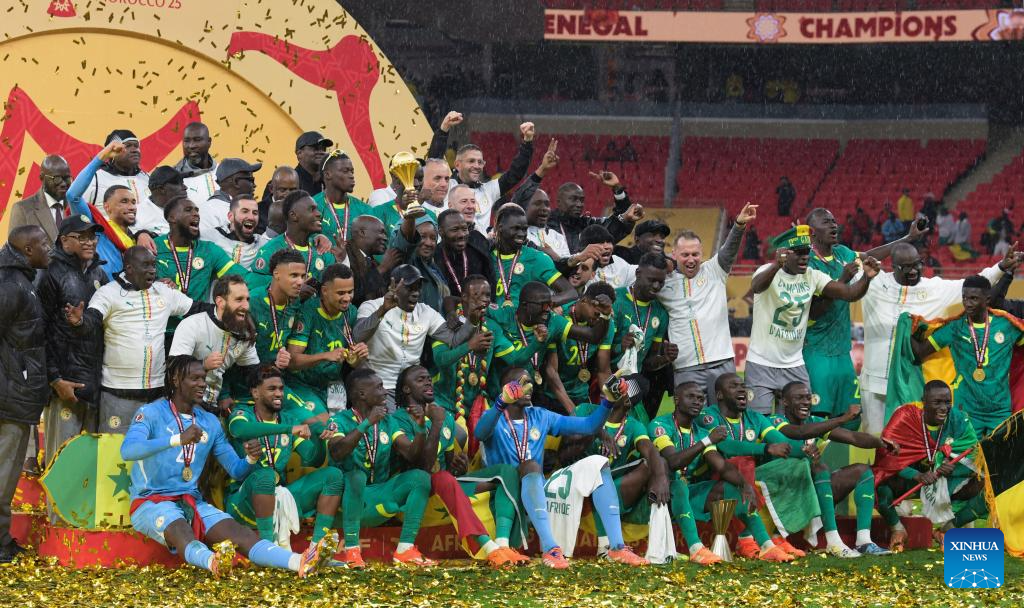
 Players of Senegal celebrate with the trophy after winning the Africa Cup of Nations final between Senegal and Morocco in Rabat, Morocco, Jan. 18, 2026. (Photo by Aissa/Xinhua)
Football across the continent has been thrown into unprecedented turmoil following a historic decision by the Confederation of African Football (CAF) to overturn the result of the 2026 Africa Cup of Nations (AFCON) final.
The decision saw CAF stripping Senegal of the title and awarding it to Morocco.
The ruling, delivered by CAF’s Appeal Board nearly two months after the final, has stunned fans, players and officials alike, marking what many analysts describe as one of the most sensational decisions in African football history.
Prior to this, there had been no known instance of a major continental final being overturned and reassigned in such a manner.
In its determination, CAF declared the match “null and void” and ruled that Senegal had forfeited the final, with the result officially recorded as a 3-0 win in favour of Morocco.
“This is an unprecedented decision,” Moses Okumu, a football fan from Kenya, commented following the verdict.
“Overturning the outcome of a final is not something taken lightly, but the regulations are clear on what constitutes forfeiture.”
At the centre of the controversy are Articles 82 and 84 of CAF’s AFCON regulations, which govern match forfeiture and team conduct.
Article 82 provides that any team that withdraws from a match, refuses to play, or leaves the field without the referee’s authorisation before full time is deemed to have lost and is eliminated from the competition.
“If, for any reason whatsoever, a team withdraws from the competition or does not report for a match, or refuses to play or leaves the ground before the regular end of the match without the authorisation of the referee, it shall be considered a loser and shall be eliminated,” the article states.
Article 84 reinforces this provision by stipulating the consequences of such actions.
“The team that contravenes the provisions… shall be eliminated for good from the competition. This team will lose its match by 3-0,” the regulation reads, while also allowing CAF to impose further disciplinary measures.
According to the Appeal Board, Senegal’s conduct during the final fell squarely within these provisions.
The controversy stems from dramatic scenes during the final played on January 18.
With the score locked at 0-0 deep into stoppage time, referee Jean Jacques Ndala awarded Morocco a penalty after consulting VAR over a challenge by defender El Hadji Malick Diouf on Brahim Diaz.
The decision sparked fury on the Senegal bench. Head coach Pape Thiaw, already angered by an earlier disallowed goal from Ismaila Sarr, instructed his players to walk off the pitch in protest.
CAF found that Senegal’s players remained off the field for more than 10 minutes, which it interpreted as a refusal to continue the match.
“By leaving the pitch and delaying the match for an extended period, the team effectively refused to play,” the Appeal Board noted in its ruling.
Despite efforts by star player Sadio Mane to persuade his teammates to return, the protest caused a 17-minute delay before play eventually resumed.
When the match restarted, Diaz’s penalty was saved by goalkeeper Edouard Mendy, and Senegal went on to win 1-0 in extra time through a goal by Pape Gueye.
However, CAF’s ruling has now nullified that outcome entirely.
FIFA President Gianni Infantino, who attended the final, later criticised the incident, describing it as “unacceptable.”
“The disruption caused when players leave the field undermines the integrity of the game,” Infantino said, underscoring FIFA’s long-standing stance on maintaining discipline and respect for match officials.
The decision has reignited debate about the strict application of football regulations, particularly in high-stakes matches.
Experts note that while refereeing errors, even controversial ones, rarely lead to overturned results, actions such as abandoning a match or refusing to play fall into a different category entirely.
The Senegalese Football Federation has strongly rejected the ruling and announced plans to appeal to the Court of Arbitration for Sport (CAS), the independent body that adjudicates global sporting disputes.
In a statement, the federation described the verdict as “an unfair, unprecedented and unacceptable decision that brings discredit to African football.”
Legal experts say CAS will review whether CAF correctly interpreted and applied its own regulations, as well as whether due process was followed.
The fallout from the decision is expected to be far-reaching, potentially setting a precedent for how disciplinary rules are enforced in continental competitions.
CAF defended its stance, saying that “through the conduct of its team, Senegal infringed Article 82,” automatically triggering the sanctions outlined in Article 84.
For Morocco, the ruling delivered a historic continental title under extraordinary circumstances. For Senegal, it marks a painful and controversial reversal of what had been celebrated as a hard-fought victory.