
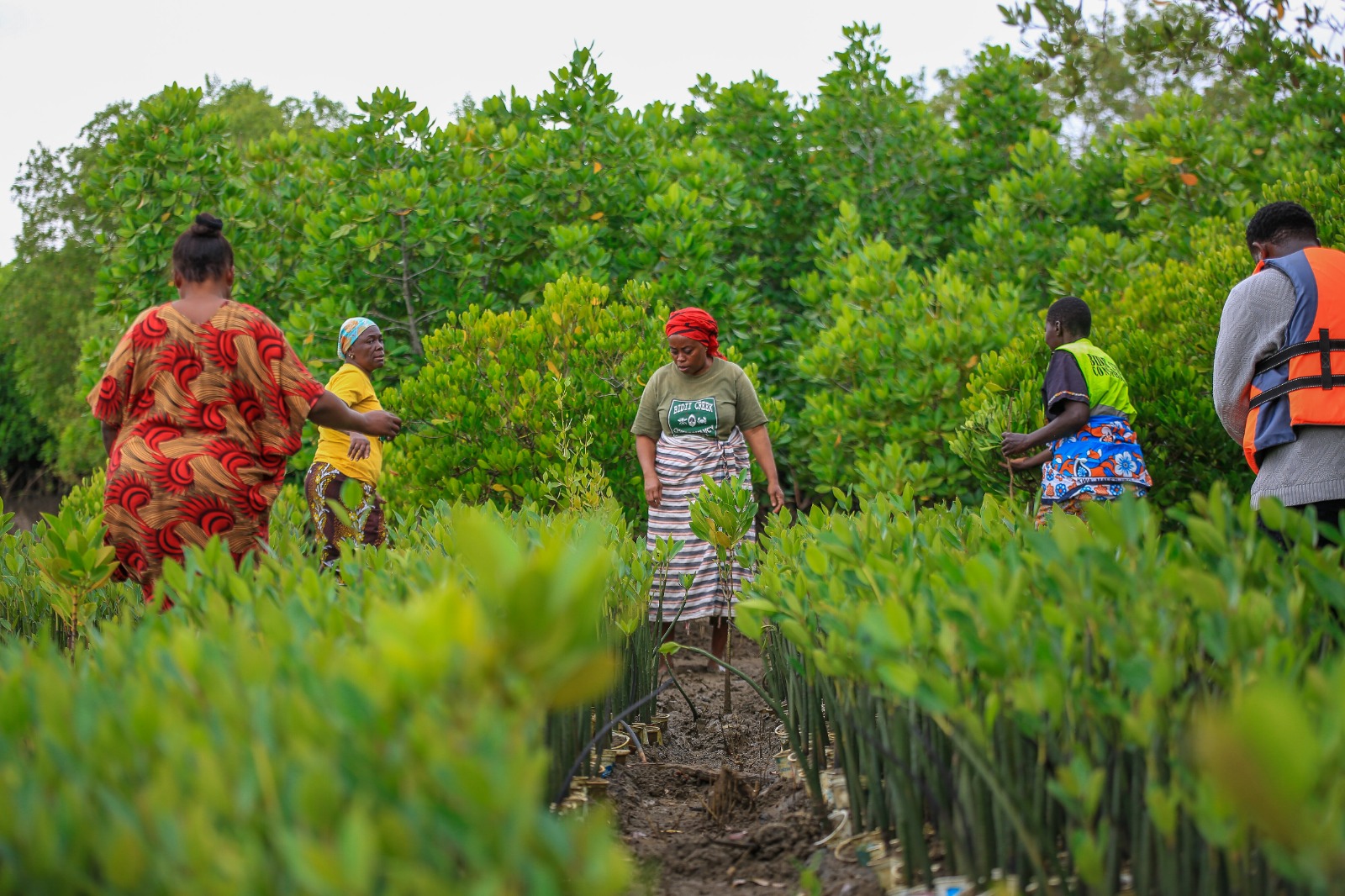
 Bidii Creek Conservancy women inspect the mangrove seedlings nursery in Jomvu Kuu along Tudor Creek.
Along Kenya’s coastline, mangrove forests quietly perform vital work.
They protect communities from storm surges, prevent erosion, sustain fisheries, support tourism and provide livelihoods for coastal residents.
From Lamu and Tana River to Kwale, Mombasa and Kilifi, these ecosystems are both a shield and a lifeline.
Yet, despite the urgency of conservation, scientists warn that large-scale planting drives alone cannot guarantee successful restoration.
About a decade ago, nearly 40 per cent of Kenya’s mangrove forests had been degraded, with Kwale county suffering the most at 44.6 per cent loss.
It was followed by Mombasa at 40 per cent, according to the National Mangrove Ecosystem Management Plan.
In response, government agencies, NGOs and community groups have launched restoration initiatives.
Some have focused on high-profile planting campaigns where thousands of seedlings are planted within hours, often attracting media attention and public praise.
But the rush to plant trees for the sake of numbers may be undermining the very ecosystems these efforts seek to save.
“Restoration cannot be achieved in a single day,” says Dr Judith Okello, senior research scientist at the Kenya Marine and Fisheries Research Institute and chair of the National Mangrove Management Committee.
“Planting millions of trees in a matter of hours is not logical when you consider the environmental factors required for mangroves to thrive,” Okello said.
She said successful restoration requires proper site assessment, protection of areas suitable for natural regeneration and involvement of local communities.
Ignoring ecological conditions—such as tidal flows, salinity and the suitability of specific mangrove species—leads to widespread seedling mortality.
“Many initiatives focus on planting without addressing the causes of degradation,” she adds.
“Sometimes, simple interventions like clearing blocked water channels or restoring salinity balance can allow natural regeneration without planting a single tree.”
Kenya Forestry Research Institute research scientist Henry Komu echoes the concern.
“Restoration must begin with an understanding of the site’s history and why degradation occurred.
Otherwise, resources are wasted and ecosystems remain fragile.”
Despite these challenges, there are promising developments.
Komu notes that in areas where communities have embraced science-based restoration, the situation has improved.
Kefri, in partnership with Wetlands International, WWF-Kenya and KMFRI, has trained coastal communities on proper restoration techniques, emphasising sustainable practices rather than publicity-driven mass planting.
Wetlands International senior project officer Abdul Hazeez says the organisation promotes Community-Based Ecological Mangrove Restoration (CBEMR).
This focuses on restoring natural tidal flows, assessing sites thoroughly and engaging local communities.
“This approach allows mangroves to regenerate naturally while addressing the root causes of degradation,” he said.
WWF-Kenya has also raised concerns about the misconceptions surrounding mangrove restoration.
“Restoring mangroves is not simply about planting trees,” says Nathaniel Mwangeka, a WWF-Kenya officer.
“Large-scale planting campaigns often ignore ecological conditions necessary for survival. Without proper site assessments and protection measures, these efforts fail.”
The pressure on Kenya’s mangroves is only increasing. Climate change, coastal development and unsustainable land use continue to threaten these ecosystems.
Mangroves make up just 1.8 per cent of Kenya’s total forest cover, yet they require specific conditions and a balanced mix of species to thrive.
Misguided restoration could disrupt natural processes and undermine long-term resilience.
Scientists emphasis that conservation should prioritise long-term ecological health over media attention.
CBEMR encourages communities to take ownership, restoring tidal flows, monitoring regeneration and preventing future degradation.
“When communities understand the ecosystem and its needs, restoration becomes sustainable,” Hazeez says.
Komu adds that mangrove restoration also presents opportunities for income generation.
“Many individuals have set up mangrove nurseries along the Coast, but the goal should not be endless planting. Protecting ecosystems and allowing natural regeneration is often more effective.”
The shift from mass planting to science-based restoration marks a significant evolution in Kenya’s conservation efforts.