 Born in Dakar, Senegal, Khaby Lame is the most followed content creator on TikTok.
His name is Khabane Lame, but he is known worldwide as Khaby Lame. Born in Dakar, Senegal, he is the most followed content creator on TikTok.
Chaplin’s films carry emotional weight, driven by social and political themes. His character, the tramp, is a poor wanderer pushing back against an unfair industrial world.
Khaby Lame’s style is closer to Keaton’s. He says nothing. He simply shows how unnecessary and complicated these internet quick fixes are. His absolute impassivity in the face of the absurd is what Keaton perfected with his famous “great stone face”.
Wordless humour allowed him to build a global audience because there are no language barriers, just as silent film stars like Charlie Chaplin became global icons a century ago.
TikTok’s algorithm favours content that anyone can understand instantly. Chaplin needed a movie theatre, Khaby Lame needs only a phone and an algorithm. The mechanics are similar. The way it spreads has completely changed.
Digital identity
In January 2026, Khaby Lame’s carefully crafted expressive persona took on a new status. It became a financial asset. He sold his company, Step Distinctive Limited, for US$975 million to Rich Sparkle, a publicly traded company based in Hong Kong. The agreement includes the transfer of rights to use his image, voice and behavioural models to create an artificial intelligence-powered digital twin.
This digital twin will produce multilingual content, including material for advertising and promotions. Companies will be able to run commercials in several countries without Khaby being physically present.
According to Rich Sparkle, this could help generate over US$4 billion in annual sales, especially through livestream e-commerce (a format already dominant in Asia), broadcast simultaneously around the world.
This transaction marks a turning point. Digital identity no longer merely represents a person. It becomes an asset that can be separated from the individual who created it. Now, a creator is no longer a brand ambassador, but a brand in its own right. In theory, Khaby Lame’s digital being is now legally separate from Khaby Lame himself.
The digital twin is, in this sense, the Buster Keaton body that digital platform capitalism has always dreamed of – impassive, reproducible, available across all time zones.
Signature gesture
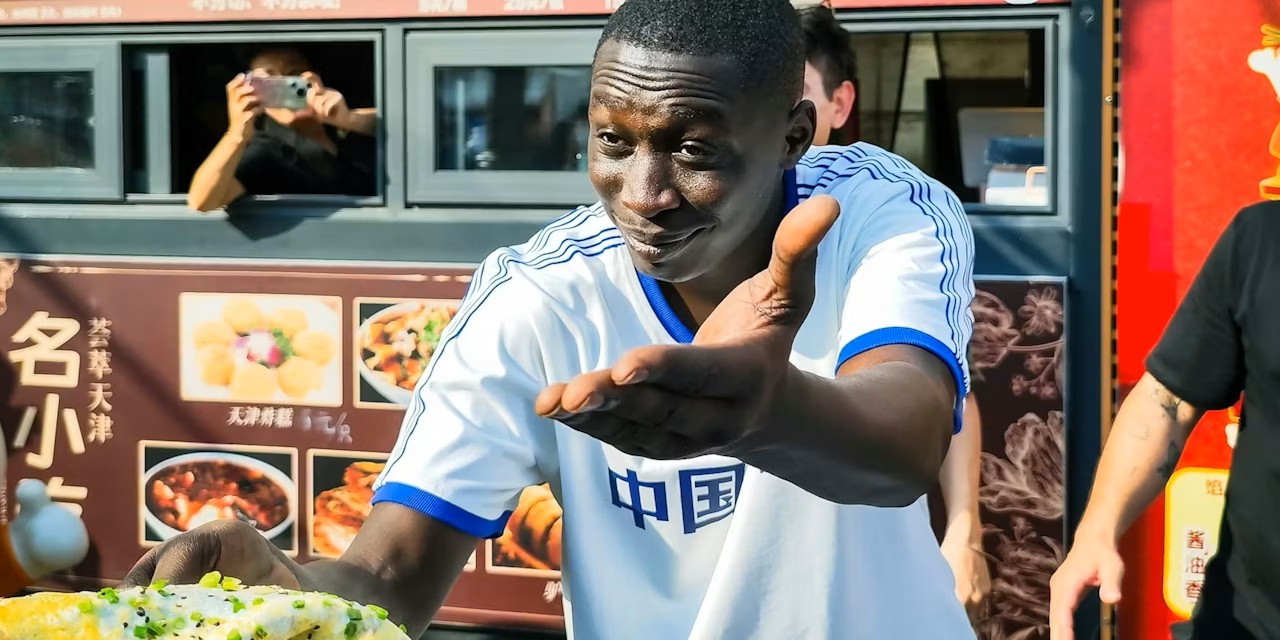
Khaby Lame’s signature gesture is to place both palms open and turned upward. This seems simple and easy to understand, a light and humorous sign of of disbelief. But the gesture carries deeper meanings.
In Islamic tradition, as in many African cultures, this same gesture is linked to dua, the act of raising one’s hand in supplication to God. What millions of viewers read as a comic signature is also a spiritual practice.
Yet Khaby Lame’s digital double is not simply an image. It can act in his name. It can speak with his voice. It can repeat his familiar gestures. This is no longer simple representation. It is a form of transferring his way of expressing himself onto a digital system.
The same open hands, the same expressive gaze, the same voice that once recited the suras of the Quran in a school in Dakar are now the attributes of a commercial transaction valued at nearly a billion dollars.
There is an ethical question in handing over his active identity to financial markets.
An ethical question
For many young Africans, especially in Senegal, Khaby Lame embodies the possibility that digital spaces are territories where Africans can succeed, where the hierarchies inherited from colonial history can, at least symbolically, be overturned.
But the deal raises a difficult question: what does it mean to sell your digital self in a world where Black and African bodies have been used and profited from for centuries without consent and fair compensation?
Is this a win or a new form of exploitation? Can the financial benefits balance the transfer of his identity?
More African creators are building global audiences every year. That means these questions will become harder to ignore. Who owns a creator’s digital twin once it’s sold? Who set the rules for its use?
Khaby Lame is not just a social media success story. He is a revelation of the future and, perhaps unwittingly, a pioneer.
Fanny Georges, enseignant-chercheur, Université Sorbonne Nouvelle, Paris 3
This article is republished from The Conversation under a Creative Commons license.