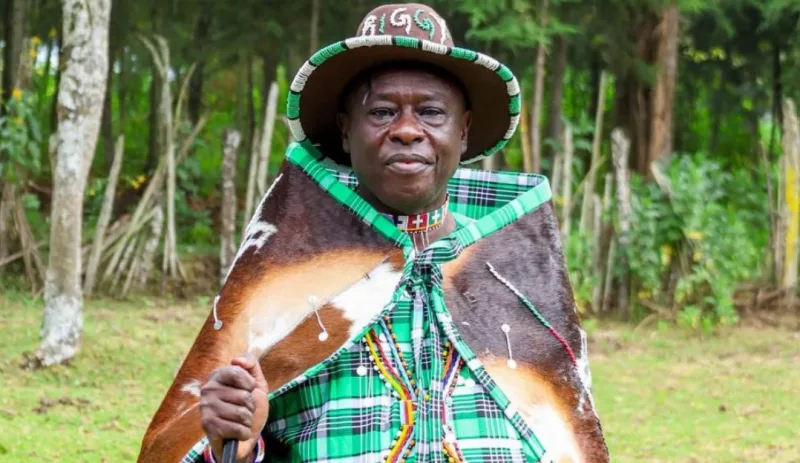
 CS Kipchumba Murkomen during the Cherangany Unity Cup in Trans Nzoia County./HANDOUT
For decades, Kerio Valley region has been associated with insecurity, cattle rustling, and banditry that have disrupted livelihoods and education across parts of the North Rift.
Communities in counties such as West
Pokot, Elgeyo Marakwet, Baringo, and Turkana have repeatedly endured cycles of
violence that have forced school closures, displaced families and strained
security resources.
But alongside the security operations that have dominated headlines over the
years, a quieter shift is emerging—one that combines enforcement with youth
engagement, education and community development. CS Kipchumba Murkomen during the Cherangany Unity Cup in Trans Nzoia County./HANDOUT
While security remains a central priority for the government, Murkomen has
increasingly spoken about the need for broader interventions that address the
social and economic conditions that have historically fuelled insecurity in
banditry-prone areas.
A region long affected by insecurity
Kerio Valley sits along a vast and
often difficult terrain stretching across several counties in the North Rift.
For years, the area has been among the regions most affected by cattle rustling
and armed banditry.
According to reports by The Standard Media Group and Nation Media Group,
attacks in the region have in the past led to deaths, displacement of families
and disruption of essential services, including education. CS Kipchumba Murkomen in Elgeyo Marakwet/HANDOUT
Government security operations have intensified over the past two years in a
bid to restore stability. Authorities have deployed specialised security units
and expanded coordinated operations aimed at dismantling criminal networks
behind banditry.
Officials say these efforts have helped restore relative calm in several
affected areas, allowing schools to reopen and normal economic activity to
gradually resume.
Sports as an early entry point
Long before assuming leadership of
the country’s security docket, Murkomen had begun exploring ways to engage
young people in the region. CS Kipchumba Murkomen and his education counterpart Migos Ogamba in Elgeyo Marakwet./HANDOUT
The tournaments drew hundreds of young people and turned local football grounds into spaces for community interaction.
Beyond the sporting aspect, the competitions offered cash prizes that organisers hoped would provide modest economic incentives while steering young people away from criminal activities.
The initiative reflected a broader idea increasingly discussed by policy experts—that tackling insecurity requires more than enforcement alone.
Youth engagement programmes, education opportunities and economic alternatives are often cited by development experts as key components in addressing the root causes of conflict in marginalised regions.
Murkomen’s involvement in sports-driven youth initiatives later intersected with his work in the government’s sports docket before he was appointed to lead the Interior and National Administration ministry.
Today, the ministry is responsible for overseeing national security operations, including those targeting banditry in the North Rift.
Signs of gradual stability
Security agencies say coordinated operations have begun restoring stability in several parts of Kerio Valley.
In areas where insecurity had previously forced schools to close, learning
institutions have reopened and teachers have gradually returned. Local
businesses and farming activities that had been disrupted by violence are also
beginning to recover.
Residents interviewed by local media in recent months have reported improved
security in some areas, although concerns remain in pockets where sporadic attacks
still occur.
The government maintains that restoring long-term stability will require a
broader development strategy beyond security operations.
Murkomen has repeatedly emphasised that addressing insecurity requires
collaboration across sectors including education, infrastructure and economic
development.
Education takes centre stage
That approach was evident last Friday when Murkomen convened the inaugural Elgeyo Marakwet Elimu Conference, a forum focused on improving education outcomes in the county and the wider Kerio Valley region.
The conference was held at the Lorna Kiplagat Sports Academy and brought
together more than 2,500 education stakeholders, including teachers,
administrators, policymakers and community leaders.
The meeting sought to examine ways of strengthening education systems in the
region and expanding opportunities for young people.
Among those present were Education Cabinet Secretary Julius Migos Ogamba, Basic
Education Principal Secretary Belio Kipsang, National Treasury Principal
Secretary Chris Kiptoo and Education Principal Secretary Sarah Muoria.
Local leaders also attended, including Elgeyo Marakwet Governor Wisley Rotich.
The governor welcomed the initiative and highlighted the county government’s
commitment to supporting education.
“This conference is a game changer for education in our county. As a county
government, we remain committed to supporting needy students through
scholarships and bursaries while continuing to enhance infrastructure in our
schools to create a conducive learning environment,” Governor Rotich said.
Focus on practical reforms
The forum, themed “Collaborative Education for the Betterment of Society,” focused on practical interventions aimed at strengthening learning outcomes.
Stakeholders discussed ways to increase student enrolment, improve academic
performance and strengthen transition rates from primary to secondary school
and from secondary school to higher education.
Participants also examined the need to enhance institutional capacity through
improved infrastructure and adequate staffing.
Education experts have long warned that parts of the North Rift face unique
education challenges linked to insecurity, poverty and limited access to
learning facilities.
National education data cited by Kenyan media indicates that transition rates
in some marginalised areas lag behind national averages, particularly where
insecurity disrupts schooling.
Addressing social challenges in schools
Participants at the conference also discussed social challenges affecting learners.
Among the concerns raised were alcohol and drug abuse within school
environments and the growing availability of illicit substances near learning
institutions.
One of the proposals discussed was stricter enforcement of the 300-metre rule,
which prohibits the establishment of alcohol outlets near schools.
Education stakeholders argued that enforcing the regulation more strictly could
help create safer environments for students.
The issue has previously been raised by education officials and community
leaders in several counties where unregulated alcohol outlets have been linked
to student indiscipline and school dropouts.
Private sector joins the effort
The conference also drew support from the private sector, which participants said could play an important role in supporting both security and education in the region.
Representatives from Safaricom said the telecommunications firm would continue
strengthening network connectivity in Kerio Valley and neighbouring counties.
“Reliable communication infrastructure is critical for effective security
coordination. Safaricom remains committed to boosting network coverage in the
region to support security operations while also expanding connectivity to
schools to enhance ICT learning for students,” a County representative from the
company noted.
Financial institutions also pledged to continue supporting education through
scholarships and mentorship programmes targeting students from disadvantaged
backgrounds.
Leaders from KCB Bank Kenya, Equity Bank Kenya and Sidian Bank reaffirmed their
commitment to education sponsorship initiatives.
“Education remains one of the most powerful tools for transforming communities.
As financial institutions, we will continue supporting scholarships and
mentorship programmes to ensure that bright students from vulnerable
backgrounds are able to pursue their education and realise their full
potential,” the institutions said in a joint commitment.
Leadership and community responsibility
For Murkomen, the conference highlighted what he described as the responsibility leaders have to invest in their communities.
“We have a responsibility, as leaders, to give back to the communities that nurtured us by championing development initiatives that uplift lives, expand opportunities and inspire hope for future generations,” he noted.
A long-term approach
Observers say initiatives that combine security, education and economic empowerment could play a role in addressing the deeper causes of instability in regions such as Kerio Valley.
Analysts have previously told Kenyan media that young people in marginalised
areas are often vulnerable to recruitment into criminal networks due to limited
economic opportunities.
Expanding access to education and employment opportunities, they argue, could
help reduce those risks over time.
The Elgeyo Marakwet Elimu Conference reflects a growing recognition that
long-term stability in historically insecure regions may require integrated
approaches that extend beyond policing.
In the Kerio Valley, where football tournaments once served as rallying points
for youth engagement, the conversation is now increasingly shifting toward
classrooms, scholarships and institutions that many hope will shape the future
of the next generation.