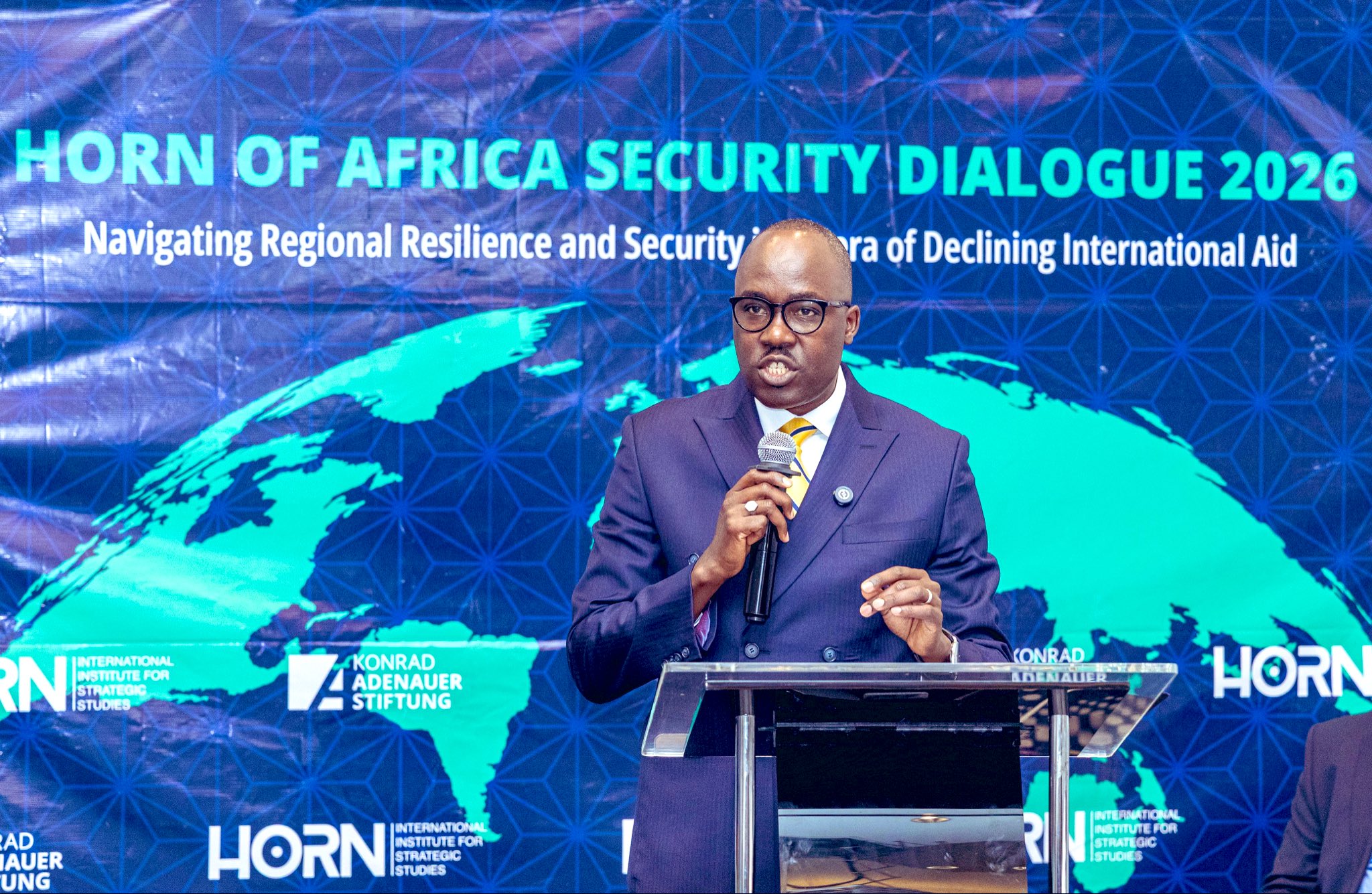
Speaking at the Horn of African Security Dialogue 2026 on Thursday, Foreign Affairs PS Korir Sing'oei said African states must reduce reliance on external assistance and instead invest in their own security institutions and financing mechanisms.
Sing’oei argued that the region could no longer depend indefinitely on foreign aid to manage conflicts, humanitarian crises and security threats.
“The Horn of Africa cannot remain indefinitely dependent on external actors. Peace and security must be built on African ownership, strong institutions and committed leadership,” he said.
The Horn of Africa, which hosts more than 300 million people, is facing overlapping crises, including political instability, violent extremism, humanitarian emergencies and growing geopolitical competition linked to developments in the Red Sea and the wider Middle East.
The conflicts in Sudan and South Sudan are deepening, tensions are rising between Ethiopia and Eritrea, and Somalia continues to face security threats from al Shabaab militants.
Sing’oei said these pressures have left 26 million people forcibly displaced across the East, Horn and Great Lakes region, including more than 19 million internally displaced persons and more than 5.5 million refugees and asylum seekers.
Kenya’s position aligns with broader efforts by African leaders to secure predictable financing for African-led peace missions, particularly through the implementation of United Nations Security Council Resolution 2719.
The resolution, adopted in December 2023, established a framework allowing the United Nations to finance up to 75 per cent of African Union-led peace support operations through UN-assessed contributions.
African leaders, including President William Ruto, have pushed for the full operationalisation of the framework to support the African Union Support and Stabilisation Mission in Somalia (Aussom), which replaced the AU Transition Mission in Somalia.
Ruto last year called on African leaders to explore ways of fortifying the continent’s peace and security architecture.
“One pertinent proposal is to convene a High-Level Panel of perhaps three experts to conduct a comprehensive review of the AU's peace and security framework,” he said.
“This panel would also assess the feasibility of implementing UN Security Council Resolution 2719, which offers a viable pathway for financing AU-led, UN-mandated peace support operations through assessed contributions.”
Ruto spoke during a high-level retreat of the Extended Bureau of the African Union Institutional Reforms on January 27 last year.
However, the proposal has faced resistance from the United States, which has expressed concerns over how the mechanism would be implemented and has instead advocated for broader “burden sharing” among African states, European partners and other international donors.
Washington has maintained that African countries should increase their own contributions to peace operations, while partners such as the EU also play a greater financing role, particularly on Somalia.
Sing’oei said African states must nevertheless take greater responsibility for funding their own security priorities.
He pointed to ongoing reforms in the AU, including efforts to expand the Peace Fund, which stands at about $400 million but is expected to grow to at least $1 billion.
The AU has also proposed a financing model based on a small levy on eligible imports by member states to generate sustainable funding for peace and security initiatives.
Addressing the financing issue, Partha Moman, PhD candidate at the London School of Economic and Political Science, said the AU should diversify its funding streams to hedge against risk.
He added that the AU should prioritise funding from member states, as he doesn’t see the Resolution 2719 being implemented.
“I’m sorry to say, having followed this issue closely in the context of Somalia, I would not pin your hopes on that coming to resolution, whether for Somalia or for any other context,” Momna said in the panel discussion.
“I recently spent a few weeks in Washington DC and New York, having discussions on this issue, and I came away rather bleak about the prospects of Resolution 2719 moving forward.”
He, however, noted that the UN logistical support model represents a different pathway for bringing UN-assessed contributions into AU peace operations.
“If you look at the overall UN-AU budget in Somalia, nearly 70 per cent of it comes from the UN support office”.
Beyond financing, Sing’oei emphasised the need for stronger political will among African states to deploy regional security mechanisms, such as the African Standby Force.
He cited the conflict in Sudan as an example where earlier intervention might have prevented the escalation into one of the world’s worst humanitarian crises.
“At the onset of the Sudan crisis, there was a window for intervention, but we did not mobilise the political consensus required,” Sing’oei said.
The PS also called for the establishment of humanitarian logistics hubs in Africa to improve emergency responses.
Sing’oei said cities such as Nairobi, Kampala and Accra could serve as regional hubs, allowing faster response to emergencies, while also strengthening African institutional capacity.