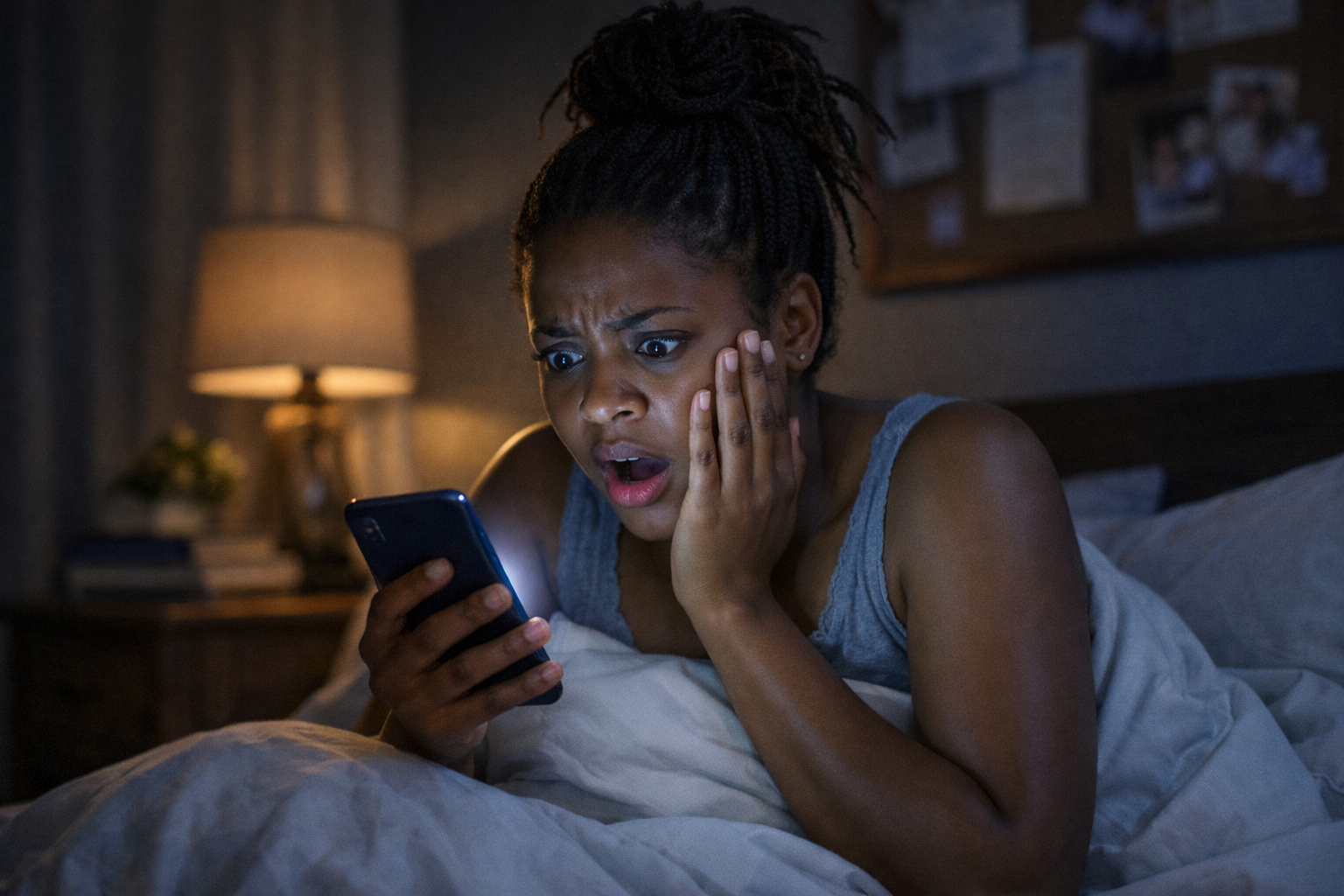
A girl looks in shock at trolling on her social media / AI GENERATED
I used to think bullying was something that happened in school corridors: under jacaranda trees, behind the science block, in whispers that curdled into laughter when you walked past. Then I grew up, got a smartphone, opened a Twitter account and realised the corridor had simply moved into my pocket. Same cruelty. Faster Wi-Fi.Here’s the part that still messes with my head: People who wouldn’t dare raise their voice at you in public suddenly become keyboard gladiators online. There’s a weird bravery that comes with anonymity, like being masked at a carnival. Suddenly you can throw drinks at strangers and call it “just jokes”.
I’ve been on the receiving end of this. I once posted a photo from a volunteer clean-up in Mathare. Within minutes, someone replied, “Clean your face first before cleaning the slums.” It landed like a slap. I laughed it off in the comments because that’s what you do when you don’t want to look soft, but I didn’t post for two weeks after. Silence can be a bruise you don’t see.
I’m skeptical of anyone who bullies online because “there’s less consequence”. That logic is lazy. Consequences don’t disappear just because you can’t see them. They just migrate into people’s bedrooms at 1am, into the place where you are alone with your thoughts and your screen, which is glowing like an accusation.
*Amanda (not her real name), 24, runs a small thrift page on Instagram. One day, a buyer publicly accused her of being a scammer because a delivery was late. The pile-on was instant. Memes. “Expose threads.” People who had never bought from her chimed in. The delivery came the next day. The comments stayed. *Amanda told me, “I started shaking every time my phone buzzed. I felt like I was being dragged in front of a virtual chief’s baraza.” That’s the thing about online spaces: The crowd forms before the facts.
We know this isn’t harmless. Research keeps reminding us that cyberbullying is linked to anxiety, depression and worse mental health outcomes, especially for young people. Kenya’s own data and school-based studies show rising online harassment among teens as smartphone access spreads. And globally, platforms like TikTok have acknowledged how easily trends can turn into targeted cruelty. “Roasting”, “rating”, “exposing” are among the content formats that reward humiliation with views. Algorithms don’t care about your feelings; they care about engagement. Outrage travels faster than kindness because outrage is sticky.
Still, I’m not here to pretend we’re all angels offline. Bullying existed before fiber-optic cables. But online spaces add two dangerous ingredients: scale and speed. In school, one rumour might ruin your week. Online, a screenshot can ruin your reputation in minutes. And screenshots don’t forget.
I’ve watched classmates get dragged for old tweets dug up like digital fossils, stripped of context, paraded as proof of permanent guilt. Accountability matters; people should own harm they’ve caused, but the mob version of accountability is blunt and often wrong. It confuses justice with spectacle.
I hear the counter-argument from fellow Gen Zs all the time. Keith Mwangi, 26, shrugged and said, “If you post online, you’re basically signing a consent form for comments. Don’t be sensitive.” Faith Chepkirui, 25, chimed in, “Roasting is our love language. If you can’t handle it, log off.”
I get the impulse behind that. Humour is how we survive. Kenyans roast to cope — with politics, with the price of unga, with heartbreak. But there’s a line between roasting and dehumanising. The first quote excuses cruelty as consent. The second pretends everyone has the privilege to log off. Try telling a small business owner, a student building a portfolio or a creator paying rent with content to just disappear from the digital marketplace. The Internet isn’t a hobby anymore; it’s infrastructure.
My own breaking point came after a thread about body image went viral. Someone posted a video of a girl dancing at a campus event. The comments were brutal: zoomed screenshots, nicknames, edited memes. I recognised the campus. I recognised the cafeteria behind her. I imagined her waking up to strangers turning her body into a public sport. I typed a reply calling out the cruelty.
The backlash hit me instead: “White knight”, “Simp”, “Why are you crying online?” It’s wild how defending basic decency gets framed as weakness. We’ve confused thick skin with moral strength.
Safe online spaces aren’t about wrapping everyone in bubble wrap. They’re about building rooms where disagreement doesn’t require degradation. Gen Zs have shown we can organise online for good causes, such as fundraisers for medical bills, amplifying missing persons and calling out corruption with receipts. We know how to use the Internet as a megaphone for accountability.
We can use the same skills to create norms: Call out dogpiling, report targeted harassment, back creators when mobs form without facts. Platforms can help with better moderation and faster responses, sure, but culture is built by users. By us.
I’m not asking for a softer Internet. I’m asking for a braver one. Brave enough to disagree without humiliating. Brave enough to call out our friends when they are cruel for clout. Brave enough to remember that behind every avatar is a person with a room, a bed, a late-night phone glow and a heart that can still bruise. If we can roast systems that fail us, surely we can stop roasting people who are just trying to exist online.