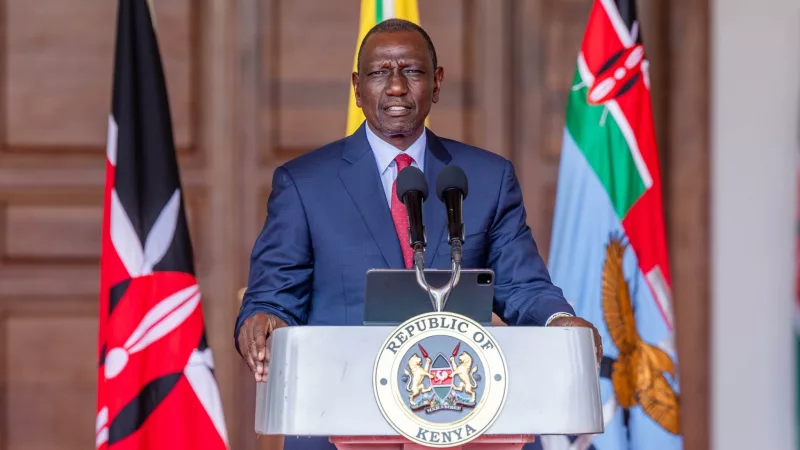
 President William Ruto/PCS
The Court of Appeal on Friday temporarily reinstated President William Ruto’s advisors, staying the High Court ruling that had declared the creation of their offices unconstitutional.
The decision followed an application filed by the Attorney General on 27 January 2026, seeking to suspend the High Court judgment that found the offices unlawful.
In its judgment on January 22, 2026, Justice Bahati Mwamuye quashed all decisions relating to the creation of the advisory offices and the appointments of the individuals.
He noted that the creation of the advisory offices through a non-competitive process undermined the constitutional principles of transparency, accountability, and efficiency in public service.
The Attorney General appealed the decision in an application through Principal Administrative Secretary Arthur Osiya, arguing that the High Court orders had “technically rendered the Executive Office of the President inoperative and ineffective.”
He stressed that failing to suspend the judgment would render any successful appeal meaningless, particularly given that the advisors were already performing their duties when the High Court delivered its ruling.
“That, unless a conservatory order stays the execution of the judgment and orders of 22nd January 2026 in Nairobi Constitutional Petition No. E312 of 2025 is granted pending the hearing and determination of the intended appeal; the appeal, if successful, will be rendered nugatory,” the court heard.
The Public Service Commission, through Secretary Paul Famba, supported the application, highlighting the public interest in maintaining continuity in critical national functions.
Famba noted that advisors such as David Ndii, Monica Juma, and Makau Mutua were engaged in advising the President on national security, foreign relations, economic policy, intergovernmental coordination, and constitutional affairs.
Abruptly removing them without proper handover, he noted, could compromise the President’s ability to perform his constitutional functions.
Opposing the application, Katiba Institute, through litigation manager Emily Kimana, argued that there was no irreparable harm to the Executive if the High Court orders were enforced.
She maintained that reinstating the advisors could lead to duplication of roles, administrative inefficiency, and wastage of public resources, ultimately prejudicing the public.
The Court of Appeal, however, noted that the intended appeal against the High Court ruling was arguable and merited consideration.
The judges conducted a proportionality evaluation, weighing the competing public interests.
They found that since the advisors were already in office rendering services to the public, their immediate removal could disrupt the operations of the Executive Office.
“The 3rd to 23rd Respondents (advisors) were already rendering services to the public by the time the impugned judgment was delivered, and there is a likelihood of disruption of the functions of the Office of the President should the application be declined,” the bench observed.
The court emphasised that the issue of role duplication and efficiency could be addressed in the substantive appeal.
Consequently, the three-judge bench granted the Attorney General’s application, staying the execution of the High Court judgment pending the hearing and determination of the appeal.
The court also recommended that the appeal be heard on a priority basis, given its significant public interest implications.
The costs of the application were to abide by the outcome of the appeal.