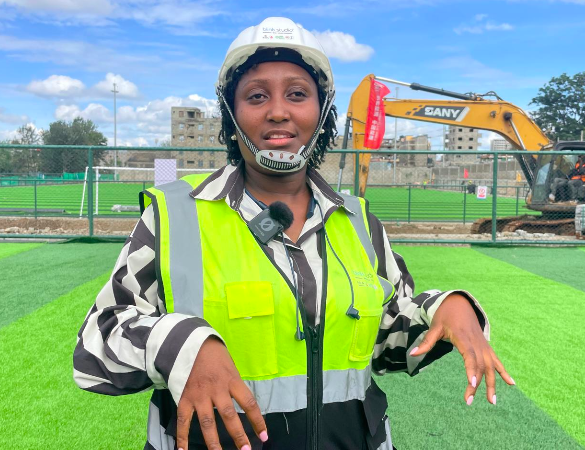
 Health, safety and environment officer Janeth Mwikali at the Kamukunji project site/Gilbert Koech
The long-awaited facelift of Kamukunji, part of the broader Nairobi River Regeneration and Engineering Works Programme, is nearing completion.
Site engineer Ismael Muchiri said the social hall, or community centre, is about 70 per cent complete, with painting, greasing and gutter works remaining.
The changing room, delayed by public requests for a boxing ring, is 60 per cent done, while civil works are at 50 per cent.
The basketball court is complete, with only painting pending, and the football pitch is almost ready.
Five high electric masts have been installed, and the community park across the road is 40 per cent complete.
The project, launched last year by President William Ruto, forms part of the Sh50 billion Nairobi River Regeneration Programme.
It targets flood control, sewer upgrades, solid waste management, non-motorised transport corridors, and urban landscaping.
It covers approximately 175km of river length, including Nairobi, Ngong, Mathare, and sections of the Stony Athi River down to Thwake Dam in Makueni county.
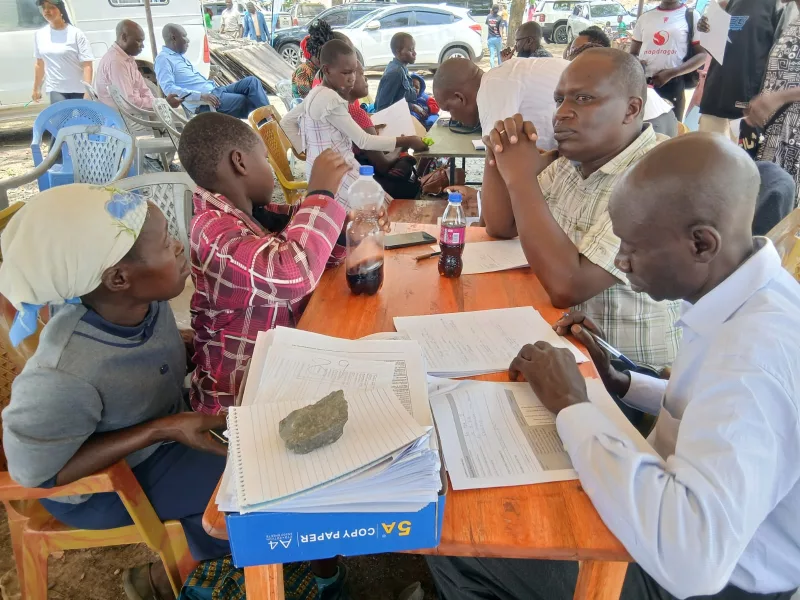
The Nairobi Rivers Commission has called on property owners in the riparian zone to submit ownership documents for verification.
Chief executive Joseph Muracia said genuine owners will have their titles confirmed by a multi-agency team under the Ministry of Lands, while structures with invalid documentation will be removed by the state.
Muracia emphasised that enforcement will curb illegal dumping, restore riparian buffers and improve water flow, stormwater systems and flood zones.
“The restoration of riparian and floodplain corridors is critical to addressing longstanding flooding, pollution and environmental degradation,” he said.
“Once fully implemented, the Nairobi Rivers Regeneration Programme will strengthen climate resilience, improve urban drainage and restore the ecological integrity of city rivers.”
The Kamukunji works employ 200–250 people daily, including carpenters, masons, plumbers, electricians, drivers, operators, and unskilled labourers.
Health, safety and environment officer Janeth Mwikali said many community members have already benefited from the ongoing works.
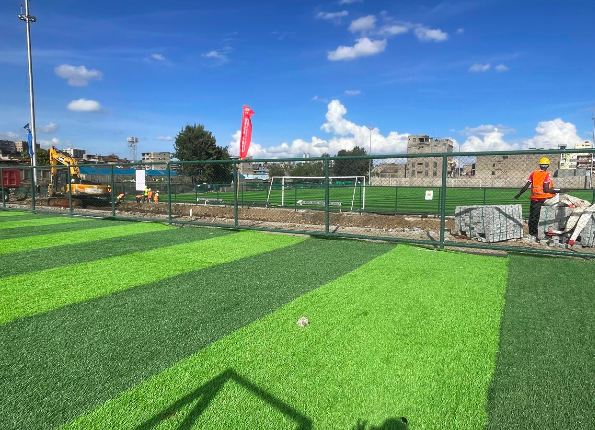 Kamukunji football pitch/Gilbert Koech
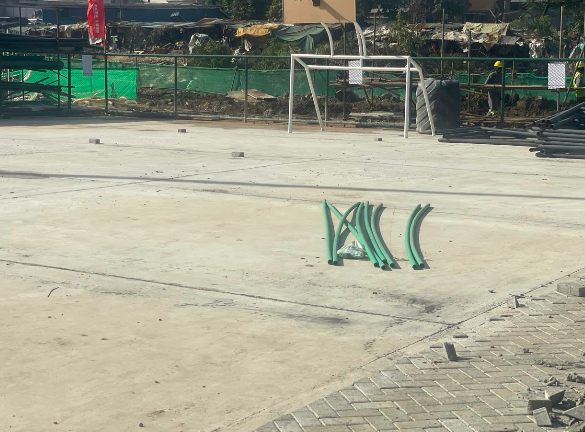 Kamukunji basketball court/Gilbert Koech