
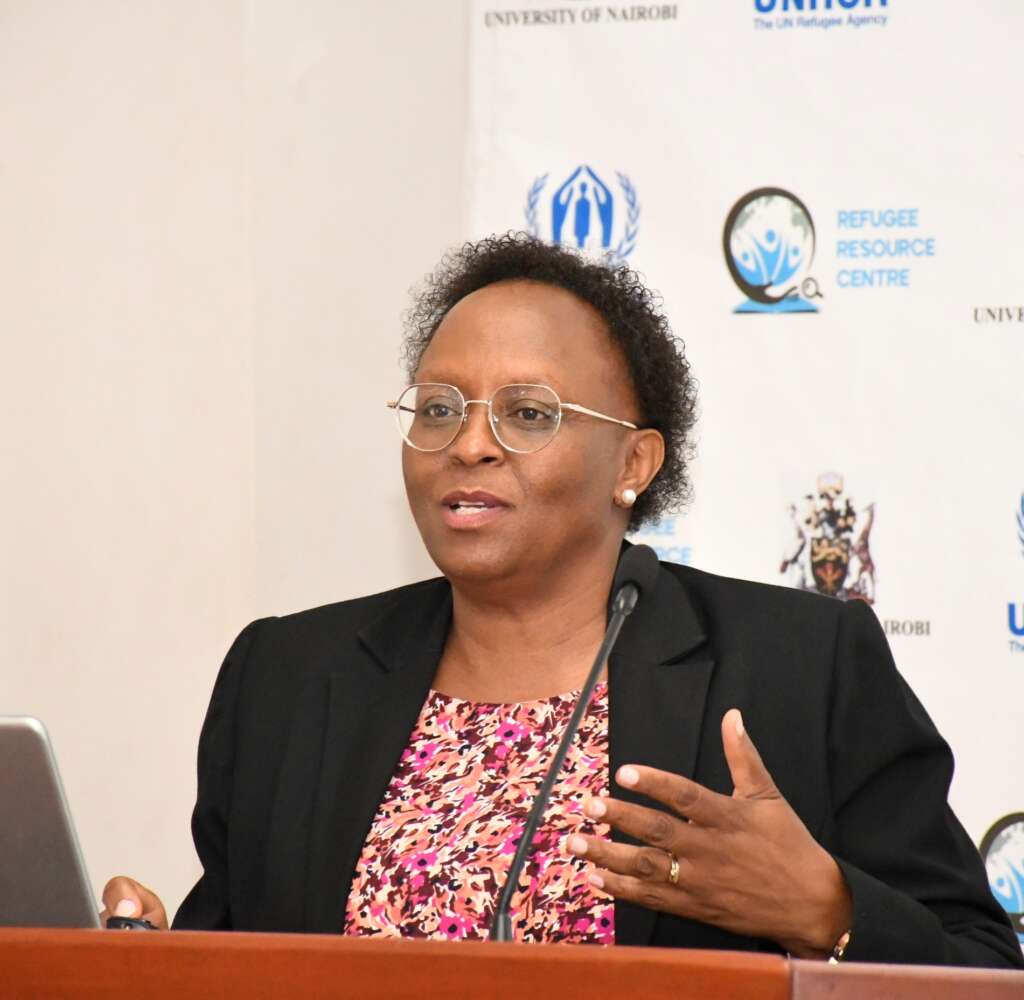
 Dr Lucy Wakiaga from APHRC giving a speach on women contribution on the agricultural sector on March 12 /HANDOUT
Kenyan women produce between 60 and 80 per cent of the country’s food yet they receive minimal financial returns and control very few productive resources, APHRC ha said.
Lucy Wakiaga of African Population and Health Research Centre said women’s disproportionate contribution to agriculture has significant economic implications for the country.
“Women are the backbone of food production in Kenya, yet their work is largely informal and unrecognised in the official economy,” she said. “Despite producing most of the nation’s food, women hold less than 10 per cent of land titles independently and receive less than 10 per cent of agricultural credit.”
Agriculture contributes between 22 and 25 per cent of Kenya’s Gross Domestic Product (GDP), making it a critical sector for employment, income generation and national food security.
Yet, much of the work done by women in subsistence farming and household food production, which is excluded from formal economic accounting, limiting their financial empowerment.
The lack of land ownership restricts women’s control over agricultural production, including decisions on what to plant, how much to produce and which markets to sell to. Without title deeds, women farmers also face challenges in accessing loans or investing in modern farming technologies that could improve yields.
Time poverty further compounds the issue. On average, women in agriculture spend 12.9 hours per day balancing farm work with domestic and caregiving responsibilities, compared to 8.2 hours for men. This limits their ability to engage in more productive activities or expand their businesses.
 Mary Mbithi, an associate professor at the University of Nairobi /HANDOUT
Professor Mary Mbithi said addressing these barriers could significantly improve Kenya’s agricultural productivity. Research shows closing the gender gap in access to land, credit and technology could increase agricultural yields by 20 to 30 per cent.
“This is not just about fairness, empowering women farmers is a direct pathway to higher household incomes, improved food security and stronger national economic resilience," Mbithi said.
"Innovative solutions can make a tangible difference. Through the Women’s Economic Empowerment Hub at the University of Nairobi, researchers piloted affordable childcare services for women entrepreneurs and traders," she added
Over three years, women who accessed childcare increased their time spent in business by 12 per cent, sales by 40 per cent and profits by 25 per cent.
“The results show that reducing structural barriers can significantly enhance women’s productivity and financial returns,” Mbithi said.
Experts also called for stronger enforcement of constitutional provisions guaranteeing women equal rights to land ownership and inheritance under the Constitution of Kenya 2010.
Increasing women’s representation in leadership and decision-making within the agricultural sector was also highlighted as critical to ensuring policies and programmes address women’s specific needs.
“Unlocking the full potential of women in agriculture is key to Kenya’s economic development,” Mbithi said. “Investing in women farmers is not just a matter of equity it is an investment that will yield tangible economic returns for the country.”
The pilot project found that women who accessed childcare increased the time spent in their businesses by 12 per cent, while sales rose by 40 per cent and profits increased by 25 per cent over a three-year period.
Experts at the forum called for stronger enforcement of laws guaranteeing women equal rights to land ownership and inheritance under the Constitution of Kenya 2010.
They also urged financial institutions to develop gender-responsive financial products and called for increased participation of women in leadership and decision-making within the agricultural sector.
According to researchers, unlocking the full potential of women farmers will be key to driving Kenya’s agricultural transformation and strengthening national food security.







